
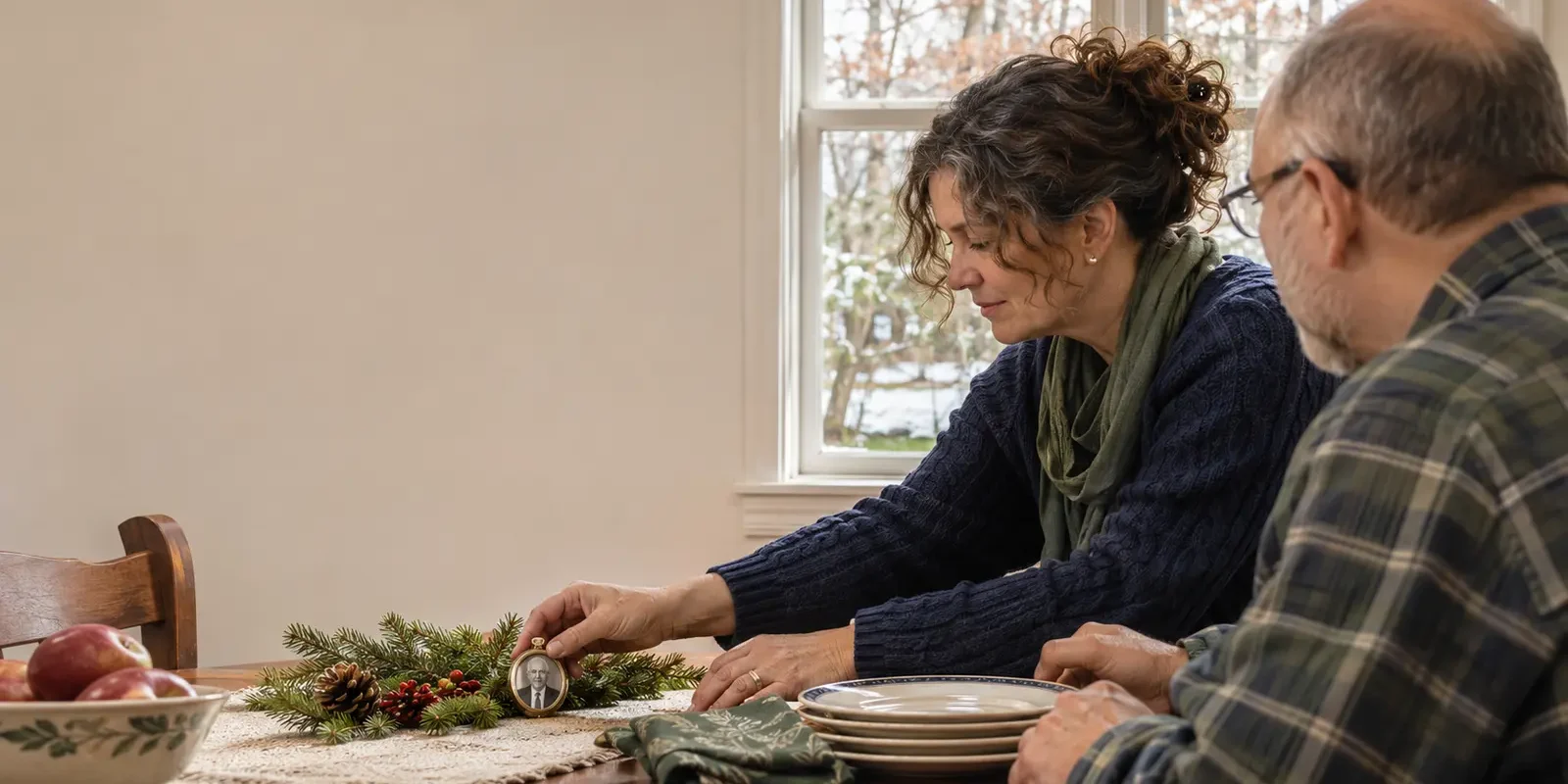
Grief during the holidays can feel heavy before the season even starts, especially the first year after someone dies. Invitations show up. Traditions carry memories. A song, a recipe, an ornament, or an empty chair at the table can bring grief into an ordinary moment. Later years can be hard too, even when the loss isn’t recent anymore.
Why Grief During the Holidays Can Feel Heavier
Holidays pack a lot of memory and expectation into a few weeks. They tend to repeat the same places, foods, music, roles, and family routines every year. The NIH Clinical Center notes that the days leading up to a holiday or anniversary can bring dread and anxiety, and that taste, smell, and music can stir up grief without warning.1
Grief can show up as sadness, anger, guilt, relief, numbness, anxiety, fatigue, appetite changes, or poor sleep, and it can shift from one hour to the next. SAMHSA describes grief as deeply personal, shaped by your relationship with the person, the support you have, the circumstances of the loss, culture, and how you usually cope.2 A hard holiday doesn’t mean you’re grieving the wrong way.
The pressure to be cheerful adds another layer. You might want company and still need to leave early. You might laugh at dinner and cry in the car. Enjoying part of the day doesn’t take anything away from the person who died, and feeling sad doesn’t ruin the holiday.
Four Decisions for Handling Grief During the Holidays
A plan can’t take grief away. It can cut down on pressure you don’t need and give you choices when the day gets hard. Decide what you’ll attend, how you’ll protect your energy, how you might include the person who died, and what you’ll change this year.
1. Decide What You’ll Attend
Look at invitations and traditions one at a time and sort them into three groups: yes, no, and decide later. A yes doesn’t have to mean the whole event. You can come for dinner and skip the gift exchange, join by video, arrive after the biggest crowd has left, or pick one gathering instead of several.
Ask yourself:
- Which parts of this event matter to me?
- Which parts feel draining or impossible this year?
- Who will be there, and who could support me?
- What would make it easier to go?
Tell the host what you know without promising more than you can do:
If you’re not sure yet, say that. It gives everyone a chance to adjust.
2. Protect Your Energy and Plan a Way to Leave
Grief during the holidays can drain your focus and stamina. Plan for less than you think you should be able to handle. Eat something, take any prescribed medication, and protect your sleep as much as you can. If you’re driving, don’t lean on alcohol or other substances to get through the day.
For an in-person event, decide ahead of time how you’ll leave. Drive yourself, line up a ride, keep your coat and keys handy, or ask someone you trust to check in with you at a set time. Have a simple line ready:
You don’t owe anyone a long explanation. When you’re at someone’s home, find a spot where you can take a short break. A walk, a quiet room, or a few minutes outside can help you settle before you decide whether to go back in. Taking a break isn’t failing. It’s part of the plan.
3. Include the Person Who Died in a Way That Fits
Some people want to talk about the loss openly. Others would rather do something private. Both are respectful ways to carry grief during the holidays. The NIH Clinical Center suggests that new traditions can help people remember a loved one in a meaningful way during holidays and birthdays.3
You might:
- Make one of their recipes.
- Set out a photo or keepsake.
- Share one story before a meal.
- Donate to a cause they cared about.
- Visit a place that meant something to them.
- Write a private note.
- Skip a memorial this year if that’s what you need.
Ask before starting a group ritual. Family members may differ in what they can handle, so keep it optional. A small gesture often means more than a long program.
4. Adjust Holiday Traditions and Expectations
You can change a tradition for one year or for good. Move the gathering, shorten it, simplify the food, skip gifts, invite fewer people, or plan something new for the day. You don’t have to recreate the last holiday before the death.
Pick one or two priorities. A holiday can count as a good one because you spent time with one person, ate a familiar meal, went to worship, took a walk, or rested. It doesn’t have to look complete from the outside.

Text version of this graphic
- Plan: Choose what you’ll attend. Yes, no, or decide later. Going for part of an event counts.
- Protect: Prepare for changes in your energy. Arrange a ride or a way to leave, and keep a support person close.
- Include: Choose an optional way to remember the person, such as a photo, story, recipe, donation, or private note.
- Adjust: Change traditions this year. Simplify plans and keep one or two priorities.
Your plan can change. Choose what fits this holiday.
When Family Members Handle Grief Differently During the Holidays
Grief during the holidays often looks different from one family member to the next. One person wants every tradition kept exactly the same. Another wants to cancel the gathering. Someone tells stories, while someone else can’t say the person’s name. As grief expert Kenneth Doka writes for the Hospice Foundation of America, these are differences in how people cope, not measures of how much they loved the person who died.4
Try to keep preferences separate from judgments. “I want to keep dinner small” is different from “You don’t care about this family.” Say what you need, ask what matters most to the other person, and look for a small compromise. The family might keep one tradition, change another, and let people opt out of a memorial activity.
Conflict can still happen. Step away from conversations that turn insulting or threatening. Grief can explain a short temper, but it doesn’t excuse intimidation, violence, unsafe driving, or other harmful behavior.
What Grief Counseling Can and Can’t Do
Grief counseling gives you a private place to talk about the death, everything that changed around it, and how grief during the holidays is hitting you this year. Research on bereavement counseling is mixed: a 2025 review of 33 earlier reviews found these interventions generally helpful, but the quality of the studies often limited how firm the conclusions could be.5 That’s one reason good grief counseling starts with your goals, not a set formula.
- Prepare for hard dates and gatherings.
- Work through guilt or self-blame.
- Say what you need to family and friends.
- Rebuild daily routines.
- Address anxiety or low mood that comes with the loss.
- Take away the loss.
- Tell you the “right” way to grieve.
- Guarantee the holiday will be easier.
- Replace medical, legal, financial, pastoral, hospice, substance-use, or emergency support.
You don’t need a diagnosis to ask for counseling. It may be worth considering when:
- Grief is taking up most of your attention.
- Everyday tasks are getting hard to finish.
- You’re pulling away from everyone who supports you.
- Family conflict keeps getting worse.
- You want help planning for the season.
Choose the Kind of Support You Need
Counseling is one way to get support for grief during the holidays, but it isn’t the only one.
- People you trust: Ask for something specific, like company at an event, a meal, childcare, a ride, or a check-in call.
- Grief or peer groups: A group can offer understanding and practical ideas from people who’ve been through a loss.
- Faith or community support: A pastor, faith community, cultural group, or community organization can help with ritual, meaning, and connection.
- Hospice bereavement services: If hospice was involved, ask what bereavement support they offer families and for how long.
- Your doctor: Get medical advice for ongoing or worrying changes in sleep, appetite, pain, energy, medication use, or physical health.
- Substance-use care: Ask for an assessment if alcohol or drugs are becoming your main way to get through the day. Don’t stop heavy or dependent use suddenly without medical advice.
When You Need Urgent or Specialized Help
- Immediate danger or a life-threatening medical emergency: call 911.
- Suicidal thoughts, self-harm urges, or a mental health crisis: call or text 988, or chat at 988lifeline.org. The 988 Lifeline is free and confidential.6
- Severe symptoms that don’t let up: contact a doctor or mental health professional. NIMH recommends getting help when severe symptoms last two weeks or more, including trouble keeping up with your usual tasks and activities.7
- Alcohol or drug concerns: contact a medical professional or a substance-use service. Withdrawal from some substances can be dangerous and may need medical care.
WPA Counseling is an outpatient practice, not an emergency service. Please don’t use our website form, email, phone messages, or texts during a crisis.
How WPA Counseling Can Help With Grief During the Holidays
We offer grief counseling and individual counseling at our North Huntingdon and Penn Hills offices, plus online counseling in Pennsylvania for clients anywhere in the state. Our care team can confirm which counselor fits, plus scheduling, format, and insurance. See our locations and statewide telehealth options.
If someone you love is still living but you’re expecting the loss, our guide to anticipatory grief covers support before a death. We also have guides on pet loss grief and friendship breakup grief.
Questions About Grief During the Holidays
Is it okay to skip holiday events while grieving?
How can I remember someone without making the gathering too painful?
When should I consider grief counseling?
A Smaller Holiday Can Still Mean Something
You don’t have to figure out the whole season today. Pick the next event, the person you can call, the way you’ll leave if you need to, and the tradition you want to keep or change. Your plan can change as the day gets closer. Grief during the holidays may still show up, but you’ll have choices ready when it does.
Sources
- NIH Clinical Center. Holidays. Accessed November 2, 2026. cc.nih.gov
- Substance Abuse and Mental Health Services Administration. Coping with Bereavement and Grief. Accessed November 2, 2026. samhsa.gov
- NIH Clinical Center. Kind Ways to Support Someone Who Is Grieving. Accessed November 2, 2026. cc.nih.gov
- Doka, K. J. What Will This Holiday Mean for Me Now? Hospice Foundation of America. November 19, 2025. hospicefoundation.org
- Avis, K. A., Missler, M., van Deursen, D., Lenferink, L. I. M., Stroebe, M., & Schut, H. The Efficacy of Bereavement Interventions: A Systematic Umbrella Review. Harvard Review of Psychiatry, 33(3), 127–148. 2025. pmc.ncbi.nlm.nih.gov
- 988 Suicide & Crisis Lifeline. Get Help. Accessed November 2, 2026. 988lifeline.org
- National Institute of Mental Health. My Mental Health: Do I Need Help? Revised 2025. nimh.nih.gov