

When Family Relationships Break Down: What Family Estrangement Therapy Can Do
Family estrangement therapy is a form of counseling that helps individuals — and sometimes families — heal the emotional wounds left when a family relationship breaks down completely or becomes deeply strained.
If you’re looking for a quick answer, here’s what you need to know:
- What it is: A structured, emotionally safe space to process the pain of family cutoff, whether you’re the one who stepped back or the one who was left behind
- Who it’s for: Estranged parents, adult children, siblings, or anyone navigating the grief of a broken family bond
- What it does: Helps you process grief, reduce shame, set healthy boundaries, and decide — without pressure — whether reconciliation, acceptance, or something in between is right for you
- Does it require the other person? No. Healing can happen individually, even if the other family member never participates
- Where to start: Working with a licensed counselor who understands the unique complexity of family estrangement
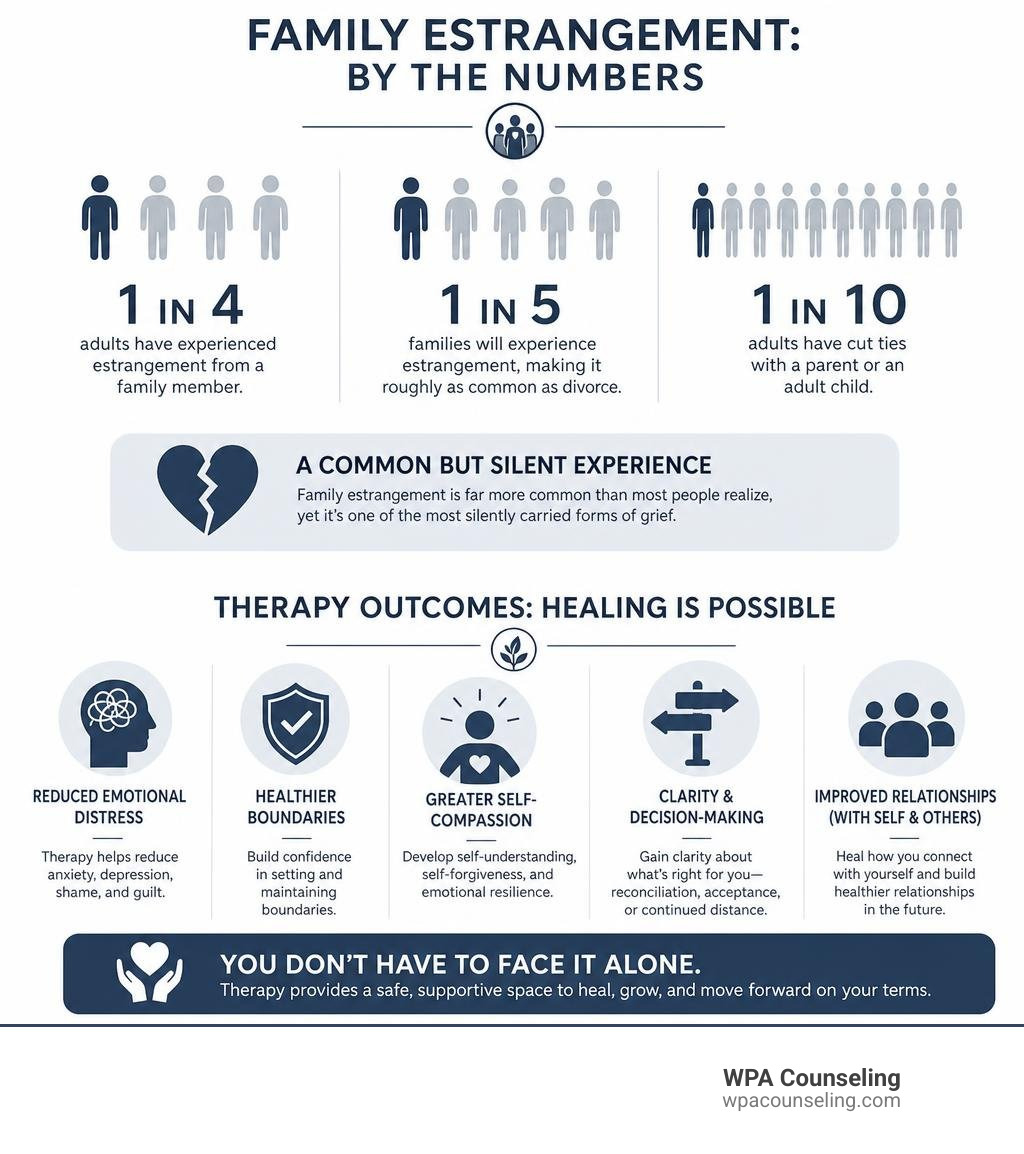
Family estrangement is far more common than most people realize. Research suggests that more than 1 in 4 adults have experienced estrangement from a family member — and yet it’s one of the most silently carried forms of grief.
It shows up in therapy rooms in quiet, painful ways: a grief that doesn’t fit any recognized category, a shame that makes it hard to tell even close friends what’s happening, and a loneliness that hits hardest during holidays and milestones.
Unlike a bereavement, estrangement has no clear ending. There’s no socially accepted mourning ritual. No agreed-upon story of what happened. That ambiguity is part of what makes it so hard to carry alone — and why thoughtful, informed professional support can make such a meaningful difference.
At WPA Counseling, we understand that behind every fractured family relationship is a real person in real pain. You deserve a space to process that — without judgment, and without anyone telling you how the story has to end.
Understanding Family Estrangement: Definitions, Prevalence, and Causes
In clinical and research contexts, family estrangement is defined as a significant breakdown in the relationship between family members, resulting in physical distance, little to no communication, and a profound sense of emotional detachment. It exists on a wide spectrum. For some, it looks like complete “no-contact” decisions. For others, it involves low-contact arrangements where interactions are superficial, highly controlled, and emotionally guarded.
While society often treats family bonds as permanent and unbreakable, research painting a picture of modern dynamics in June 2026 shows a very different reality. In fact, research shows that 1 in 5 families will experience an estrangement, making it roughly as common as divorce. Furthermore, more than 1 in 4 adults experience estrangement from a family member, and roughly one in ten has cut ties with a parent or an adult child.
This is not a localized phenomenon. In a nationally representative sample of approximately 10,000 adults in Germany, 9% had experienced estrangement from a mother and 20% had experienced estrangement from a father. In the United States, demographic studies reveal that 27% of fathers are currently estranged from at least one of their children. Interestingly, demographic risk factors show that Black mothers are the least likely to be estranged, while White fathers are the most likely to experience a relational cutoff. However, fathers in general are very much at risk for estrangement regardless of race.
The pathways leading to these rifts are highly complex and rarely happen overnight. They are often the culmination of years of tension, unresolved conflicts, and systemic family issues. Some of the most frequent causes include:
- Relational Trauma and Abuse: Experiences of emotional, physical, or verbal abuse during childhood or adulthood.
- Divorce and Parental Alienation: High-conflict divorces where children are caught in loyalty binds or actively turned against a parent.
- Value and Lifestyle Clashes: Severe disagreements regarding religion, politics, or the rejection of a family member’s LGBTQ+ identity.
- Problematic Spouses: Situations where an adult child marries a partner who demands they choose between their spouse and their family of origin.
- Emotional Immaturity: Parents who lack the capacity for self-reflection, making it impossible to resolve grievances or establish healthy boundaries.
As explored in The Hidden Pain of Family Estrangement – Brighton Therapy Partnership, estrangement often functions as a form of communication when direct speech has failed or felt entirely unsafe. When one family member feels they can no longer protect their mental health or physical safety through dialogue, cutting contact becomes a necessary act of self-preservation.
The Psychological Impact of Relational Trauma and Family Rifts
The emotional toll of a family rupture is heavy and far-reaching. Because family is traditionally expected to be our primary source of safety and belonging, the breakdown of these bonds results in a specific kind of wound known as relational trauma. This trauma affects how we view ourselves, how we regulate our emotions, and how we approach other relationships.
To understand how relational trauma manifests, it helps to read Relationship Trauma And Emotional Abuse and explore The Ultimate Guide To Healing From Trauma In A Relationship. When a family environment is marked by emotional abuse, denial, or constant criticism, our nervous systems remain in a chronic state of fight, flight, or freeze. Over time, this chronic stress can manifest physically as somatic symptoms, anxiety, and clinical depression.
One of the most difficult aspects of family estrangement is the presence of complicated, ambiguous grief. Unlike mourning a death, where there is a clear ending and community support, grieving an estranged family member is a lonely, ongoing process. The person is still alive, leaving the door to hope perpetually ajar. This “living grief” is often accompanied by intense shame and societal stigma. Estranged individuals frequently feel judged by others who default to phrases like, “But they’re your family,” which can make the estranged person feel deeply misunderstood and abnormal.

This isolation is reflected in clinical data. A study on the community experiencing family rifts revealed that 51% of attendees of facilitated support groups for family estrangement confirmed that they had been diagnosed with a mental health problem, with the most prevalent being depression. When we carry the weight of toxic family patterns alone, the emotional toll can easily become overwhelming.
How Family Estrangement Therapy Supports Healing
Because family rifts are so deeply painful, navigating them requires a specialized, sensitive approach. Family estrangement therapy is designed to help you make sense of the chaos, process your emotions, and build a path forward that prioritizes your well-being.
Therapists who specialize in this work look at the situation through the lenses of family systems theory and attachment theory. Family systems theory helps us see that families operate like mobile sculptures: when one piece moves, the entire structure shifts. Estrangement is rarely just about two people; it ripples outward, creating loyalty binds for siblings, aunts, uncles, and even grandchildren. Attachment theory helps us understand how our early relationships with caregivers shaped our sense of safety and self-worth, and why a threat to those bonds triggers such intense survival responses in adulthood.
In therapy, we focus on establishing safety and building healthy boundary-setting skills. Whether you are considering limiting contact, are currently in a period of no-contact, or are hoping to navigate a complex reconciliation, a skilled therapist can help you find your footing. For more on how professional counseling helps resolve deep-seated family issues, you can read about Family Counseling For Conflict Resolution.
Navigating the Spectrum of Family Estrangement Therapy Outcomes
A common misconception is that the sole goal of family therapy is always to bring everyone back together. In the context of family estrangement, a professional, objective therapist never assumes reconciliation is the healthiest or most realistic outcome. Instead, therapy supports three distinct possibilities along a broad spectrum:
- Reconciliation and Repair: If both parties possess a high capacity for self-reflection, a willingness to take responsibility, and a commitment to change, therapy can facilitate a structured, step-by-step reconnection.
- Partial Repair (Low Contact): Establishing clear, firm boundaries that allow for limited contact (such as communicating only via email or seeing each other only at major events) while protecting your emotional peace.
- Radical Acceptance and Permanent Distance: When a family member remains unsafe, abusive, or unwilling to acknowledge any harm, healing means accepting that the relationship cannot be saved.
For those navigating the painful reality of permanent distance, cognitive behavioral strategies can be incredibly healing. As detailed in REBT and the Treatment of Emotional Disturbance Related to Estrangement from Adult Children | Journal of Rational-Emotive & Cognitive-Behavior Therapy | Springer Nature Link, Rational Emotive Behavior Therapy (REBT) helps individuals challenge rigid, self-defeating beliefs (such as “I am a bad person because my child/parent doesn’t talk to me”) and cultivate unconditional self-acceptance.
For parents hoping to understand their adult child’s perspective and find a path forward, resources like The Roadmap to Healing Family Estrangement highlight the vital importance of non-defensiveness. When parents can find even a small kernel of truth in their child’s complaints and express sincere empathy without debating the facts, the door to healing begins to open.
What to Expect in a Family Estrangement Therapy Session
If you decide to seek support, you might wonder what the actual process looks like. First and foremost, a therapy session provides an objective, confidential, and safe space. You do not have to “take off a mask” or pretend that everything is fine.
If you’re wondering Is Therapy Right For You, estrangement therapy is highly tailored to your individual needs. If you are attending therapy alone, your sessions will focus on processing your childhood history, understanding intergenerational trauma, and developing practical coping strategies for triggering moments (like the holiday season).
If you are attending therapy with a family member in hopes of repairing a rift, the therapist will act as a neutral facilitator. They will help you establish ground rules, slow down the communication, and ensure that both parties feel heard. To learn more about how individuals experience this process, you can read The Counseling Experiences of Individuals Who Are Estranged From a Family Member, which highlights how validating it is for clients when a therapist simply stands by their decisions and allows them to set the pace of their healing.
Evidence-Based Modalities and Structured Support Programs
When treating the deep wounds of family rifts, therapists rely on several evidence-based modalities designed to address relational trauma at both the cognitive and somatic levels:
- Internal Family Systems (IFS): This approach helps you explore different “parts” of yourself — such as the part that feels deep guilt for walking away, and the protective part that knows staying was unsafe.
- Accelerated Experiential Dynamic Psychotherapy (AEDP): A relational, emotion-focused therapy that helps process painful emotions in safety, preventing you from feeling alone in your grief.
- Eye Movement Desensitization and Reprocessing (EMDR): An excellent tool for processing specific traumatic memories or family interactions that continue to trigger a physical stress response in the present. To understand how these approaches fit into a broader healing plan, see Understanding Trauma Therapy A Path To Healing and Trauma Therapy Explained What It Is How It Works And Why It Helps.
- Somatic Experiencing: Relational trauma lives in the body; somatic therapy helps release stored tension and calms an overactive nervous system.
In addition to individual therapy, facilitated support groups and structured programs play a massive role in reducing psychological distress. According to a landmark study, The efficacy of a facilitated support group intervention to reduce the psychological distress of individuals experiencing family estrangement, structured community support is highly effective.
The research showed that 70% of attendees of facilitated support groups experienced a significant reduction in psychological distress. Furthermore, 35% of those attendees experienced a reduction of distress that was 6 points or higher on the CORE-10 scale, moving their distress levels from moderate to mild. Meeting others who share similar experiences is a powerful antidote to the shame and isolation of family rifts. For further details on specialized coaching and peer support structures, you can explore FAMILY ESTRANGEMENT SUPPORT | DR BECCA BLAND.
Professional Support and Our Compassionate Approach in Pennsylvania
If you are navigating the heavy burden of a family rift, you do not have to walk this path alone. WPA Counseling is a compassionate group practice of licensed professional counselors based in Irwin/North Huntingdon, Pennsylvania, with an additional office in Penn Hills. We provide convenient in-person counseling at our Western Pennsylvania offices, as well as secure, convenient telehealth therapy across the entire state of Pennsylvania.
With years of clinical experience serving the Western Pennsylvania community, WPA Counseling has established a rich history of helping individuals and families navigate complex relational trauma. Our practice was founded on the belief that high-quality, evidence-based mental health care should be accessible locally. Over the years, our licensed clinicians have helped hundreds of clients in Irwin, North Huntingdon, Penn Hills, and throughout the state of Pennsylvania heal from family rifts, rebuild self-esteem, and establish healthy boundaries. Our team brings decades of combined clinical expertise in family systems, trauma-informed care, and cognitive-behavioral therapies, ensuring that every client receives highly specialized, compassionate support rooted in proven therapeutic practices.
Whether you are seeking Virtual Family Therapy In Pa A Modern Guide or looking for a trusted specialist by searching for Family Therapy Near Me Pennsylvania, our team is here to support you.
Our therapeutic approach is guided by our unique Counseling Blueprint, a structured four-stage healing journey designed to help you process trauma and reclaim your peace:
- Take Off the Mask: We begin by building a genuine relationship of trust and safety. In this stage, you can lay down the burden of societal expectations and speak honestly about your family dynamics.
- Heal the Wounds: Together, we gently explore the emotional and relational hurts of your past, validating your pain and processing the trauma.
- Remove the Toxins: We help you identify the unhelpful beliefs, lingering lies, or internalized guilt (such as “I am unlovable because my parent rejected me”) that have kept you feeling stuck.
- Replace with Truth: Finally, we install empowering, accurate, and healthy perspectives about your self-worth, your future, and your capacity to build chosen family connections.
At WPA Counseling, our goal is to match you thoughtfully with a compatible licensed counselor who understands the complex nuances of family systems, trauma recovery, and boundary-setting.
Frequently Asked Questions about Family Estrangement
Is reconciliation always the goal of family estrangement therapy?
No, reconciliation is not always the goal. A primary focus of family estrangement therapy is supporting your personal autonomy, safety, and mental health. For many individuals, the healthiest outcome is establishing firm boundaries or maintaining a peaceful period of no-contact.
Therapy helps you process your grief, build self-trust, and decide what kind of relationship (or lack thereof) is safest for you.
How common is family estrangement?
Family estrangement is incredibly common, affecting roughly 1 in 5 families. Because of the heavy societal stigma and shame surrounding family rifts, people rarely discuss it openly. However, with more than 25% of adults experiencing some form of estrangement, you are far from alone.
When should I seek professional help for family conflict?
You should consider seeking professional help if family relationships are causing you persistent emotional distress, anxiety, or depression. Common signs that indicate therapy is appropriate include:
- Feeling like you are “walking on eggshells” around family members.
- Experiencing intense dread, anxiety, or physical symptoms before family gatherings.
- Navigating severe boundary violations or emotional abuse.
- Experiencing deep loneliness or “holiday melancholy” due to family rifts.
If you are noticing these patterns in your life, you can read about When To See A Therapist 10 Signs You Should Not Ignore to help guide your decision.
Conclusion
Healing from toxic family patterns and navigating the pain of estrangement is a deeply personal, non-linear journey. It requires immense courage, radical self-compassion, and a willingness to prioritize your own emotional well-being over societal expectations. Whether your ultimate path leads to a carefully structured reconciliation, a low-contact boundary, or the peaceful acceptance of permanent distance, your story deserves to be held with gentleness and respect.
You do not have to carry the heavy weight of family rifts in silence. At WPA Counseling, we are ready to stand by your side, helping you take off the mask, heal your wounds, and build a hopeful, peaceful future.

When you are ready to take the first step toward reclaiming your peace, we invite you to explore our thoughtful matching process. Schedule a consultation today to connect with a licensed Pennsylvania counselor who truly understands.
This article was researched with AI and heavily edited by Stephen Luther for accuracy and relevance.
Stephen Luther is the Executive Director and Founder of WPA Counseling. He holds a Master’s degree in Education from the University of Georgia and a Master’s degree in Marriage and Family Therapy from Duquesne University. He is a licensed professional counselor in Pennsylvania (LPC).
Since 1997, Steve has been helping children, adolescents, adults, couples, and families overcome emotional and relational challenges. He specializes in working with hurting families, including those with foster, adopted, or traumatized children. Steve uses Attachment-Based Therapy, client-centered therapy, and Therapeutic Parent Coaching to support healing and relationship restoration.
This guide is for educational and spiritual encouragement and is not a substitute for personalized professional counseling. If you are in crisis, please reach out for immediate help.
Relationship Trauma Types and How They Impact Your Life