

When Depression Feels Stuck: How Dialectical Behavior Therapy Can Help
Dialectical behavior therapy for depression is a structured, evidence-based treatment that targets the emotional dysregulation underneath depressive symptoms — not just the sad mood itself.
Quick answer: What is DBT for depression?
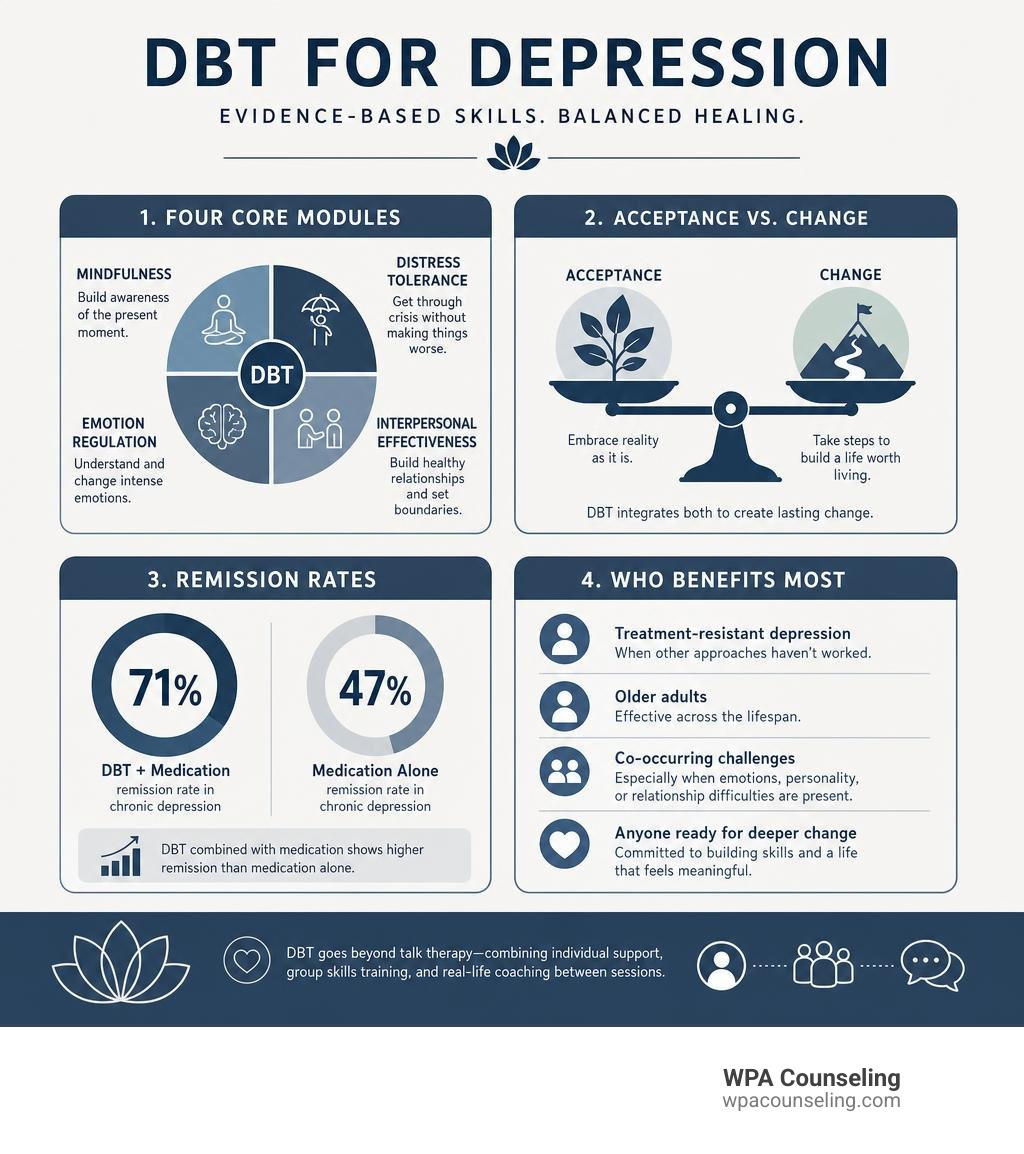
- DBT is a therapy that combines acceptance and change to help people manage intense, overwhelming emotions
- It teaches four core skill sets: mindfulness, distress tolerance, emotion regulation, and interpersonal effectiveness
- Research shows DBT can achieve a 71% remission rate in chronic depression when combined with medication — compared to 47% with medication alone
- It is especially effective for treatment-resistant depression, older adults, and people with co-occurring emotional or personality difficulties
- DBT goes beyond talk therapy — it includes individual sessions, group skills training, and real-life coaching between sessions
If you’ve tried other approaches to depression and still feel like you’re stuck in the same painful loop, you’re not alone. Depression has a way of pulling people inward — into rumination, avoidance, and emotional exhaustion that can feel impossible to escape.
Traditional approaches help many people. But for others — especially those whose depression is tied to intense emotions, difficult relationships, or a long history of feeling misunderstood — something more is needed.
That’s where DBT comes in.
Developed by Dr. Marsha Linehan, DBT was built on a simple but powerful idea: that healing requires both accepting where you are and actively working toward change. It’s a balance that speaks directly to the experience of depression, where self-judgment and avoidance often make everything harder.
At WPA Counseling, we work with Pennsylvania residents who are navigating exactly these kinds of challenges — people who feel emotionally overwhelmed, relationally exhausted, and ready for a different path forward. This guide walks you through everything you need to know about DBT and depression, from the core skills to the clinical research to what treatment actually looks like in practice.
Dialectical behavior therapy for depression word roundup:
Dialectical Behavior Therapy for Depression: What It Is and How It Works
At its core, dialectical behavior therapy for depression is built on the concept of dialectics—the idea that two seemingly opposite truths can exist at the same time. In the context of depression, the core dialectic is the balance between acceptance and change. You must accept yourself exactly as you are in this moment, and yet, you must also work to change the thoughts and behaviors that are keeping you stuck.
When someone experiences chronic depression, they often struggle with severe emotional dysregulation. This means emotions feel incredibly intense, hit rapidly, and take a long time to return to a baseline level of calm. Dr. Marsha Linehan originally developed DBT in the late 1980s to treat borderline personality disorder and chronic suicidality, but researchers and clinicians soon realized that these same principles were highly effective for mood disorders.
Instead of treating depression as just a “sad mood,” DBT views it as a system-wide struggle with emotional processing. Scientific research on emotional processing in DBT shows that learning how to actively experience, identify, and tolerate emotions reduces the urge to escape them. For a deeper look at how depressive cycles manifest, you can read our guide on understanding depression.

Why Dialectical Behavior Therapy for Depression Differs from CBT
People often wonder how DBT differs from standard Cognitive Behavioral Therapy (CBT). While DBT is a specialized branch of CBT, their clinical focuses are quite different.
Traditional CBT focuses heavily on cognitive restructuring (changing your thoughts to change your mood) and behavioral activation (doing more positive activities). It relies on logic to challenge negative thought patterns.
DBT, on the other hand, prioritizes validation and emotional acceptance before jumping into change strategies. It assumes that trying to “think logically” when you are highly emotionally dysregulated is incredibly difficult. DBT meets you in the emotional storm first, validates your pain, and then provides concrete behavioral skills to survive the moment.
| Feature | Cognitive Behavioral Therapy (CBT) | Dialectical Behavior Therapy (DBT) |
|---|---|---|
| Primary Philosophy | Logic, cognitive restructuring, and behavioral change. | Dialectics: Balancing emotional acceptance with active change. |
| Core Mechanism | Identifying and challenging cognitive distortions. | Validating emotions, practicing mindfulness, and distress tolerance. |
| Treatment Structure | Typically individual sessions (12–20 weeks). | Individual therapy, skills groups, and phone coaching (6–12 months). |
| Best Suited For | Mild-to-moderate depression, specific anxiety disorders. | Chronic depression, treatment-resistant cases, intense emotional dysregulation. |
To understand how these approaches can be tailored to your needs, check out the complete guide to CBT and read about what to expect in CBT for depression.
The Biosocial Theory of Depression
How does someone develop the kind of depression that benefits from DBT? DBT explains this through the Biosocial Theory.
According to this model, depression is the result of a transaction between a biological sensitivity and an invalidating environment:
- Biological Sensitivity: Some individuals are naturally born with a highly sensitive nervous system. They feel emotions more quickly, experience them with greater intensity, and take longer to calm down.
- Invalidating Environment: This refers to surroundings where emotional expressions are dismissed, punished, or ignored. When a sensitive child is repeatedly told to “stop crying,” “get over it,” or that they are “too dramatic,” they learn to distrust their own emotional experiences.
Over time, this transaction leads to emotional avoidance. Because emotions feel painful and are met with invalidation, the individual tries to suppress them. When suppression fails, they feel overwhelmed, leading to a state of learned helplessness—the classic, heavy, and immobilized feeling of deep depression.
The Four Core DBT Modules and Their Depression-Specific Applications
To break the cycle of emotional avoidance and learned helplessness, DBT organizes its curriculum into four core modules. Each module targets a specific vulnerability of depression.
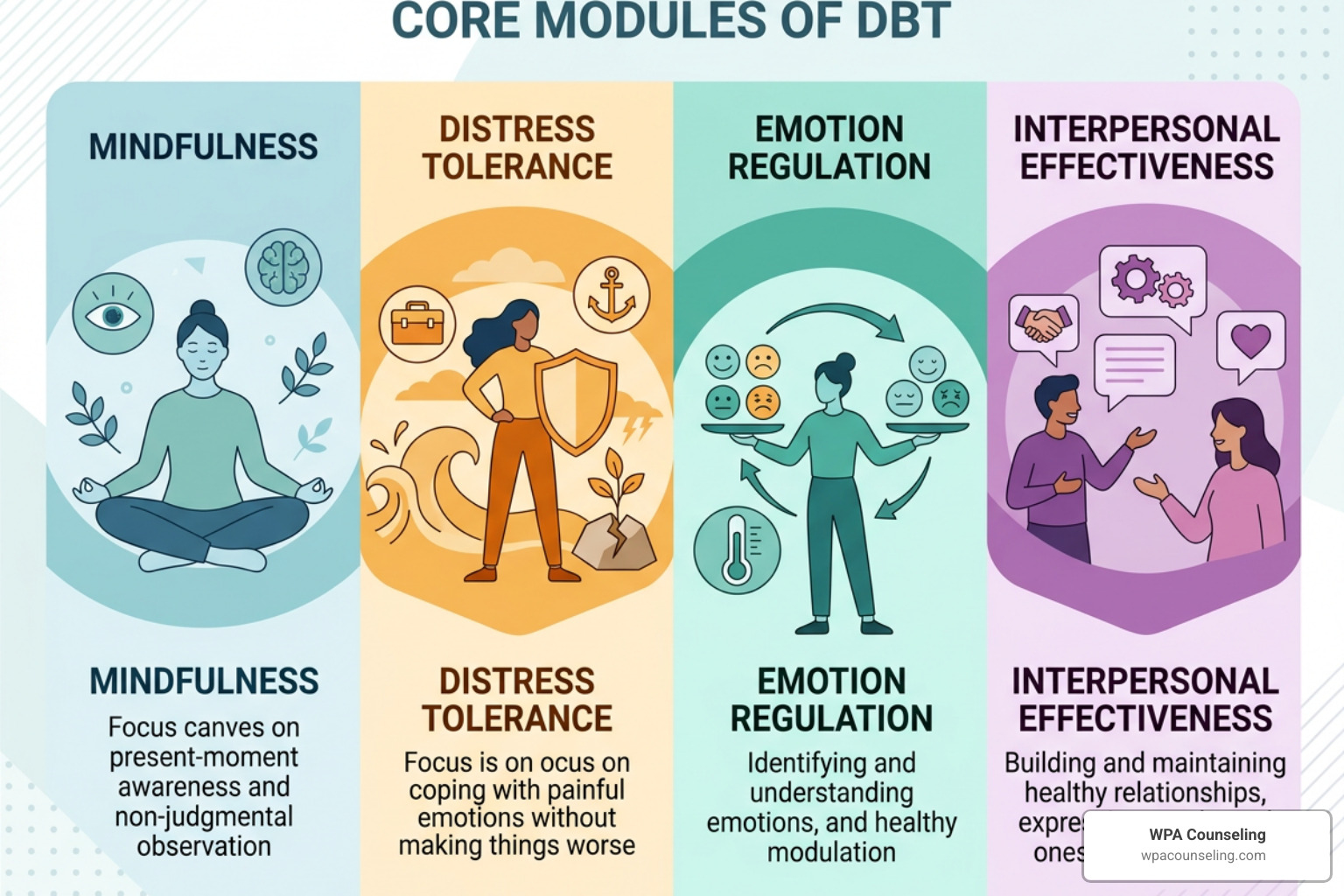
For a comprehensive overview of how these modules fit together, you can explore the University of Pennsylvania’s overview of DBT.
Mindfulness: Anchoring the Mind to Counter Rumination
Depression thrives on rumination—replaying past mistakes, dwelling on regrets, or worrying about an hopeless future. DBT mindfulness skills teach you how to bring your attention back to the present moment without judgment.
A central concept in DBT mindfulness is the three states of mind:
- Emotional Mind: Ruled by feelings, urges, and moods. In depression, the Emotional Mind tells you, “Everything is hopeless, so don’t even bother getting out of bed.”
- Rational Mind: Ruled by logic, facts, and cold intellect. It might say, “You have no logical reason to feel sad right now.”
- Wise Mind: The synthesis of both. It is the place of deep, intuitive knowing where you acknowledge your feelings while also recognizing objective reality. Wise Mind says, “I feel incredibly heavy and sad today, and that is valid, but I also know that taking a short walk will help me feel slightly better.”
Developing present-moment awareness helps you step out of the depressive trance. Learn more about integrating these practices in our article on holistic approaches to depression.
Distress Tolerance: Surviving Emotional Crises
When you are deeply depressed, emotional pain can feel like an absolute emergency. Without coping skills, you might resort to impulsive behaviors to escape the pain—such as social withdrawal, substance use, or self-harm.
Distress tolerance skills are designed to help you survive crises without making them worse. Key techniques include:
- TIPP Skills: Rapid, physiological ways to calm your nervous system.
- Temperature: Splash cold water on your face or hold an ice cube to trigger the mammalian dive reflex and slow down your heart rate.
- Intense Exercise: Spend 15 minutes doing jumping jacks or sprinting to burn off intense emotional energy.
- Paced Breathing: Breathe in for 4 seconds, hold, and exhale for 8 seconds to activate your parasympathetic nervous system.
- Progressive Muscle Relaxation: Tense and release muscle groups from head to toe.
- Radical Acceptance: Completely accepting reality as it is in this exact moment, without trying to fight it or judge it. Accepting that you are struggling does not mean you approve of it; it simply means you stop wasting energy wishing the present moment were different.
- Self-Soothing: Engaging your five senses (sight, sound, smell, taste, touch) to bring comfort during moments of distress.
These tools build psychological safety, which is essential for resilience building in counseling.
Emotion Regulation: Managing Mood Instability and Anhedonia
Depression often brings a profound sense of anhedonia—the inability to feel pleasure—and a tendency to act purely on how you feel (mood-dependent behavior). The emotion regulation module teaches you how to manage these states.
- PLEASE Skills: Taking care of your physical body to reduce emotional vulnerability.
- PL (Treat Physical iLlness)
- Eating (Balanced meals)
- Avoiding mood-altering substances
- Sleeping (Consistent sleep hygiene)
- Exercising daily
- Opposite Action: When depression tells you to isolate, stay in bed, and pull the blinds, you do the exact opposite. You get up, open the blinds, and reach out to a friend. This breaks the behavioral feedback loop that keeps depression alive.
Interpersonal Effectiveness: Building Healthy Connections
Depression often leads to severe social isolation, which in turn deepens the depression. Interpersonal effectiveness skills help you navigate relationships, express your needs, and establish firm boundaries.
- DEAR MAN: A structured communication tool to express your needs assertively:
- Describe the facts.
- Express your feelings.
- Assert your wishes.
- Reinforce the benefit to the other person.
- Mindful of your goal (avoid distractions).
- Appear confident.
- Negotiate a compromise.
By improving assertive communication and boundary setting, you can rebuild a supportive social network and pull yourself out of isolation.
Specific DBT Techniques for Managing Depressive Symptoms
Standard talk therapy can sometimes feel too abstract when you are in the depths of depression. DBT provides concrete, daily coping skills and structured tracking methods, such as diary cards and behavioral analysis, to help you monitor your progress.
To explore these practical exercises further, you can read about specialized DBT techniques for depression.
One Mindful: Focusing on the Present Moment
The skill of being One Mindful means doing exactly one thing at a time with your full attention. When depression tries to overwhelm you with a mountain of worries, you practice single-tasking.
If you are washing the dishes, you focus entirely on the warmth of the water, the texture of the bubbles, and the sound of the plates. When depressive thoughts drift in, you practice cognitive defusion—noticing the thoughts like clouds passing in the sky, without grabbing onto them, and gently bringing your focus back to the dish in your hand. This simple practice of sensory awareness reduces cognitive overwhelm.
Accumulating Positives: Actively Building a Life Worth Living
When anhedonia makes everything feel grey, you cannot wait for motivation or joy to return on its own. You must build it systematically.
- Short-Term Positives: Dedicate at least 10 to 15 minutes a day to a small, pleasant activity, even if you don’t feel like doing it (e.g., sipping hot tea, listening to a favorite song, sitting in the sun).
- Long-Term Values: Identify your core values (such as connection, creativity, or learning) and schedule small, manageable steps that align with those values. This process of pleasant events scheduling is a highly effective behavioral intervention for countering depression.
Check the Facts: Challenging Depressive Thoughts
Depression is a master liar. It presents cognitive distortions (such as “I am a complete failure” or “Nobody cares about me”) as absolute truths.
The Check the Facts technique asks you to pause when you feel an intense wave of sadness or shame and ask: What are the objective, verifiable facts of this situation?
- Does my emotional intensity match the actual facts of the situation?
- What is the worst-case scenario, and how can I cope with it?
- By separating feelings from objective reality, you can construct more balanced, realistic perspectives that weaken depression’s grip.
Clinical Evidence: What the Research Says About DBT for Depression
DBT is not just a collection of nice ideas; it is backed by robust clinical data. Research consistently shows that DBT leads to significant reductions in depressive symptoms, lower dropout rates, and higher treatment retention compared to standard supportive therapies. To dive deeper into the clinical data, you can read this comprehensive research on DBT efficacy.
Treatment-Resistant Depression and Radically Open DBT (RO-DBT)
While standard DBT was designed for individuals who struggle with undercontrol (impulsivity, highly visible emotional outbursts), some people experience depression characterized by severe overcontrol. This is known as refractory depression or treatment-resistant depression.
For these individuals, a specialized adaptation called Radically Open DBT (RO-DBT) was developed.
- Emotional Overcontrol: People with overcontrolled personalities are often highly perfectionistic, detail-oriented, and excellent at hiding their distress.
- Social Signaling: Because they suppress their emotions, they often appear aloof, cold, or hard to read, which leads to deep social isolation.
RO-DBT targets this overcontrol by focusing on openness, flexibility, and authentic social signaling. You can read more about its clinical trials in this study on RO-DBT for refractory depression.
DBT for Older Adults and Co-Occurring Personality Disorders
Late-life depression can be incredibly difficult to treat, especially when it is complicated by comorbid personality disorders or physical health challenges.
A landmark clinical trial evaluated standard DBT adapted for older adults (ages 60+) who were experiencing chronic depression. The results were highly encouraging:
- 71% remission rate was achieved by the end of treatment for patients who received antidepressants combined with DBT skills training.
- In comparison, only 47% of those who received medication alone achieved remission.
- At a 6-month follow-up, 75% of the DBT group remained in stable remission, compared to just 31% of the medication-only group.
This highlights DBT’s power to create lasting, structural change. You can read the full publication in this study on older adults and DBT.
Evidence-Based Depression Therapy in Pennsylvania
If you are looking to break free from the heavy cycles of depression, you don’t have to navigate this path alone. WPA Counseling is a compassionate group practice of licensed professional counselors based in Western Pennsylvania.
With years of clinical experience and a rich history of serving our local communities, WPA Counseling has established itself as a trusted mental health provider in the region. Our team of highly trained therapists brings decades of combined expertise in delivering evidence-based treatments. Over the years, we have helped hundreds of individuals in Pennsylvania overcome chronic depression, anxiety, and complex trauma through dedicated, counseling-based strategies. Our practice history is built on clinical excellence, continuous professional development, and a deep commitment to the well-being of our clients.
We provide in-person counseling at our welcoming offices in Irwin / North Huntingdon and Penn Hills, as well as secure, convenient telehealth therapy across the entire state of Pennsylvania. We use highly effective, evidence-based methods—including CBT, DBT, and trauma-informed care—to help you build emotional resilience.
If you are local to our physical locations, explore our North Huntingdon depression therapy services, or learn about how to access our virtual services through online depression therapy in Pittsburgh.
Is Dialectical Behavior Therapy for Depression Right for You?
DBT is a highly specialized therapy, and while it is incredibly effective, it is not always the first line of treatment for everyone. It might be the ideal fit for you if:
- You have tried traditional talk therapies or medications and still struggle with treatment-resistant depression.
- Your depression is accompanied by intense emotional dysregulation, mood swings, or chronic self-harm urges.
- You find yourself trapped in severe cycles of social isolation, chronic emptiness, or relationship instability.
To learn more about how DBT compares to other clinical approaches, read our guide on depression therapy options.
The Four-Stage Counseling Blueprint: Integrating DBT and Healing
At WPA Counseling, we guide our clients through a structured, compassionate journey called the Counseling Blueprint. This four-stage healing process aligns beautifully with DBT principles:
- Take Off the Mask: We build deep, genuine rapport and safety. You don’t have to pretend you have it all together here.
- Heal the Wounds: We explore the emotional hurts, past invalidation, and relational wounds that fuel your depression.
- Remove the Toxins: Using DBT techniques, we identify the unhelpful behaviors, avoidance strategies, and lingering lies that keep you stuck.
- Replace with Truth: We help you install empowering, accurate perspectives and practical coping skills, building a life that truly feels worth living.
If you are ready to take this step, you can meet with our depression specialists in Pittsburgh.
Frequently Asked Questions About DBT for Depression
How long does DBT treatment for depression typically take?
A standard comprehensive DBT program is highly structured and typically lasts 6 to 12 months. This duration is necessary because you are essentially learning a brand-new psychological language. A full program generally includes weekly individual therapy to address personal goals, a weekly skills group (which operates like a class to teach the modules), and phone coaching for real-time support. However, many clients begin noticing significant improvements in their distress tolerance and mindfulness within the first 6 to 12 weeks of consistent practice.
Can DBT be used for depression without borderline personality disorder (BPD)?
Yes, absolutely. While DBT was originally created to treat BPD, it is now widely recognized as a highly effective transdiagnostic application. This means the skills are designed to treat the underlying mechanism of emotional dysregulation, regardless of your specific diagnosis. If you experience major depressive disorder, persistent depressive disorder, or bipolar depression, DBT can help. In fact, many clinicians successfully integrate DBT with other evidence-based approaches, as discussed in this clinical case study on the integration of MBCT and DBT.
What is the difference between standard DBT and Radically Open DBT (RO-DBT)?
The primary difference lies in the personality style they target:
- Standard DBT is designed for emotional undercontrol. It helps people who experience highly impulsive behaviors, intense outbursts, and rapid mood shifts learn to pause, tolerate distress, and regulate their emotions.
- RO-DBT is designed for emotional overcontrol. It is tailored for individuals with treatment-resistant depression who are highly perfectionistic, rigidly controlled, and prone to hiding their pain behind a calm mask. RO-DBT focuses on teaching flexibility, self-enquiry, and emotional expression to improve social connectedness.
Conclusion
Depression can make your world feel incredibly small, heavy, and static. But as dialectical behavior therapy teaches us, change is always possible when we start with a foundation of radical self-acceptance. You do not have to spend your life fighting your feelings or running away from them. You can learn to ride the emotional waves and build a life that feels genuinely worth living.
At WPA Counseling, our team of licensed Pennsylvania counselors is dedicated to walking alongside you. Through our thoughtful personalized matching process and our structured four-stage healing process, we will help you find the right therapist for your unique journey.
Whether you prefer to meet with us in person at our Western PA offices in Irwin/North Huntingdon and Penn Hills, or via secure telehealth from anywhere in the state, we are here to support you. Explore our depression therapy services today, and let’s take that first step together.
This article was researched with AI and heavily edited by Stephen Luther for accuracy and relevance.
Stephen Luther is the Executive Director and Founder of WPA Counseling. He holds a Master’s degree in Education from the University of Georgia and a Master’s degree in Marriage and Family Therapy from Duquesne University. He is a licensed professional counselor in Pennsylvania (LPC).
Since 1997, Steve has been helping children, adolescents, adults, couples, and families overcome emotional and relational challenges. He specializes in working with hurting families, including those with foster, adopted, or traumatized children. Steve uses Attachment-Based Therapy, client-centered therapy, and Therapeutic Parent Coaching to support healing and relationship restoration.
This guide is for educational and spiritual encouragement and is not a substitute for personalized professional counseling. If you are in crisis, please reach out for immediate help.
3 Stages of Trauma Recovery You Might Not Know About