

When Depression Won’t Let Go, CBT Offers a Clear Path Forward
Cognitive behavior therapy for depression is one of the most researched and effective treatments available today — and if you’re trying to decide whether it’s the right option for you, here’s the short answer:
CBT for depression works by helping you identify and change negative thought patterns and behaviors that keep depression going. It is structured, goal-oriented, and typically lasts 8 to 20 sessions. Research shows it is as effective as antidepressant medication — and often better at preventing relapse.
Quick overview of what CBT for depression involves:
- What it is: A structured talk therapy that targets the connection between thoughts, feelings, and behaviors
- How it works: You learn to spot and challenge distorted thinking, then replace it with healthier patterns
- How long it takes: Usually 8 to 20 sessions (depending on severity)
- Who it’s for: Adults, teens, and people with mild to severe depression — sometimes combined with medication
- Key benefit: Lower relapse rates compared to medication alone
Depression doesn’t just affect your mood. It quietly shapes how you see yourself, the world, and the future. Many people living with depression describe it as being trapped — not by their circumstances, but by their own thoughts.
That’s exactly what CBT addresses.
At WPA Counseling, we work with many Pennsylvania residents who feel exhausted by cycles of sadness, hopelessness, and low motivation. They’ve often tried pushing through on their own. CBT gives them tools — not just insight — to start changing the patterns that feed their depression.
The research backs this up. A meta-analysis of 409 trials involving more than 52,000 patients found that CBT produces moderate to large improvements in depression symptoms, with effects that hold up at 6 to 12 month follow-up better than medication alone.
This guide walks you through exactly how CBT works, what to expect, and how to know if it’s the right fit for you.
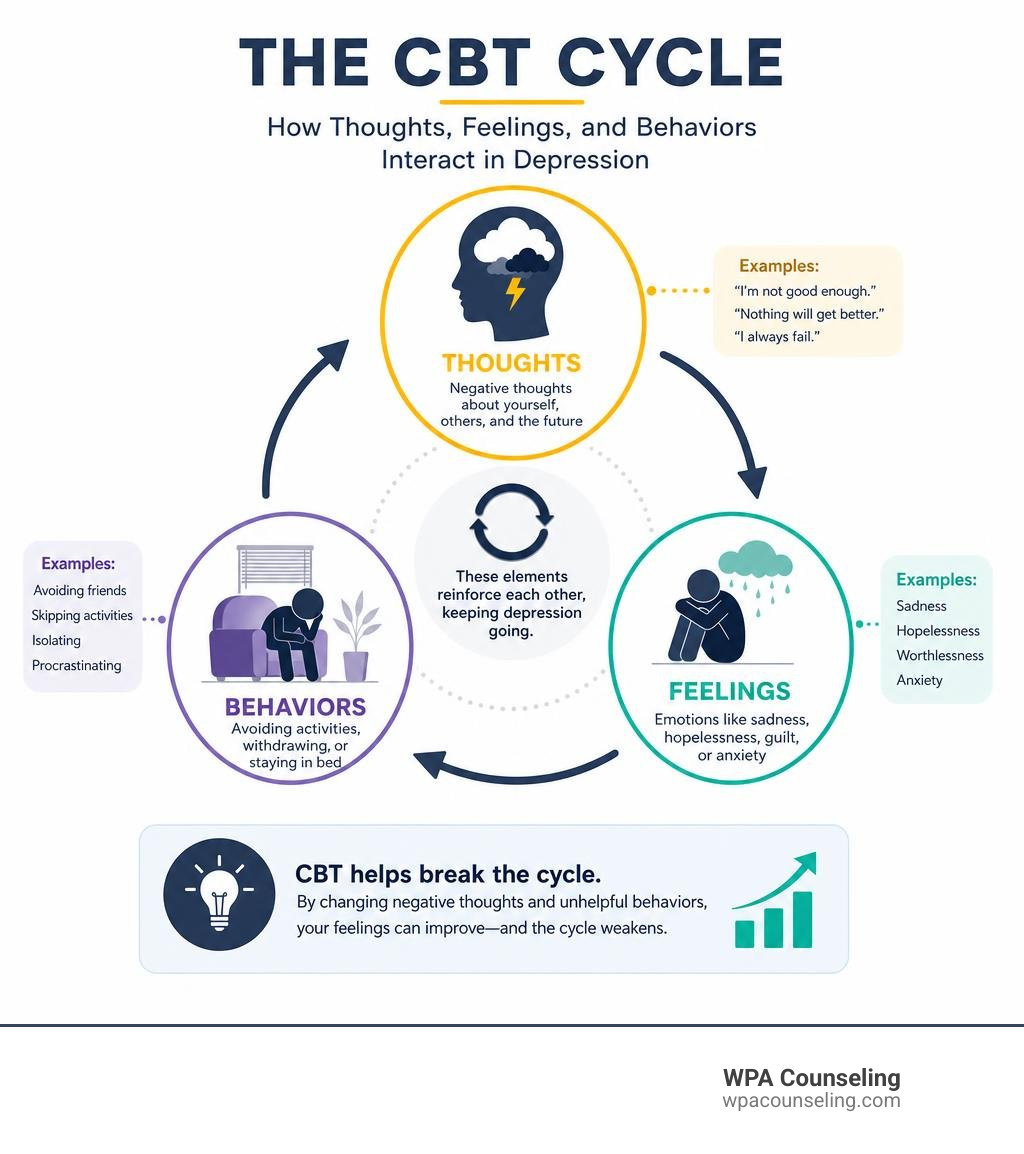
Simple guide to cognitive behavior therapy for depression:
What is Cognitive Behavior Therapy for Depression?
To understand how cognitive behavior therapy for depression works, we have to look at the fundamental assumption of cognitive therapy: a thought precedes a mood.
Developed by psychiatrist Aaron Beck in the 1960s, cognitive therapy evolved from the observation that depression is fundamentally a cognitive disorder rather than purely an emotional one. When you are depressed, your brain doesn’t just feel heavy—it actively processes information through a highly biased, negative lens.
Beck identified what is known as the Negative Cognitive Triad. This triad represents three distinct layers of negative beliefs that characterize depression:
- Negative view of the Self: Believing “I am worthless,” “I am a failure,” or “I am fundamentally unlovable.”
- Negative view of the World: Believing “The world is a hostile, demanding place,” or “Nobody cares about me.”
- Negative view of the Future: Believing “Things will never get better,” or “I am destined to fail no matter what I do.”
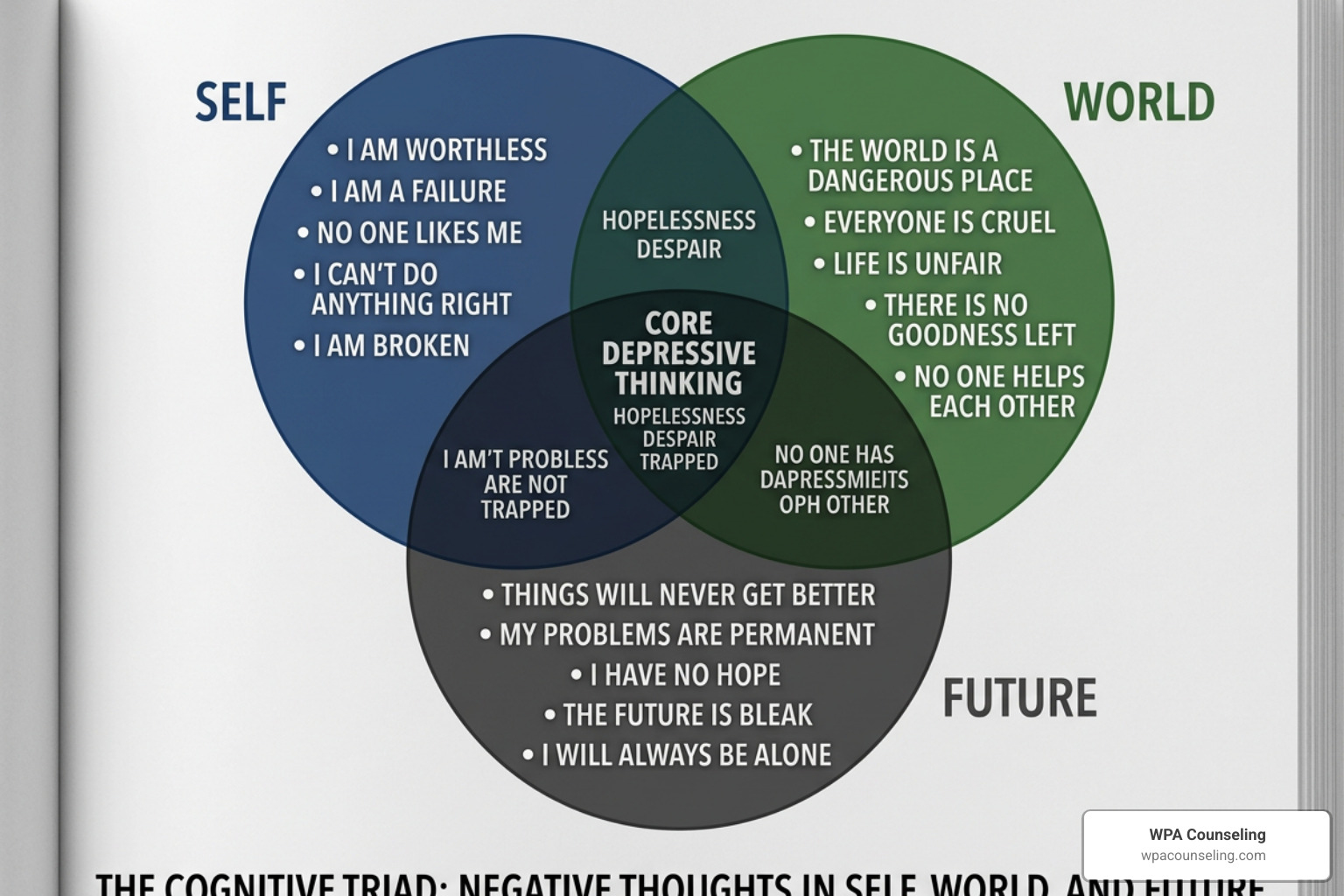
These deeply held beliefs (often called schemas) act like a pair of dark, distorted sunglasses. Every event, conversation, and experience is filtered through them. When something goes wrong, your brain instantly generates negative automatic thoughts (NATs)—rapid, knee-jerk self-evaluations that you accept as absolute truth.
For example, if a friend doesn’t reply to a text message immediately, a healthy brain might think, “They must be busy.” A depressed brain, filtered through a negative schema, instantly jumps to: “They are ignoring me because they find me boring.”
These automatic thoughts are driven by cognitive distortions—systematic errors in logic. Common distortions in depression include:
- Black-and-white thinking: Viewing things in all-or-nothing terms (e.g., “If I’m not perfect, I’m a complete failure”).
- Catastrophizing: Expecting the worst possible outcome in every situation.
- Emotional reasoning: Assuming your feelings reflect objective reality (e.g., “I feel like an idiot, so I must be one”).
- Disqualifying the positive: Rejecting positive experiences by insisting they “don’t count.”
CBT combines cognitive therapy (identifying and challenging these distorted thoughts) with behavioral therapy (changing unhelpful action patterns). The behavioral side focuses heavily on behavioral activation—helping you overcome the physical and emotional inertia of depression by strategically reintroducing positive, rewarding activities into your life.
To explore how these cognitive and behavioral pieces fit into a broader therapeutic framework, read The Complete Guide to Cognitive Behavioral Therapy and check out the clinical overview on the Cognitive Behavior Therapy – StatPearls archive.
How Cognitive Behavior Therapy for Depression Rewires the Brain
It is easy to think of talk therapy as simply “venting,” but modern neuroscience shows that CBT actually changes the physical structure and functioning of your brain.
A fascinating study conducted at Stanford Medicine utilized functional MRI (fMRI) scans to observe the brains of adults experiencing depression. The researchers focused on the cognitive control circuit—the brain network responsible for problem-solving, emotional regulation, and managing everyday stressors. In about a quarter of people with depression, this circuit is significantly underactive or dysfunctional, leaving them feeling stuck in a state of “cognitive freeze.”
The study matched participants with problem-solving therapy, a specialized branch of CBT. The results were striking: after just two months of active therapy, fMRI scans showed measurable, adaptive changes and enhanced connectivity within the cognitive control circuits.
Even better, 32% of the participants responded successfully to the therapy, showing a reduction in their depression symptoms by half or more. In comparison, the response rate for traditional antidepressants in this specific group was only 17%. By teaching the brain to actively solve real-world problems and challenge negative assumptions, CBT literally rewires the neural pathways responsible for emotional control, helping patients transition from passive rumination to active recovery.
The Core Techniques of CBT for Depression
In a typical session, you won’t just sit on a couch and talk about your childhood while your therapist nods silently. CBT is an active, collaborative, and highly practical process.
To help you understand how we bridge the gap between thoughts and actions, we use several evidence-based techniques designed to dismantle depression from both sides:
- Thought Records: A structured worksheet where you write down upsetting situations, identify the exact emotions and automatic thoughts that arose, and write down the objective evidence for and against those thoughts. This helps you step back and view your mind’s assumptions as hypotheses rather than facts.
- Socratic Questioning (Guided Discovery): Rather than telling you that your thoughts are wrong, your therapist will ask gentle, targeted questions to help you evaluate the logic of your beliefs. For example, if you believe “I ruin every relationship I’m in,” your therapist might ask: “What evidence do we have that supports this? What are some exceptions to this rule? How would you view a friend who made this same statement?”
- Activity Scheduling with Pleasure and Mastery Ratings: Depression robs you of motivation, leading to a cycle of withdrawal and worsening mood. To break this, you will keep a daily activity log. You will schedule small, manageable tasks and rate them from 0 to 10 on two scales: Pleasure (how much you enjoyed it) and Mastery (the sense of accomplishment or control it gave you). Even a simple task like making your bed or drinking a quiet cup of coffee can score surprisingly high on mastery, helping to restore a sense of autonomy.
- Behavioral Experiments: This is where you put your negative predictions to the test in the real world. If your brain tells you, “If I call my friend, they will find me annoying and try to hang up quickly,” your therapist will help you design a safe “experiment.” You will make the call, record what actually happens, and compare the real-world outcome to your brain’s catastrophic prediction.
For a deeper look at how these tools fit into a comprehensive recovery plan, you can read our Understanding Depression: A Comprehensive Guide and read through the clinical literature in the Cognitive Behavioral Therapy for Depression – PMC study.
Here is a quick comparison of how we balance these two primary pillars of CBT:
| Cognitive Restructuring (Changing Thoughts) | Behavioral Activation (Changing Actions) |
|---|---|
| Focus: Identifying and reframing negative automatic thoughts (NATs). | Focus: Overcoming physical inertia, fatigue, and social withdrawal. |
| Primary Tool: Thought Records and challenging cognitive distortions. | Primary Tool: Activity scheduling with Pleasure and Mastery ratings. |
| Example: Reframing “I am completely useless at my job” to “I made a mistake on this report, but I have completed my other projects successfully.” | Example: Scheduling a 15-minute walk outside or calling a family member, regardless of whether you “feel like it” initially. |
| Goal: Correcting biased thinking patterns to reduce emotional pain. | Goal: Building momentum, breaking the cycle of isolation, and experiencing positive reinforcement. |
How CBT Compares to Medication and Other Therapies
When exploring your options, it is natural to wonder how CBT stacks up against alternative approaches, such as psychiatric medication (pharmacotherapy) or other forms of psychotherapy.
The scientific consensus is clear: CBT is as effective as, or more effective than, other forms of psychological therapy or psychiatric medications for mild-to-moderate depression.
Here is what the clinical evidence shows:
- CBT vs. Medication Alone: A comprehensive meta-analysis including 409 trials and over 52,000 patients published in World Psychiatry showed that while the short-term effects of CBT and antidepressants are relatively similar, CBT is significantly more effective at the 6 to 12-month follow-up mark. This is because CBT teaches you self-management skills that you keep using long after therapy ends, whereas medication only works as long as you continue taking it.
- The Power of Combined Treatment: For severe, chronic, or recurrent depression, a combination of psychotherapy and pharmacotherapy is the gold standard. A meta-analysis of studies involving patients with severe depression showed that combining CBT with medication yields significantly higher remission rates than medication alone. One landmark study found an 85% response rate for combined treatment compared to just 55% for medication alone.
- Relapse Prevention: This is where CBT truly shines. Evidence suggests that the relapse rate for patients treated with cognitive therapy is roughly half that of patients treated with pharmacotherapy alone. When medication is discontinued, relapse rates can spike up to 60%, whereas patients who have completed a course of CBT experience a relapse rate of only about 29.5%.
- Delivery Formats: A systematic review and network meta-analysis published in the British Journal of Psychiatry evaluated the delivery of CBT in adults. It revealed that while traditional, face-to-face CBT yields the strongest short-term reductions in depressive symptoms, hybrid models (combining face-to-face sessions with digital tools) and multimedia CBT are also highly effective, viable options for busy individuals.
To help you weigh these paths, read our guide on All About Depression Therapy Options and explore the data in the Comprehensive Meta-Analysis of CBT for Depression.
What to Expect in a CBT Treatment Plan
Many people avoid therapy because they are afraid of the unknown. They worry they will walk into an office, feel pressured to talk about things they aren’t ready to share, or leave feeling more overwhelmed than before.
CBT is designed to be transparent, predictable, and collaborative. You and your therapist are partners working together to solve a problem.

A typical CBT session is highly structured and lasts about 50 to 60 minutes. Here is the blueprint of a standard session:
- Brief Mood Check: You and your therapist quickly rate your mood and review any changes since the last session.
- Bridge from the Previous Session: You discuss what you took away from the last session and make sure you are still on the same page.
- Collaborative Agenda Setting: You decide together what specific problems or topics you will focus on during today’s session. This keeps the therapy focused and prevents you from getting sidetracked.
- Homework Review: You look at the practice exercises you completed during the week. If you struggled to complete your homework, you will troubleshoot the obstacles together without judgment.
- Discussion of Agenda Items: You work through the scheduled problems using cognitive and behavioral techniques.
- New Homework Assignment: Together, you design a practical task to practice during the week to reinforce what you learned in session.
- Final Summary and Feedback: You summarize the key takeaways of the session, and your therapist asks for your feedback to ensure the session was helpful.
As you near the end of your treatment plan (typically after 8 to 16 sessions), the focus shifts to creating a Relapse Prevention Blueprint. This is a personalized, written document that outlines:
- Your specific early warning signs of slipping back into depression (e.g., changes in sleep, skipping workouts, or increased rumination).
- The exact cognitive and behavioral strategies that helped you get better.
- A step-by-step action plan of what to do if your symptoms start to return.
To learn how to manage this process smoothly, read How to Navigate the World of Depression Therapy Without Losing Your Mind and read about session structures in The Process and Delivery of CBT for Depression.
What to Expect in Your First Cognitive Behavior Therapy for Depression Session
Your very first session is primarily about assessment, goal setting, and building a comfortable alliance.
Your therapist will guide you through a clinical interview to understand the onset of your current symptoms, your background, and how depression is currently impacting your daily life. You will likely complete standardized, objective rating scales in the waiting room or online, such as the Beck Depression Inventory (BDI) and the Beck Anxiety Inventory (BAI).
These scores give us a clear baseline. For example, a BDI score of 21 indicates moderate depression, while a score of 30+ indicates severe depression. By tracking these scores weekly, you and your therapist can visually plot your progress and see exactly how well the therapy is working.
Finally, you will collaboratively draft a list of specific, measurable treatment goals. Instead of a vague goal like “I want to feel happy,” your therapist will help you refine it to: “I want to be able to go for a 20-minute walk three times a week, resume my weekly game night with friends, and reduce my daily negative self-talk.”
Our Approach: Evidence-Based Depression Therapy in Pennsylvania
At WPA Counseling, we are a compassionate group practice of licensed professional counselors based in Irwin / North Huntingdon, Pennsylvania, with an additional office in Penn Hills. We provide convenient, in-person counseling at our Western Pennsylvania offices, as well as secure, HIPAA-compliant telehealth therapy across the entire state of Pennsylvania.
Our Clinical Experience and Local Practice History
For over a decade, WPA Counseling has served as a trusted mental health resource in Western Pennsylvania. Our clinical team brings decades of combined experience in treating complex mood disorders, anxiety, and trauma using evidence-based, counseling-focused strategies. Over the years, we have helped hundreds of local residents in Westmoreland and Allegheny Counties break free from the cycle of depression and reclaim their lives. Our deep roots in the local community allow us to understand the unique stressors facing Pennsylvania families, ensuring that our clinical approach is not only scientifically rigorous but also culturally relevant and deeply compassionate.
We believe that effective therapy requires a careful balance of evidence-based methods—like CBT—and deep, genuine human connection. To guide this journey, we developed our core clinical framework: The Counseling Blueprint.
This four-stage healing journey aligns beautifully with the structured nature of CBT:
- Take Off the Mask (Rapport & Trust): We establish a warm, non-judgmental space where you can share your struggles honestly. We build a strong collaborative alliance, complete baseline assessments, and define your personal goals.
- Heal the Wounds (Exploration): We explore the emotional and relational hurts that contributed to your depression, identifying the core schemas and experiences that shaped your view of yourself and the world.
- Remove the Toxins (Identifying Lies): This is where cognitive restructuring comes to life. We help you identify the cognitive distortions, negative automatic thoughts, and unhelpful core beliefs (the “toxins” or lies) that keep you trapped in a cycle of sadness.
- Replace with Truth (Installing Empowerment): We work together to install empowering, accurate, and realistic perspectives. Through behavioral experiments, activity scheduling, and cognitive reframing, we help you step into a life built on truth and renewed motivation.
Whether you prefer meeting in person in Westmoreland County or utilizing our secure statewide telehealth services, our team of licensed Pennsylvania counselors is dedicated to walking alongside you. To read more about building emotional durability, read Resilience Building Through Depression Counseling.
Frequently Asked Questions About CBT for Depression
How many sessions of CBT are typically needed for depression?
The duration of CBT is highly individualized and depends on the severity and complexity of your depression:
- Mild Depression: Often successfully treated within 8 to 12 sessions.
- Moderate Depression: Typically requires 8 to 16 sessions to achieve stable, lasting change.
- Severe or Chronic Depression: May require 16 or more sessions, frequently combined with psychiatric medication, followed by periodic “booster sessions” over 1 to 2 years to maintain progress.
Can CBT prevent depression from returning?
Yes. Relapse prevention is one of the primary advantages of CBT. Because CBT teaches you active, practical skills to challenge negative thoughts and modify behaviors, you essentially become your own therapist.
Long-term follow-up studies, including research on the Prevention of Major Depression in Older Adults, demonstrate that patients who complete CBT maintain their gains and experience significantly lower rates of recurrence compared to those who rely solely on medication.
Is CBT effective for adolescents with depression?
Absolutely. Depression can impact individuals of all ages, and CBT has been extensively adapted for children and teenagers.
A meta-analysis of adolescent depressive disorder studies showed that CBT was significantly more effective than placebo or inactive interventions, yielding a 62% response rate compared to 36% for control conditions. For teens, CBT often incorporates creative worksheets, active problem-solving for school and peer stressors, and collaborative family involvement to build a supportive home environment.
Conclusion
Depression can make you feel as though you are staring at a permanent wall, but you do not have to navigate this painful season alone. Cognitive behavior therapy offers a practical, structured, and scientifically proven way to dismantle the negative patterns keeping you stuck, allowing you to gradually rebuild your life from the inside out.
At WPA Counseling, we are committed to making your therapeutic journey as smooth and supportive as possible. Through our thoughtful matching process, we will connect you with a compatible, licensed Pennsylvania counselor who understands your unique struggles and matches your personality.
Whether you want to sit down with us in our cozy Irwin/North Huntingdon or Penn Hills offices, or connect from the comfort of your home anywhere in Pennsylvania via telehealth, we are here to help you take off the mask, heal your wounds, and step into a brighter, more hopeful future.
If you are ready to take that first courageous step toward healing, discover how we can support you by visiting our Depression Therapy page today.
This article was researched with AI and heavily edited by Stephen Luther for accuracy and relevance.
Stephen Luther is the Executive Director and Founder of WPA Counseling. He holds a Master’s degree in Education from the University of Georgia and a Master’s degree in Marriage and Family Therapy from Duquesne University. He is a licensed professional counselor in Pennsylvania (LPC).
Since 1997, Steve has been helping children, adolescents, adults, couples, and families overcome emotional and relational challenges. He specializes in working with hurting families, including those with foster, adopted, or traumatized children. Steve uses Attachment-Based Therapy, client-centered therapy, and Therapeutic Parent Coaching to support healing and relationship restoration.
This guide is for educational and spiritual encouragement and is not a substitute for personalized professional counseling. If you are in crisis, please reach out for immediate help.
Before You Let Anxiety Win, Read This