
Why Cognitive Behavioral Therapy for Anxiety Is the Most Researched Treatment Available
Cognitive behavioral therapy for anxiety is a structured, evidence-based treatment that helps you identify and change the negative thought patterns and behaviors that keep anxiety alive.
Here’s a quick summary of what CBT for anxiety involves:
- What it is: A short-term, goal-oriented form of talk therapy developed by psychiatrist Aaron Beck
- How it works: Targets the cycle of thoughts, feelings, and behaviors that fuel anxiety
- How long it takes: Typically 12 to 20 weeks of weekly sessions
- Who it’s for: Anyone experiencing anxiety — from everyday stress to diagnosed disorders like GAD, OCD, PTSD, or social anxiety
- Does it work? Yes — decades of clinical research and large-scale meta-analyses confirm it is one of the most effective treatments for anxiety available
Nearly 1 in 3 people will meet the criteria for an anxiety disorder at some point in their life. Yet only about 37% of people with anxiety ever receive treatment.
At WPA Counseling, our licensed professional counselors in Pennsylvania use CBT as a core part of helping clients work through anxiety, stress, trauma, and more — both in person and via secure telehealth across the state. With a deep-rooted history in the local community and years of clinical experience, our practice is dedicated to providing accessible, high-quality mental health services to our neighbors across the Commonwealth.
CBT was designed specifically to break the cycle of anxiety. Unlike older forms of therapy that focus on your past, CBT focuses on right now — the thoughts you’re having today, and the behaviors those thoughts are driving. Think of it less like “venting to a professional” and more like working with a personal trainer for your mind. You learn specific, practical skills that become second nature over time.
This guide walks you through everything: how CBT works, the techniques involved, what to expect in treatment, and how to get started.
Understanding Cognitive Behavioral Therapy for Anxiety
When we talk about cognitive behavioral therapy for anxiety, we are referring to the “gold standard” of psychological treatment. Developed in the 1960s by Dr. Aaron Beck, CBT shifted the focus of therapy from long-term exploration of childhood roots to a practical, present-focused approach.
As of May 2026, scientific research on CBT for anxiety continues to demonstrate that this method is as effective as, and often more durable than, medication alone. It is based on a simple but profound core principle: our psychological problems are partially based on unhelpful ways of thinking and learned patterns of unhelpful behavior.

At WPA Counseling, we see how these maladaptive patterns take root. Whether you are seeking anxiety therapy services in our Irwin office or via telehealth from elsewhere in Pennsylvania, the goal is the same: to help you “unlearn” the habits that keep you stuck in a state of high alert.
The Connection Between Thoughts, Feelings, and Behaviors
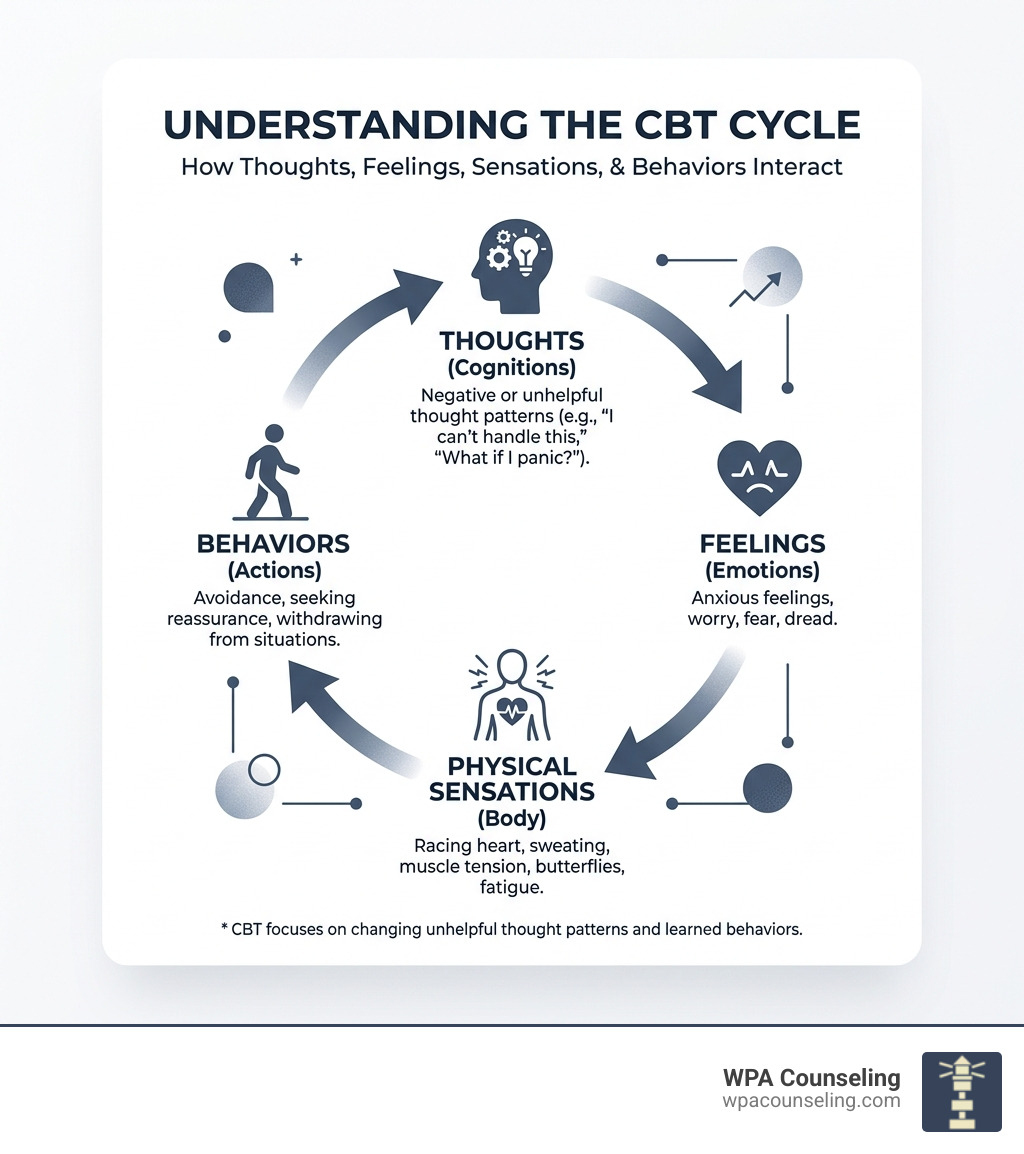
The heart of CBT is the “vicious cycle.” Imagine you have a presentation at work in Pittsburgh.
- The Thought: “I’m going to mess this up, and everyone will think I’m incompetent.”
- The Feeling: Intense fear, dread, and physical tension (sweating, racing heart).
- The Behavior: You spend all night over-preparing (perfectionism) or you call in sick to avoid it (avoidance).
This cycle reinforces itself. By avoiding the presentation, you never get the chance to see that you could have succeeded. Your brain learns that “avoidance equals safety,” which actually makes your anxiety grow stronger the next time.
Understanding anxiety counseling in Pennsylvania means recognizing that these components are all “links in a chain.” If we can change the thought or the behavior, the feeling will eventually follow. This is what psychologists call emotional processing—modifying the “fear structures” in our brain by providing them with new, safer information.
Identifying Common Cognitive Distortions in Cognitive Behavioral Therapy for Anxiety
Most of us have “thinking traps” or cognitive distortions. These are biased ways of looking at the world that feel like facts but are actually just habits of the mind. In our work with high functioning anxiety support, we often see clients who are incredibly successful but are plagued by these traps:
- Catastrophizing: Expecting the absolute worst-case scenario. If a friend doesn’t text back, you assume they hate you or something terrible has happened.
- Overgeneralization: Taking one single negative event and seeing it as a never-ending pattern of defeat. “I tripped during my speech; I’m a failure at everything.”
- Filtering: Focusing exclusively on the one thing that went wrong while ignoring the twenty things that went right.
- Polarized Thinking (Black-and-White): Seeing things in extremes. You’re either a total success or a complete failure, with no middle ground.
- Jumping to Conclusions: Mind-reading (assuming you know what others think) or fortune-telling (predicting a bad outcome without evidence).
Recognizing these traps is the first step in cognitive behavioral therapy for anxiety. Once you can name the distortion, it loses its power over you.
Core Techniques and Exercises for Mental Wellness
If CBT is like a “toolbox,” these are the tools we use most often. These exercises aren’t just for the therapy office; they are skills you use in your daily life in Penn Hills, North Huntingdon, or wherever you may be.

Mastering Cognitive Behavioral Therapy for Anxiety Techniques
One of the most effective tools is Cognitive Restructuring. This involves identifying, challenging, and replacing unhelpful thoughts. A popular way to do this is the Triple Column Technique:
- Column 1 (Automatic Thought): Write down the negative thought exactly as it appears. (e.g., “I will fail my exam.”)
- Column 2 (Distortion): Identify which thinking trap it is. (e.g., “Fortune-telling.”)
- Column 3 (Rational Response): Write a balanced, evidence-based alternative. (e.g., “I have studied for ten hours and passed all my previous exams. I am prepared.”)
This isn’t just “positive thinking.” It’s “accurate thinking.” We use Socratic questioning to help you find the evidence. We might ask, “What is the evidence that this thought is true? What is the evidence against it?” This practical CBT guide approach helps you become your own scientist, testing your fears against reality.
If you are looking for anxiety counseling in Pittsburgh, you’ll likely find that journaling and thought records are essential “homework” that help translate what we talk about in session into real-world change. These are part of the different kinds of counseling services we offer to ensure you have a customized plan for your specific needs.
Behavioral Activation and Successive Approximation
Anxiety thrives on avoidance. When we are anxious, we stop doing the things that make us feel good or productive. Behavioral Activation is the process of scheduling activities that provide a sense of pleasure or accomplishment to break the cycle of low mood and worry.
However, if a task feels overwhelming, we use Successive Approximation. This means breaking a large, scary goal into tiny, manageable steps. If you’re afraid of social situations, we don’t start by having you host a party. We might start by having you say “hello” to a neighbor.
Don’t let anxiety hold you back from the life you want to lead. By taking these small steps, you build “mastery,” which is a natural antidote to anxiety.
How Exposure Therapy Works for Anxiety Disorders
Exposure therapy is perhaps the most misunderstood part of cognitive behavioral therapy for anxiety. Many people fear that exposure means being “thrown into the deep end.” In reality, it is a gradual, controlled process of facing your fears to facilitate “extinction learning”—the process where your brain learns that the feared situation is not actually dangerous.
We start by creating a fear hierarchy. This is a list of situations ranked from 1 (least scary) to 10 (most scary). We work our way up the list slowly, ensuring you feel a sense of control at each step. This is a cornerstone of social anxiety treatment in Pennsylvania.
In Vivo, Imaginal, and Interoceptive Exposure
Depending on the type of anxiety you’re experiencing, we use different types of exposure:
- In Vivo Exposure: Facing the feared object or situation in real life (e.g., a person with a phobia of dogs visiting a park where dogs are on leashes).
- Imaginal Exposure: Vividly imagining the feared event. This is common in anxiety and depression counseling for PTSD, where we help you process trauma by safely revisiting the memory.
- Interoceptive Exposure: Deliberately inducing physical sensations that mimic panic (like spinning in a chair to feel dizzy or breathing through a straw) to learn that these sensations are uncomfortable but not dangerous. This is the “gold standard” for treating Panic Disorder.
Specific Disorders and Empirical Evidence
CBT isn’t just a general approach; it has specialized protocols for different conditions. Research on exposure protocols shows high success rates for:
- Generalized Anxiety Disorder (GAD): Focusing on “worry time” and uncertainty tolerance.
- OCD: Using Exposure and Ritual Prevention (ERP) to stop the compulsions that “fix” the anxiety.
- Social Anxiety: Testing “social costs” by intentionally making small mistakes in public to see that the world doesn’t end.
Whether you prefer in-person sessions or online anxiety therapy in Pennsylvania, these transdiagnostic protocols are designed to target the underlying mechanisms of fear.
What to Expect During Your Treatment Course
One of the reasons people choose cognitive behavioral therapy for anxiety is that it is time-limited. You aren’t expected to be in therapy for years. Most people see significant improvement within 12 to 20 weeks.
| Feature | Cognitive Behavioral Therapy (CBT) | Traditional Psychoanalysis |
|---|---|---|
| Focus | Present-focused (“Here and Now”) | Past-focused (Childhood roots) |
| Duration | Short-term (12-20 weeks) | Long-term (Years) |
| Goal | Skill-building and symptom relief | Insight and personality change |
| Structure | Highly structured and goal-oriented | Open-ended and exploratory |
| Homework | Essential for progress | Rarely used |
A typical session involves reviewing your “homework,” checking in on your symptoms, setting an agenda for the hour, and learning a new skill. We track your progress using standardized assessments to ensure you are actually getting better. This data-driven approach is a key part of our anxiety therapy options.
The Role of Practice and Homework in Successful Outcomes
We often tell our clients about the “99% Rule.” You spend about one hour a week in therapy. That means 99% of your life happens outside of our office. The real work of therapy—the healing—happens in that 99%.
Homework isn’t a chore; it’s the translation of clinical concepts into real-life habits. Whether it’s tracking your triggers or practicing a breathing exercise while stuck in traffic on the Parkway, these repetitions are what rewire your brain.
Overcoming Barriers with Telehealth and Digital Solutions
In May 2026, accessibility is better than ever. We understand that stigma, busy schedules, or living in more rural parts of Westmoreland County can make it hard to get to an office.
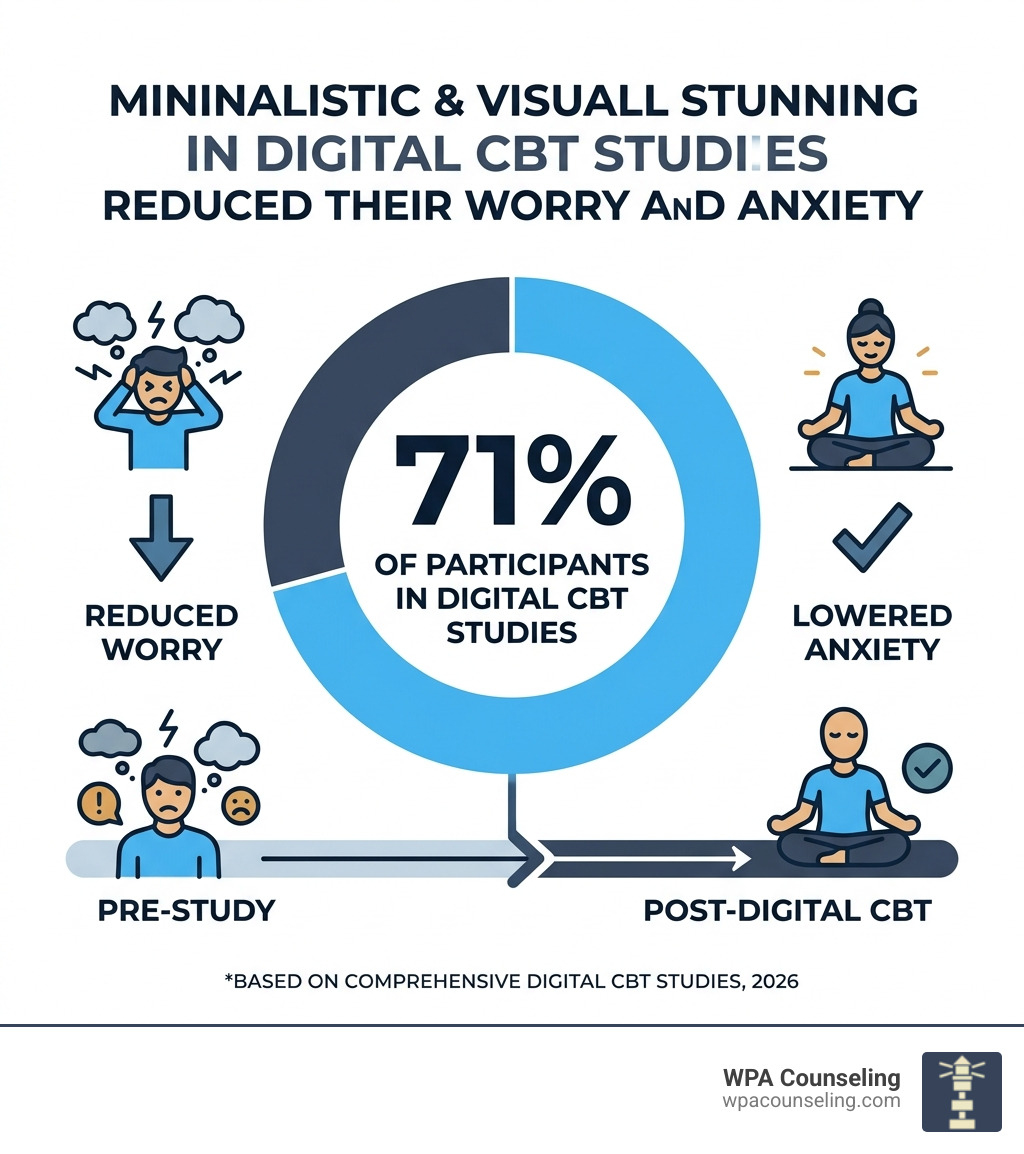
Online anxiety therapy in Pennsylvania has been shown in studies to be just as effective as face-to-face therapy for most anxiety disorders. It offers flexibility and the comfort of your own home, which can sometimes make the initial stages of exposure therapy feel more manageable.
Frequently Asked Questions about CBT
Is CBT as effective as medication for anxiety?
Yes. For many anxiety disorders, CBT is considered a first-line treatment that is as effective as medication. While medication can be a helpful tool to “lower the volume” of intense symptoms, CBT provides the long-term skills to manage the anxiety so it doesn’t return once the medication is stopped.
How long does it take to see results from CBT?
While every person is different, many clients begin to notice a shift in their perspective within 4 to 8 sessions. A full course typically lasts 12 to 20 weeks. The goal of a CBT therapist is to “put themselves out of business” by making you self-sufficient.
What are the most common myths about cognitive behavioral therapy?
The biggest myth is that CBT is “just positive thinking.” It’s actually about realistic thinking. Another myth is that it ignores your past. While we focus on the present, we do look at your history to understand how your core beliefs were formed. Finally, some think it’s “cold” or “clinical.” At WPA Counseling, we prioritize the therapeutic relationship above all else.
Conclusion: Professional Support in Pennsylvania
At WPA Counseling, we are more than just a group of therapists; we are a compassionate team of licensed professional counselors dedicated to the well-being of our Pennsylvania neighbors. Based in Irwin, our practice has a long history of serving the local community, from the busy streets of Pittsburgh and Penn Hills to the quiet neighborhoods of Westmoreland County. Our clinical experience is built on years of specialized training and a commitment to evidence-based counseling strategies that empower our clients to achieve lasting change.
We focus exclusively on counseling-based recovery, utilizing proven therapeutic techniques to address anxiety and trauma. By grounding our practice in clinical excellence and local history, we provide a trusted environment where residents of Pennsylvania can find the support they need without the use of medical detox or alternative physical therapies. Our goal is to provide the highest standard of professional counseling to help you reclaim your life.
Our practice is built on a unique four-stage healing process:
- Rapport: Building a safe, trusting connection where you feel heard and understood.
- Wound Exploration: Identifying the roots of your anxiety and the “stuck points” in your life.
- Toxin Removal: Using cognitive behavioral therapy for anxiety to challenge the distortions and behaviors that are poisoning your peace of mind.
- Truth Restoration: Replacing those toxins with healthy, balanced beliefs and the skills to maintain your mental health for years to come.
We pride ourselves on our clinical experience and our history of providing compassionate, evidence-based care. Whether you are dealing with high-functioning anxiety, trauma, or the daily stress of modern life, we are here to walk with you.
If you are ready to stop letting anxiety hold you back and start building the toolkit you need for a fulfilling life, we invite you to take the first step.
Request an appointment for anxiety therapy today. Your journey toward a calmer, more confident self starts here.
This article was researched with AI and heavily edited by Stephen Luther for accuracy and relevance.
Stephen Luther is the Executive Director and Founder of WPA Counseling. He holds a Master’s degree in Education from the University of Georgia and a Master’s degree in Marriage and Family Therapy from Duquesne University. He is a licensed professional counselor in Pennsylvania (LPC).
Since 1997, Steve has been helping children, adolescents, adults, couples, and families overcome emotional and relational challenges. He specializes in working with hurting families, including those with foster, adopted, or traumatized children. Steve uses Attachment-Based Therapy, client-centered therapy, and Therapeutic Parent Coaching to support healing and relationship restoration.
This guide is for educational and spiritual encouragement and is not a substitute for personalized professional counseling. If you are in crisis, please reach out for immediate help.
What Nobody Tells You About How Trauma Therapy Really Works