

Codependency Counseling in Irwin, PA: Is This What’s Keeping You Stuck?
If you’re looking for codependency counseling in Irwin, PA, here’s what you need to know right away:
- WPA Counseling offers codependency counseling at their office in North Huntingdon (Irwin area) and via secure telehealth across Pennsylvania.
- Same-week appointments are available, and most major insurance plans are accepted.
- To get started, fill out the 2-minute Get Matched form.
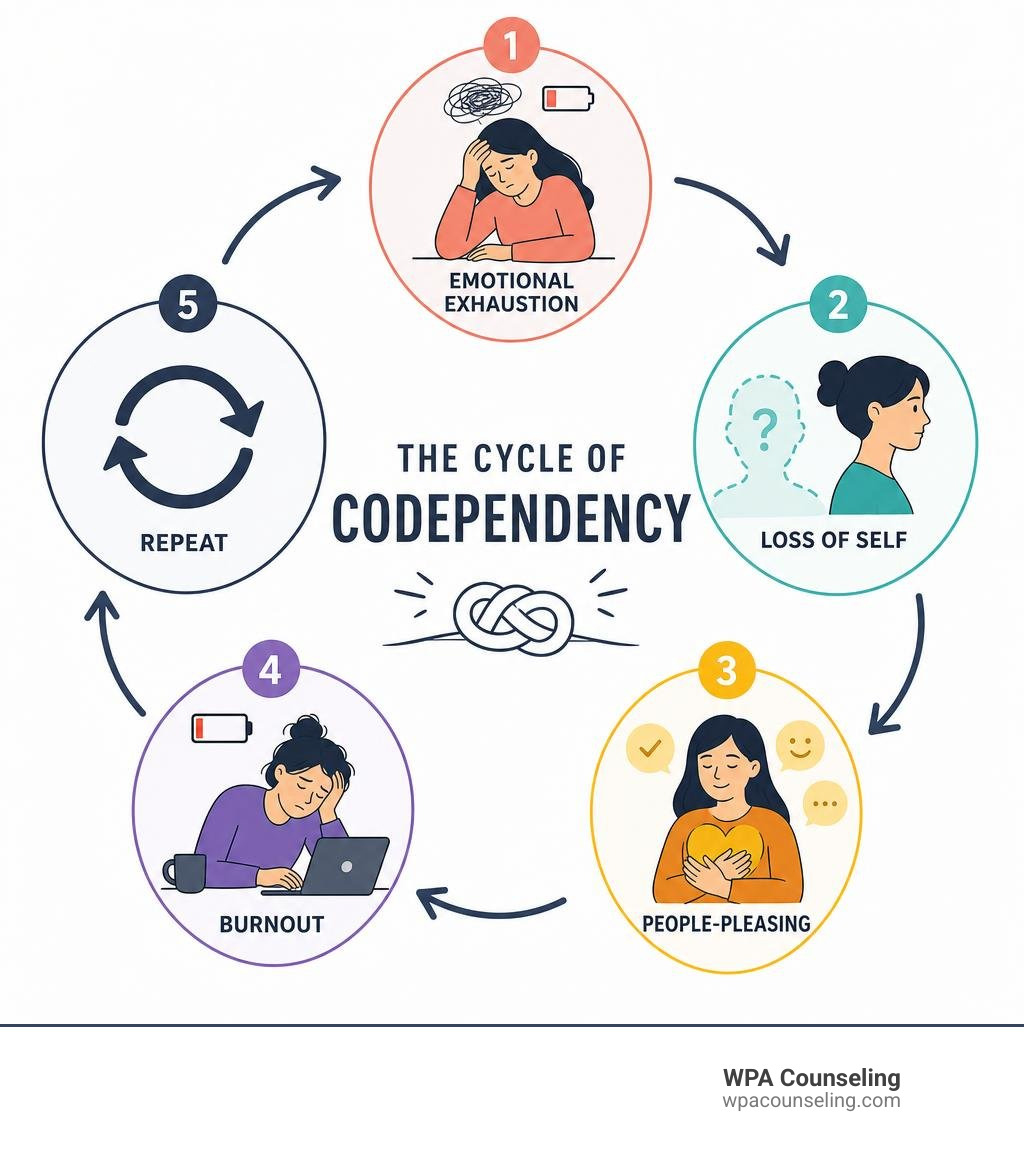
Do you find yourself constantly reshaping who you are to keep others happy — then crashing into exhaustion when it’s over? That feeling has a name.
Researchers describe codependency as living like a chameleon. You adapt, shrink, and shift yourself to fit whoever is in the room — until you can barely remember what you actually want or need. One study on the lived experience of codependency found that people describe it as “the mother ship of all addictions” — a pattern so deeply woven into daily life that it quietly drives anxiety, burnout, and broken relationships.
It’s not a character flaw. And it’s not something you simply “get over.”
Codependency often has deep roots — in childhood, in family dynamics, in the unspoken rules of households where love felt conditional or unpredictable. For many people in Irwin and across Western Pennsylvania, those early wounds still show up every day in their closest relationships.
The good news? Those patterns can change. With the right support, you can begin to find your footing again — and that’s exactly what codependency counseling is designed to help you do.
Key terms for codependency counseling Irwin PA:
- faith-sensitive counseling Western Pennsylvania
- attachment issues
- trauma informed therapy PA
Understanding Codependency: The Lived Experience of the “Chameleon-Self”

When we talk about codependency, we are talking about a deeply felt, subjective experience rather than a neat clinical diagnosis. In fact, codependency is not currently listed as a formal disorder in the DSM-V. For context, the American Psychiatric Association describes the DSM-5-TR as the standard classification of mental disorders used by mental health professionals in the United States. Even though codependency is not a formal DSM diagnosis, therapists and researchers worldwide recognize how incredibly real and disruptive it is. Studies on codependency have been conducted across the globe – from Italy and Sweden to India, Brazil, Turkey, and Korea – proving that this relational struggle transcends cultures.
At its core, the lived experience of codependency is defined by what researchers call the “Chameleon-Self.”
Imagine waking up every day and instinctively scanning the room to see who you need to be. If your partner is angry, you become the peacekeeper. If your parent is critical, you become the overachiever. If your friend is in crisis, you become the tireless savior. You blend so perfectly into your social environment that your own values, needs, and desires completely fade into the background.
This “chameleon” pattern relies on four core elements:
- External Focusing: Your attention is constantly directed outward, monitoring the moods, behaviors, and needs of others while ignoring your own.
- Self-Sacrifice: You routinely give up your own physical, emotional, and financial well-being to take care of someone else.
- Interpersonal Conflict and Control: You feel a compulsive need to fix, manage, or control situations and people, often leading to resentment and friction.
- Emotional Constraint: You suppress your true feelings – especially “difficult” emotions like anger, sadness, or disappointment – because you fear they might disrupt the relationship.
Living this way leads to a profound lack of a clear sense of self. When you spend all your energy being who everyone else needs you to be, you are left asking a painful question: Who am I when I’m alone?
The Seesaw of Extremes: Signs and Childhood Roots

Another powerful metaphor for codependency is the “seesaw of extremes.” People struggling with these patterns rarely experience a steady, balanced emotional life. Instead, they swing wildly between two poles:
- The Highs of Extreme Activity: Throwing yourself into work, caretaking, or fixing crises. You might push yourself to the absolute edge of burnout just to feel alive, validated, or needed.
- The Lows of Exhaustion and Emptiness: When the crisis ends or the other person pulls away, you crash. You are left facing a terrifying, quiet space — a sense of inner emptiness often described as a “hole in the soul.”
To escape that emptiness, you climb back onto the seesaw and look for the next person to save or the next problem to fix.
This exhausting cycle is rarely random. It is almost always rooted in childhood trauma, rigid family dynamics, and parental influence. When a child grows up in a home where a parent is emotionally absent, highly critical, unpredictable, or struggling with addiction, the child learns that their own feelings are not safe or important. To survive, they adopt a subservient, passive, or hyper-vigilant role.
If you grew up in an environment where you had to “earn” love through perfect behavior or by taking care of an adult, you are much more likely to repeat those patterns in adulthood. Recognizing these cycles is the first step toward healing, which is why we specialize in helping clients with Breaking The Cycle With Toxic Family Patterns Counseling.
To help visualize what is happening beneath the surface, it is helpful to look at how these dynamics compare to healthy relationships:
| Feature | Healthy Attachment | Trauma Bonding / Codependency |
|---|---|---|
| Sense of Self | You maintain your own identity, hobbies, and values. | You lose your identity and adapt completely to the other person (Chameleon-Self). |
| Boundaries | Clear, respected, and flexible. | Porous, weak, or completely non-existent. |
| Emotional State | Consistent, safe, and supportive. | Seesaw of extremes (high anxiety, intense highs, deep crashes). |
| Conflict Resolution | Open communication and mutual compromise. | Walking on eggshells, control, or total self-sacrifice to keep the peace. |
| Core Motivation | Mutual growth, love, and shared connection. | Fear of abandonment, rejection, or facing inner emptiness. |
How Childhood Trauma and Family Dynamics Shape Codependent Patterns
When a child experiences parental abandonment — whether physical or emotional — it leaves a deep wound. The child internalizes a belief: “I am only valuable if I am useful.”
This belief is the engine that drives trauma bonding in adulthood. A trauma bond is an unhealthy attachment formed when a relationship is marked by cycles of high-intensity affection followed by emotional neglect or abuse. If you are used to earning love through struggle, you might find yourself magnetically drawn to partners who are emotionally unavailable or volatile.
We dive deep into this dynamic in our guides, exploring The Sticky Truth About Trauma Bonding and helping you understand Trauma Bonding Vs Healthy Attachment How To Tell The Difference. In therapy, we help you trace these adult relationship patterns back to their childhood roots, allowing you to finally untangle your past from your present.
How Codependency Counseling in Irwin PA Helps Restore Balance
If you are tired of living on the seesaw, professional counseling can help you step off it. Codependency counseling is not about learning how to stop caring about others; it is about learning how to include yourself in that care.
By working with a therapist, you can build emotional balance, establish healthy boundaries, and discover who you are outside of your relationship roles. We offer specialized Relationship Counseling to help couples break toxic patterns, as well as Individual Counseling to help you focus entirely on your personal healing and growth.
What to Expect from Codependency Counseling in Irwin PA
When you begin codependency counseling in Irwin, PA, you won’t just get generic advice. We use evidence-based therapeutic modalities tailored to your unique history and goals. These include:
- Cognitive Behavioral Therapy (CBT): To help you identify and challenge the deeply ingrained, unhelpful beliefs (like “I must please everyone to be safe”) that keep you stuck in codependent loops.
- Dialectical Behavior Therapy (DBT): To provide practical tools for emotional regulation, helping you tolerate distress and quiet moments without rushing to fix others.
- Attachment-Based Therapy: To explore your early childhood relationships and help you transition from anxious, codependent attachments to secure, healthy bonds.
Our compassionate therapists are proud to be Serving/Irwin Pa/ and the surrounding Westmoreland County communities, providing a safe space close to home where you can heal.
Our Four-Stage Healing Blueprint for Lasting Recovery
At WPA Counseling, we guide our clients through a structured, highly effective journey we call the Counseling Blueprint. This four-stage process is designed to take you from survival mode to true, authentic living:
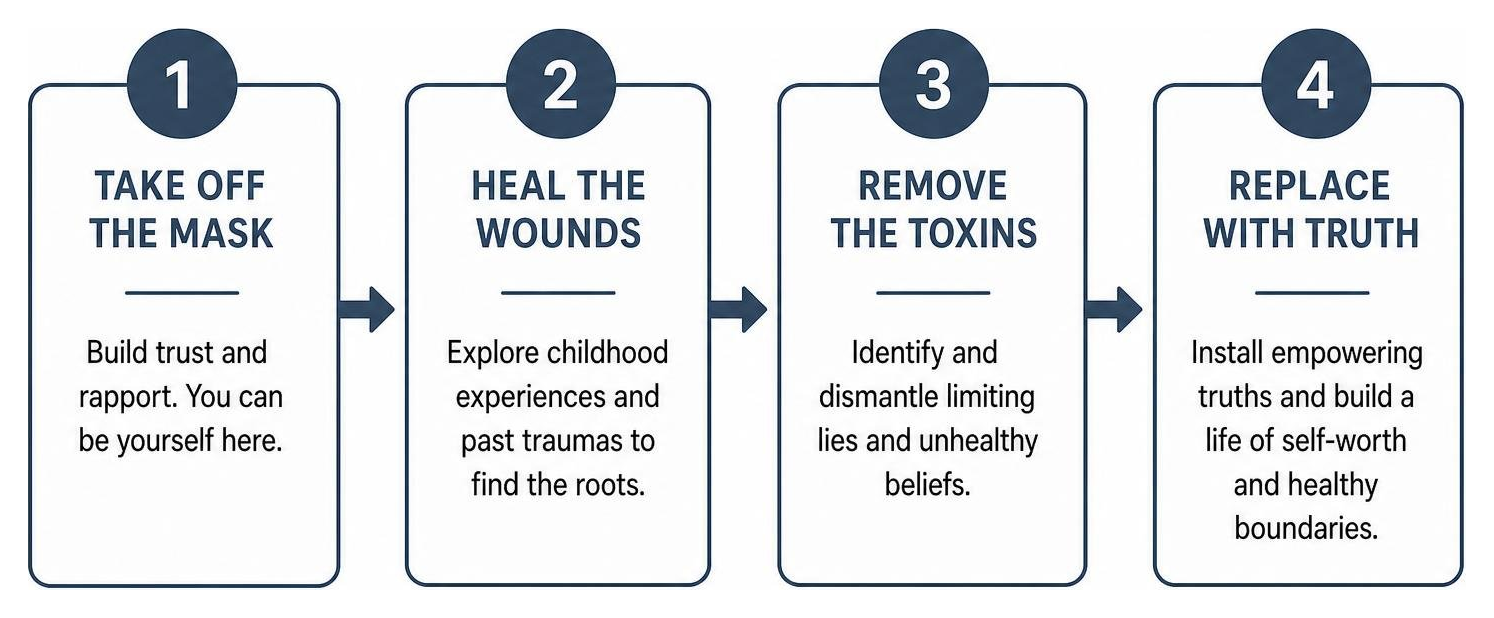
- Take Off the Mask (Rapport): We start by building a genuine, trusting relationship. You don’t have to perform, fix, or be perfect here. You can finally take off the “chameleon” mask and simply be yourself.
- Heal the Wounds (Wound Exploration): We gently look back at your childhood experiences, family dynamics, and past traumas to understand where your codependent patterns began.
- Remove the Toxins (Toxin Removal): Together, we identify and dismantle the lingering lies and unhealthy beliefs you’ve carried for years — such as the belief that you are responsible for everyone else’s happiness.
- Replace with Truth (Truth Restoration): Finally, we install empowering, accurate perspectives about your worth, your boundaries, and your capabilities, helping you build a life of genuine self-definition.
This blueprint has helped countless neighbors in our community experience profound personal growth. You can read more about this journey in our resource, Discover Irwin Counseling Your Gateway To Personal Growth.
Our Clinical Experience and Local Therapy Services in Western Pennsylvania
We believe that high-quality mental health care should be warm, professional, and highly accessible. WPA Counseling is a compassionate group practice of licensed professional counselors (LPCs) with a rich history of serving Western Pennsylvania. Over the years, our practice has established deep roots in the local community, providing thousands of hours of clinical therapy to individuals and families navigating complex relational trauma, anxiety, and codependency. Our team of highly trained clinicians brings decades of collective clinical experience, utilizing evidence-based, counseling-focused strategies to help clients heal from past wounds and build secure attachments.
We offer two convenient physical locations for in-person sessions:
- Our North Huntingdon / Irwin Office: Located at 8700 Pennsylvania Ave, North Huntingdon, PA 15642. This office features free on-site parking and offers a stress-free commute for residents of Irwin, North Huntingdon, and Westmoreland County.
- Our Penn Hills Office: Conveniently located to serve clients in the eastern suburbs of Pittsburgh.
For those who prefer the comfort and convenience of therapy from home, we also provide secure, HIPAA-compliant Online Counseling across the entire state of Pennsylvania. Whether you are sitting in our physical office or meeting with us virtually, you will receive the same high standard of evidence-based, trauma-informed care.
Finding the Right Path with Codependency Counseling in Irwin PA
We know that taking the first step can feel overwhelming. That’s why we’ve designed our process to be as simple and stress-free as possible:
- Personalized Matching: Our care team personally reviews your needs, schedule, and insurance to match you with the perfect licensed therapist in just 2 minutes.
- Convenient Hours: We offer evening appointments up to 7:00 PM so you don’t have to miss work or school to get the support you deserve.
- Insurance Friendly: We accept most major insurance plans and handle the verification process for you.
- Same-Week Appointments: You don’t have to wait months for help. We frequently have openings to get you started within the same week.
If you are ready to begin, you can easily contact us today. For more guidance on choosing a provider, check out our article on How To Find The Right Therapist For Trauma In Pennsylvania.
Frequently Asked Questions About Codependency
Is codependency a formal mental health diagnosis?
No, codependency is not listed as a formal diagnosis in the DSM-V. However, it is a widely recognized and highly clinical concept used by therapists worldwide to describe an enduring pattern of relational, emotional, and occupational imbalance. Many self-identified codependents find that the term perfectly explains their lived experience and helps them find targeted support.
How does codependency differ from healthy relationship support?
Healthy relationship support is mutual, balanced, and respects individual boundaries. You can care for a partner or family member without losing your own identity. In contrast, codependency involves extreme self-sacrifice, walking on eggshells, a lack of a clear sense of self, and a compulsive need to control or fix the other person at the expense of your own well-being.
Do you accept insurance and offer telehealth in Pennsylvania?
Yes! We accept most major insurance plans. We also provide secure, HIPAA-compliant telehealth services, allowing anyone living in Pennsylvania to meet with our licensed therapists from the comfort and privacy of their own home.
Conclusion
Living as a chameleon, constantly swinging on the seesaw of emotional extremes, is an exhausting way to live. But you do not have to keep carrying the weight of everyone else’s world on your shoulders.
At WPA Counseling, we are dedicated to helping you step off the seesaw, take off the mask, and build a life of genuine, healthy attachment. Whether you are interested in exploring individual growth, healing childhood wounds, or looking into options like coaching — such as asking Is Life Coaching Right For You, exploring our Life Coaching services, or learning Why Counseling Coaching Wins — we are here to support your unique path.
You deserve to be known, valued, and loved for exactly who you are — not just for what you can do for others. Let us help you find your way back to yourself.
If you are ready to learn how to build secure, lasting relationships, start by reading Trauma Bonding Vs Healthy Attachment How To Tell The Difference or take a look at A Roadmap To Repairing Your Damaged Bond.
Ready to get started? Fill out our quick Get Matched Form today to connect with a licensed counselor in Irwin, PA, and take your first step toward lasting recovery.
This article was researched with AI and heavily edited by Stephen Luther for accuracy and relevance.
Stephen Luther is the Executive Director and Founder of WPA Counseling. He holds a Master’s degree in Education from the University of Georgia and a Master’s degree in Marriage and Family Therapy from Duquesne University. He is a licensed professional counselor in Pennsylvania (LPC).
Since 1997, Steve has been helping children, adolescents, adults, couples, and families overcome emotional and relational challenges. He specializes in working with hurting families, including those with foster, adopted, or traumatized children. Steve uses Attachment-Based Therapy, client-centered therapy, and Therapeutic Parent Coaching to support healing and relationship restoration.
This guide is for educational and spiritual encouragement and is not a substitute for personalized professional counseling. If you are in crisis, please reach out for immediate help.
Empowering Pennsylvania: Accessible Mental Health Support Statewide