

Understanding Panic Attacks vs. Panic Disorder Diagnosis
To find the right panic disorder treatment, it is essential to understand what is actually happening in your body and mind during an attack. Between 10% and 33% of adults will experience at least one panic attack in any given year. Yet, only about 2.7% go on to develop panic disorder. Panic disorder itself affects 1% to 3% of the general population over a lifetime, often presenting during late adolescence or early adulthood.
Many people who experience an unexpected panic attack immediately go to the hospital. In fact, 17% to 25% of emergency department visits for acute chest pain are linked to underlying panic disorder. Before establishing a psychological treatment plan, clinicians must perform a full physical assessment—including EKGs and blood work—to rule out medical conditions like hyperthyroidism, cardiac arrhythmias, or asthma. Helpful guidance on these initial evaluations can be found in the Panic Disorder Clinical Guidelines.
Differentiating Acute Panic Attacks from Panic Disorder
A panic attack is a sudden surge of intense fear or discomfort that reaches a peak within minutes. During this surge, your fight-or-flight system floods your bloodstream with adrenaline, producing intense physical symptoms:
- Racing heart or palpitations
- Shortness of breath or choking sensations
- Chest pain or discomfort
- Dizziness, lightheadedness, or feeling faint
- Trembling, sweating, or hot flashes
- Feelings of unreality (derealization) or detachment from oneself (depersonalization)
- Fear of losing control, “going crazy,” or dying
Most individual panic attacks subside within 5 to 20 minutes, though some can stretch up to an hour.
Panic disorder, on the other hand, is defined by high anxiety sensitivity. This is the tendency to misinterpret harmless bodily sensations—such as a naturally elevated heart rate after climbing stairs—as dangerous medical emergencies. This cognitive misinterpretation triggers a vicious feedback loop: fear amplifies physical arousal, which increases fear, escalating into a full-blown attack.
DSM-5-TR Diagnostic Criteria and Clinical Evaluation
Under the Diagnostic and Statistical Manual of Mental Disorders, Fifth Edition, Text Revision (DSM-5-TR), diagnosing panic disorder requires:
- Recurrent, unexpected panic attacks that occur without an obvious situational trigger.
- At least one month following an attack characterized by persistent worry about having additional attacks, concern about the consequences of the attacks (such as having a heart attack), or significant maladaptive changes in behavior (like avoiding unfamiliar places).
In the DSM-5-TR, agoraphobia is classified as a distinct diagnosis, though about one-third of individuals with panic disorder report agoraphobic symptoms—avoiding places or situations where escape might be difficult if panic strikes.
Comprehensive Panic Disorder Treatment: Evidence-Based Therapies
Once medical causes are ruled out, psychological therapy serves as a core pillar of panic disorder treatment. Clinical consensus frameworks, including the NICE Panic Disorder Management Guidelines, emphasize a stepped-care model. This ranges from psychoeducation and guided self-help for mild cases to structured high-intensity psychotherapy for moderate-to-severe symptoms.
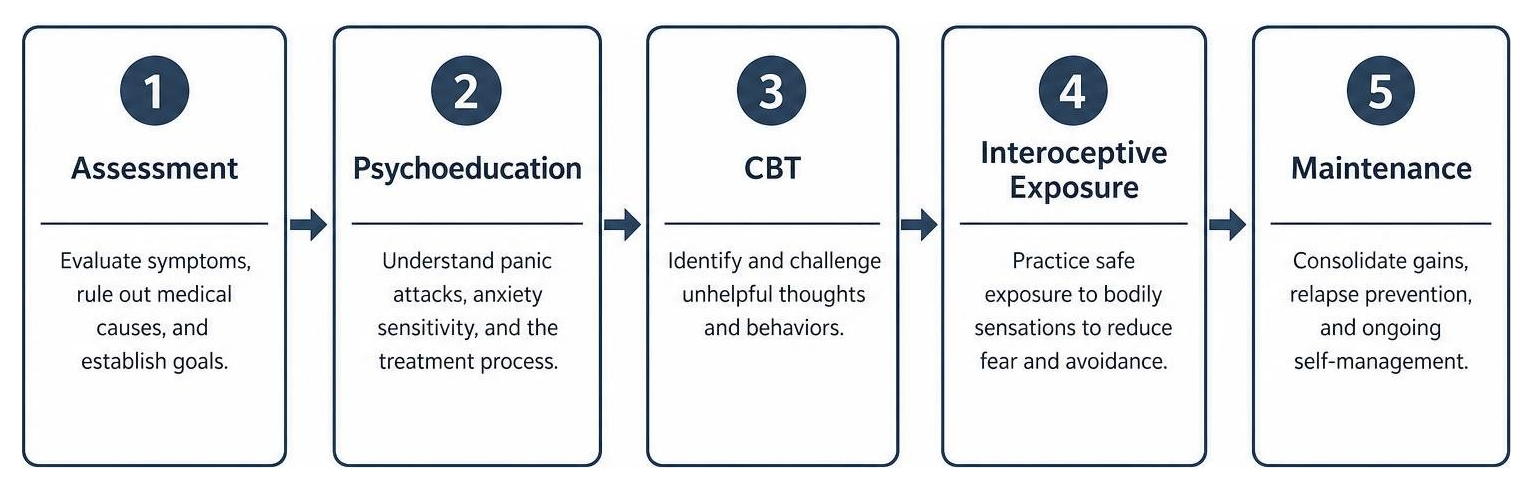
Simply understanding that panic attacks are temporary biological “false alarms” and not life-threatening medical events can significantly lower anticipatory anxiety for many individuals.
Cognitive Behavioral Therapy and Interoceptive Exposure for Panic Disorder Treatment
Cognitive Behavioral Therapy (CBT) is considered the gold-standard psychotherapy for panic disorder. Clinical trials demonstrate that CBT is 70% to 90% effective, with approximately 73% of treated patients remaining panic-free at 3 to 4 months (compared to 27% in control groups). Crucially, 46% remain panic-free two years later without any further intervention.
CBT typically spans 10 to 16 weekly sessions and focuses on two key components:
- Cognitive Restructuring: Learning to identify and challenge catastrophic misinterpretations of bodily sensations.
- Interoceptive Exposure: Systematically exposing patients to feared bodily sensations in a safe, controlled setting.
During interoceptive exposure, a therapist helps you safely recreate physical panic sensations—such as hyperventilating through a straw to mimic shortness of breath, or spinning in a chair to induce dizziness. Repeating these exercises desensitizes the brain’s panic response, teaching your nervous system that these sensations are uncomfortable, but entirely harmless. To explore these methods further, review The Complete Guide to Cognitive Behavioral Therapy.
Combining Somatic Strategies and Psychotherapy in Panic Disorder Treatment
While CBT targets cognitive patterns and conditioned fear, somatic and nervous system regulation tools help manage physical hyperarousal in daily life. Grounding exercises and capnometry biofeedback breathing training teach patients to prevent hyperventilation and maintain healthy carbon dioxide levels during stress.
You can learn more about combining these approaches by reading Stop the Panic with These Somatic Exercises for Anxiety and Anxiety Psychotherapy and CBT Explained Simply.
Pharmacotherapy Options for Panic Disorder
When psychotherapy alone is insufficient, or when panic symptoms are so severe that a person cannot engage in therapy, medication provides a powerful clinical option. According to the APA Practice Guideline for Panic Disorder, choosing between therapy, medication, or a combination should rely on shared decision-making between the patient and provider.
| Feature | Antidepressants (SSRIs / SNRIs) | Benzodiazepines |
|---|---|---|
| Primary Role | First-line long-term treatment | Short-term acute stabilization or bridging |
| Onset of Action | 2 to 4 weeks (full effect at 8 weeks) | Rapid (15 to 60 minutes) |
| Relapse Risk Post-Discontinuation | Moderate | High |
| Dependence / Tolerance Risk | None (though tapering is required) | High risk with prolonged daily use |
| Common Side Effects | Nausea, insomnia, sexual dysfunction, initial jitteriness | Sedation, dizziness, memory impairment, motor incoordination |
First-Line Medications: SSRIs and SNRIs
Selective Serotonin Reuptake Inhibitors (SSRIs) and Serotonin-Norepinephrine Reuptake Inhibitors (SNRIs) are the primary FDA-approved first-line medications for panic disorder treatment. Common choices include:
- Sertraline (Zoloft): Initial target 25 mg/day, gradually increasing to 50–200 mg/day.
- Fluoxetine (Prozac): Starting at 5–10 mg/day, titrating up to 20–60 mg/day.
- Paroxetine (Paxil): Starting at 10 mg/day, moving up to 20–60 mg/day.
- Venlafaxine ER (Effexor XR): Starting at 37.5 mg/day, titrating to 75–225 mg/day.
Because individuals with panic disorder are especially sensitive to medication side effects—and may experience a transient spike in anxiety when starting antidepressants—clinicians start doses at roughly half the amount used for depression and titrate upward slowly. Research shows that 61% of patients become panic-free after 6 to 12 weeks of antidepressant therapy.
Benzodiazepines vs. Antidepressants for Acute and Long-Term Relief
Benzodiazepines like alprazolam, clonazepam, and lorazepam offer rapid relief from severe acute distress. However, major clinical guidelines explicitly advise against using benzodiazepines as a primary long-term panic disorder treatment.
Because benzodiazepines carry risks of physical dependence, tolerance, and cognitive side effects, their best clinical role is as a brief “bridge” medication (e.g., 2 to 4 weeks) while waiting for an SSRI to reach full effect. When prescribed, benzodiazepines should be taken on a fixed schedule rather than PRN (as-needed) to prevent reinforcing the habit of taking a pill every time anxiety surfaces.
Treatment Maintenance, Tapering, and Medication Discontinuation
Once remission is achieved, pharmacotherapy should continue for at least one year to minimize relapse risk. When discontinuing medication, doctors decrease the dosage slowly over several weeks or months. Abrupt stopping can cause discontinuation symptoms and high rates of panic recurrence.
Addressing Treatment Resistance, Comorbidities, and Specialized Care
Panic disorder rarely occurs in isolation. Approximately one in three patients with panic disorder struggles with depression, and one in five attempts suicide. Clinicians evaluate suicide risk independently of co-occurring conditions, as outlined in the UpToDate Panic Disorder Treatment Overview.
Managing Co-Occurring Agoraphobia, Depression, and Substance Use
When panic disorder presents alongside agoraphobia, treatment integrates gradual in-vivo (in-person) exposure therapy to help patients re-enter feared environments like crowded stores or public transit.
If co-occurring depression or substance use is present, dual-diagnosis treatment plans are essential. For individuals with concurrent substance use disorders, non-addictive medication alternatives like gabapentin or mirtazapine are often preferred over standard agents.
Next-Step Strategies for Treatment-Resistant Panic
If a patient shows a minimal response after 6 to 8 weeks of initial therapy, clinicians re-evaluate adherence, hidden medical triggers, and underlying stressors. Next-step strategies include:
- Switching to a different SSRI or SNRI class.
- Augmenting an antidepressant with CBT.
- Using Tricyclic Antidepressants (TCAs) such as imipramine or clomipramine.
- Exploring Panic-Focused Psychodynamic Psychotherapy (PFPP), which explores the emotional and relational conflict triggers underlying panic attacks.
Our Clinical Approach to Panic Disorder Recovery in Pennsylvania
At WPA Counseling, we know how overwhelming recurring panic can be. With years of dedicated clinical experience and a rich local practice history serving communities throughout Western Pennsylvania, our group practice has helped countless individuals overcome anxiety and regain control over their lives. Our team of seasoned licensed professional counselors brings clinical expertise, evidence-based care, and deep roots in the local therapeutic community to every client relationship.

Our practice uses a structured four-stage healing approach called the Counseling Blueprint:
- Take Off the Mask: We establish a safe, non-judgmental space built on genuine trust and rapport.
- Heal the Wounds: We examine the underlying emotional, physical, and relational stressors triggering your nervous system’s fight-or-flight response.
- Remove the Toxins: We help you identify and dismantle catastrophic thoughts, core fears, and unhelpful coping mechanisms.
- Replace with Truth: We help you build empowering self-regulation strategies, healthier cognitive perspectives, and long-term resilience.
Learn more about how we support recovery by visiting our guide on Effective Panic Disorder Therapy in Pennsylvania.
Licensed Counselor Support in Western PA and Telehealth Statewide
Drawing from our local practice history in regional anxiety treatment, our licensed team is here to support you whether you prefer meeting in person or connecting online. We provide comfortable, confidential in-person counseling at our established practice locations in Irwin / North Huntingdon and Penn Hills, serving individuals throughout Western Pennsylvania and the greater Pittsburgh area.
For clients living anywhere else across the Commonwealth, we deliver secure HIPAA-compliant teletherapy backed by our years of remote clinical experience. You can read more about these flexible options through our pages on Online Anxiety Therapy in Pennsylvania and Licensed Anxiety Treatment Pittsburgh and Finding Your Calm in the Steel City.
Frequently Asked Questions About Panic Disorder
How long does panic disorder treatment usually take to work?
CBT typically produces noticeable relief within 8 to 12 weekly sessions. Antidepressant medications usually begin working within 2 to 4 weeks, taking up to 8 weeks to reach full therapeutic effectiveness.
Can panic disorder be cured without medication?
Yes. CBT is highly effective as a standalone treatment, with 70% to 90% of individuals achieving symptom recovery through therapy, interoceptive exposure, and self-regulation techniques alone.
What is the difference between a panic attack and anxiety?
Anxiety is a long-lasting, future-focused state of worry accompanied by mild-to-moderate physical tension. A panic attack is an acute, sudden surge of overwhelming fear and intense physical fight-or-flight symptoms that peaks within minutes.
Conclusion
Living with panic disorder can make your world feel increasingly small, but you do not have to navigate recovery alone. Panic disorder is exceptionally treatable. With evidence-based tools like CBT, interoceptive exposure, somatic grounding, and medication management, complete recovery and long-term peace of mind are well within your reach.
If you are ready to take the first step toward reclaiming your life, explore our dedicated options for anxiety therapy and get matched with a compassionate, licensed counselor at WPA Counseling today.
This article was researched with AI and heavily edited by Stephen Luther for accuracy and relevance.
Stephen Luther is the Executive Director and Founder of WPA Counseling. He holds a Master’s degree in Education from the University of Georgia and a Master’s degree in Marriage and Family Therapy from Duquesne University. He is a licensed professional counselor in Pennsylvania (LPC).
Since 1997, Steve has been helping children, adolescents, adults, couples, and families overcome emotional and relational challenges. He specializes in working with hurting families, including those with foster, adopted, or traumatized children. Steve uses Attachment-Based Therapy, client-centered therapy, and Therapeutic Parent Coaching to support healing and relationship restoration.
This guide is for educational and spiritual encouragement and is not a substitute for personalized professional counseling. If you are in crisis, please reach out for immediate help.
Western PA Anxiety Therapy That Helps You Breathe Easy