
When Your Body Holds the Anxiety Your Mind Can’t Shake
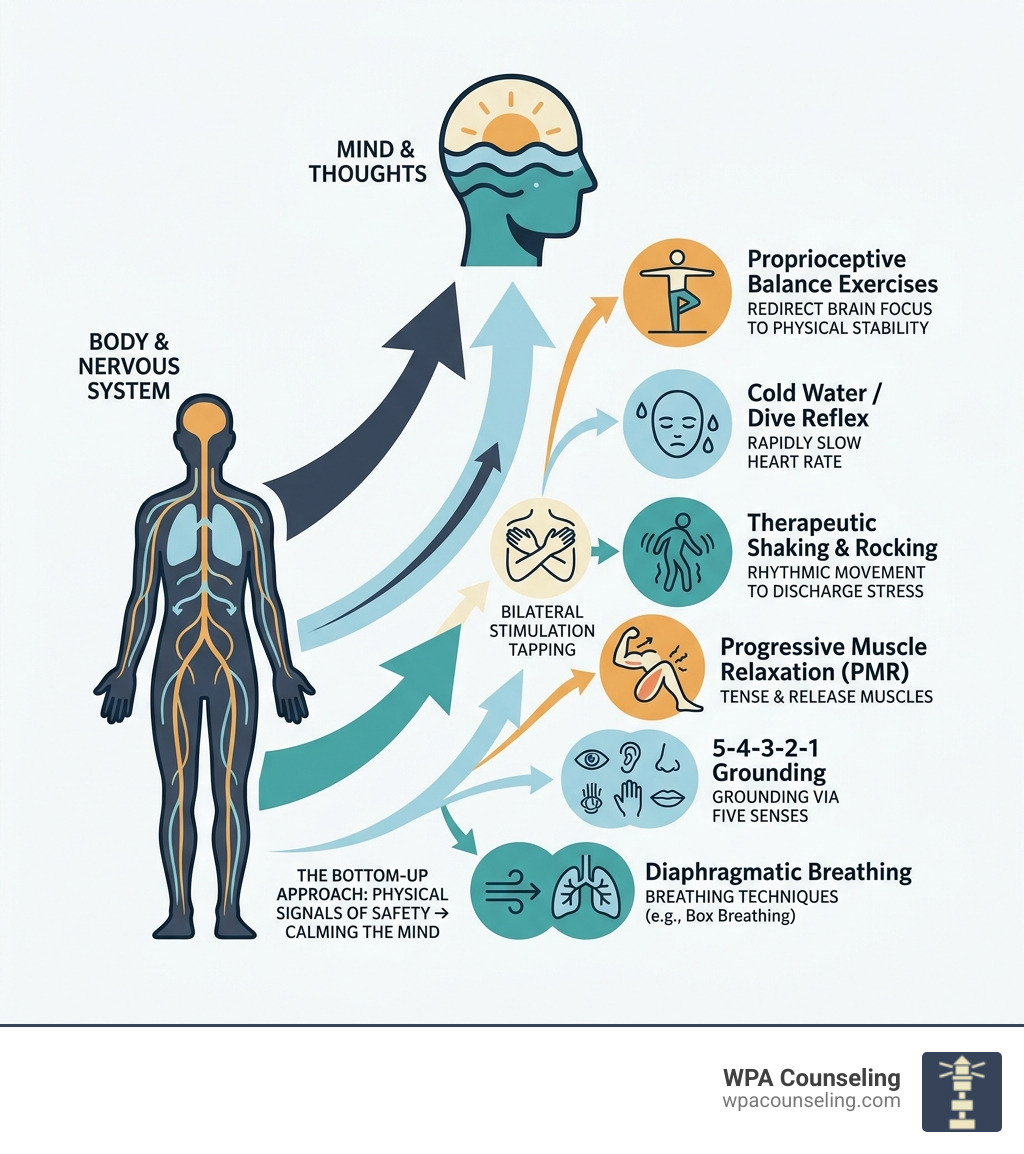
Somatic techniques for anxiety are body-based practices that calm your nervous system by working through physical sensation rather than thought alone. If you’re looking for a quick overview, here are the most effective ones:
- Diaphragmatic breathing (box breathing, 4-7-8, 4-4-6) — slows the stress response in minutes
- 5-4-3-2-1 grounding — anchors you in the present using your five senses
- Progressive muscle relaxation (PMR) — systematically tenses and releases muscle groups to discharge stored tension
- Butterfly hug — cross-arm tapping that uses bilateral stimulation to self-soothe
- Therapeutic shaking and rocking — discharges stress hormones through rhythmic movement
- Body scan and somatic tracking — maps physical sensations without judgment
- Pendulation and titration — safely processes overwhelming feelings in small doses
- Vagus nerve humming — stimulates the parasympathetic nervous system through vocal vibration
- Cold water / dive reflex — rapidly slows heart rate during acute anxiety spikes
- Proprioceptive balance exercises — interrupts rumination by redirecting brain focus to physical stability
Anxiety doesn’t just live in your thoughts. It lives in your tight chest, your clenched jaw, your shallow breath, and your tensed shoulders.
That’s why thinking your way out of it often doesn’t work — and why so many people feel stuck even after years of trying to manage anxiety through willpower or positive thinking alone.
The nervous system doesn’t respond to logic during a threat response. It responds to physical signals of safety.
According to data from the National Institute of Mental Health, nearly 32% of U.S. adults will experience an anxiety disorder at some point in their lives. And research published in the Journal of Clinical Psychology found that somatic interventions can reduce anxiety symptoms by up to 54% when practiced regularly — compared to cognitive approaches alone.
That’s a significant gap. And it points to something important: the body needs to be part of the solution.
Somatic techniques work from the bottom up — starting with the body and moving toward the mind, rather than the other way around. This approach addresses the physiological roots of anxiety that talk-based methods sometimes can’t reach on their own.
Whether you’re in the middle of an anxiety spiral or looking to build long-term resilience, the techniques in this guide are practical, evidence-informed, and many can be done anywhere — at home, at work, or on the go.
Understanding Somatic Therapy vs. Talk Therapy for Anxiety
The word “somatic” comes from the Greek word soma, which means “body.” While traditional talk therapy is often a “top-down” approach—meaning we use our conscious thoughts to try and influence our emotions—somatic therapy is a “bottom-up” approach. It focuses on the internal physical sensations, perceptions, and experiences of the living body.
When we experience anxiety, our sympathetic nervous system kicks into high gear. This is the “fight-or-flight” response. Your heart races, your breathing becomes shallow, and your muscles brace for impact. Talk therapy is wonderful for gaining insight into why you are anxious, but it often struggles to turn off the physical alarm bells once they’ve started ringing.
As we often discuss in our Somatic Therapy vs Talk Therapy guide, the body can sometimes stay stuck in a stress response long after the perceived threat has passed. Somatic techniques address this by speaking the language of the nervous system: sensation.
Comparison: Cognitive vs. Somatic Interventions
| Feature | Talk Therapy (Cognitive) | Somatic Therapy (Body-Based) |
|---|---|---|
| Primary Focus | Thoughts, beliefs, and logic | Physical sensations and the nervous system |
| Direction | Top-down (Brain to Body) | Bottom-up (Body to Brain) |
| Goal | Insight, reframing, and cognitive shifts | Nervous system regulation and tension release |
| Mechanism | Verbalizing and analyzing the past/future | Experiencing the present moment in the body |
Why Somatic Techniques for Anxiety are Effective for Long-Term Relief
Using somatic techniques for anxiety isn’t just about feeling better in the moment; it’s about rewiring your brain. This is called neuroplasticity. By consistently practicing these exercises, you are teaching your nervous system how to return to a state of “ventral vagal” safety—the “rest and digest” mode.
Regular practice improves what we call interoception—the ability to identify and understand the signals your body is sending you. In fact, individuals who practice regular somatic exercises report a 47% improvement in their ability to identify early anxiety signals and intervene effectively before a full-blown panic attack occurs. For our neighbors seeking Anxiety Counseling in Pittsburgh, integrating these body-based tools is often the key to moving from “managing” anxiety to truly healing from it.
The Science of the Stress Response
When your brain perceives stress, it floods your system with cortisol and adrenaline. This isn’t a character flaw; it’s a biological survival mechanism. However, chronic anxiety keeps these levels high, leading to fatigue, brain fog, and physical pain.
Somatic techniques leverage the Vagus nerve—the longest nerve in the autonomic nervous system. By stimulating this nerve through specific movements or breathing patterns, you can bypass the “thinking brain” (which is likely spiraling) and send a direct “all clear” signal to the brainstem. This is why we offer Western PA Anxiety Therapy That Helps You Breathe Easy; we know that once the body feels safe, the mind will naturally follow.
10 Essential Somatic Techniques for Anxiety Relief
If you are currently feeling overwhelmed, don’t feel like you have to master all of these at once. Pick one or two that resonate with you and try them for a few minutes. The goal is immediate relief and tension discharge, helping you regain your footing. For many of our clients in Anxiety Therapy, having a “toolbox” of these techniques provides a sense of agency and control over their symptoms.

1. Breathing Exercises as Somatic Techniques for Anxiety
Breathing is the only part of the autonomic nervous system that we can control consciously. It is the “remote control” for your heart rate and blood pressure.
- Box Breathing: Inhale for 4 counts, hold for 4, exhale for 4, and hold for 4. Repeat 3-6 cycles. This is used by Navy SEALs to stay calm under intense pressure.
- 4-7-8 Technique: Inhale through your nose for 4, hold for 7, and exhale forcefully through your mouth (making a “whoosh” sound) for 8. The long exhale is the secret sauce here—it stimulates the parasympathetic nervous system.
- Diaphragmatic Breathing: Place one hand on your chest and one on your belly. Breathe deeply so that only the hand on your belly moves. This “belly breathing” prevents the shallow chest breathing that often signals “danger” to your brain.
2. The 5-4-3-2-1 Grounding Technique
When anxiety makes you feel “floaty” or trapped in a future-based worry, grounding pulls you back into the present. This technique uses sensory anchors to orient you to your environment.
- 5 things you can see: Look for small details, like the pattern on a rug or a bird outside.
- 4 things you can touch: Feel the texture of your shirt, the coldness of a desk, or the weight of your feet on the floor.
- 3 things you can hear: Listen for the hum of the fridge, distant traffic, or your own breath.
- 2 things you can smell: Maybe it’s the scent of coffee or the fresh air.
- 1 thing you can taste: Focus on the lingering taste of your last meal or even just the inside of your mouth.
3. Progressive Muscle Relaxation (PMR)
Developed by American physician Edmund Jacobson in the 1920s, PMR involves systematically tensing and then releasing different muscle groups. This technique is particularly helpful for people who don’t even realize how much tension they are carrying.
Start at your toes and work your way up to your face. Tense each muscle group as hard as you can for 5 seconds, then release suddenly and feel the “flush” of relaxation for 10 seconds. This physical awareness helps break the cycle of chronic bracing.
4. Self-Soothing Touch and the Butterfly Hug
Touch is a powerful regulator. Self-soothing touch can trigger the release of oxytocin, the “bonding hormone,” which naturally lowers cortisol.
- The Butterfly Hug: Cross your arms over your chest so that your hands rest on your opposite upper arms or shoulders. Alternate tapping your hands rhythmically, like the wings of a butterfly. This provides bilateral stimulation, which helps integrate the two hemispheres of the brain and creates a felt sense of internal safety.
- Self-Holding: Place one hand on your heart and the other on your belly. Apply gentle, firm pressure. This simple act tells your nervous system, “I am here, and I am safe.”
5. Therapeutic Shaking and Rhythmic Movement
Have you ever seen a dog shake itself off after a stressful encounter? They are discharging the excess energy from the “fight-or-flight” response. Humans often suppress this instinct, which causes stress to stay “stuck” in our muscles.
- Therapeutic Shaking: Stand with your feet hip-width apart and simply start bouncing or shaking your hands and limbs. Do this for 2-3 minutes to “shake off” the day’s tension.
- Rocking: Gently swaying from side to side or front to back is an instinctive way we regulate ourselves (think of a mother rocking a baby). It mimics the natural rhythms of the body and provides a settling effect for the nervous system.
6. Body Scanning and Somatic Tracking
Body scanning involves a mental “walkthrough” of your physical state. Instead of trying to change how you feel, you simply observe. This is part of Understanding Anxiety Counseling Pennsylvania, where we learn to meet our sensations with curiosity rather than fear.
Map your sensations: “I feel a tightness in my chest,” or “My jaw feels heavy.” By naming the sensation without judgment, you move from being the anxiety to observing the anxiety. This creates the “space” needed for the sensation to eventually pass.
7. Pendulation and Titration
These concepts were developed by Dr. Peter Levine, the founder of Somatic Experiencing.
- Pendulation: This is the practice of swinging your attention between a place of tension (the “trauma vortex”) and a place of relative calm or neutrality in the body (the “healing vortex”). For example, if your stomach feels knotted, notice that, then shift your focus to your big toe, which likely feels fine. This teaches your brain that the “bad” feeling isn’t the only thing happening.
- Titration: This means experiencing a difficult sensation in very small, manageable doses. Instead of diving into a panic attack, we “sip” the sensation, keeping it within your window of tolerance so you don’t become overwhelmed.
8. Vagus Nerve Stimulation through Vocal Toning
The Vagus nerve passes right by the vocal cords and through the throat. You can stimulate it physically through vibration.
- Humming or Chanting: Try taking a deep breath and humming a low note as you exhale. Feel the vibration in your chest and throat. This “vocal toning” is a direct line to the parasympathetic nervous system. It’s a great, covert way to calm down during a stressful drive through Pittsburgh traffic!
9. Temperature Regulation and the Dive Reflex
If you are in a state of acute crisis or a panic attack, you need a “hard reset.”
- Cold Water Exposure: Splash ice-cold water on your face or hold an ice pack to your chest/eyes for 30-60 seconds. This triggers the “mammalian dive reflex,” which automatically slows the heart rate and redirects blood to the brain and heart. It is one of the fastest ways to break a high-anxiety loop.
10. Proprioceptive Balance Exercises
Anxiety often involves “rumination”—thinking the same stressful thoughts over and over. You can interrupt this by forcing your brain to focus on physical stability.
- Tree Pose: Stand on one leg. This engages your proprioceptors (the sensors that tell your brain where your body is in space). Your brain cannot easily obsess over an email while it is working hard to keep you from falling over. This redirection of focus is a simple but brilliant way to snap out of a mental spiral.
Integrating Somatic Techniques for Anxiety into Your Daily Routine
The most effective way to use these tools is through “habit stacking”—attaching a somatic practice to something you already do. For instance, do 30 seconds of therapeutic shaking while your morning coffee brews, or practice box breathing every time you sit down at your desk.
For those dealing with High-Functioning Anxiety, you might feel like you don’t have time for “self-care.” But remember: somatic practices are often just 2-5 minutes long. Consistency is more important than duration. Practicing daily, even when you aren’t anxious, builds the “muscle memory” your nervous system needs to stay regulated.
Creating a Felt Sense of Safety
The goal of somatic work is to expand your “window of tolerance.” This is the zone where you can handle stress without flipping into a panic or shutting down. By teaching your body that it is safe, you build resilience. Don’t Let Anxiety Hold You Back from living your life—start by reclaiming the safety within your own skin.
Somatic Practices for the Workplace
You don’t need a yoga mat to practice somatics. Many techniques are “covert” and can be done during a meeting or at your cubicle:
- The Physiological Sigh: Two quick inhales through the nose followed by a long exhale through the mouth.
- Seated Grounding: Press your feet firmly into the floor and feel the weight of your body in the chair.
- Hand Squeezes: Subtly squeeze your own hands or arms to feel your physical boundaries.
If you’re working remotely and need extra support, Online Anxiety Therapy in Pennsylvania can help you integrate these practices into your specific work-from-home environment.
Professional Somatic Support at WPA Counseling
While self-practice is incredibly valuable, sometimes anxiety is rooted in deeper trauma or chronic patterns that require a guided approach. At WPA Counseling, we specialize in helping Pennsylvanians navigate these waters with expert, compassionate care.
Our Clinical Experience and Local Practice History in Pennsylvania
WPA Counseling is a premier group practice of licensed professional counselors with deep roots in Irwin, Pennsylvania. For years, our clinicians have provided specialized mental health services to the communities of Western and Central PA, including Pittsburgh, North Huntingdon, and Westmoreland County. Our practice was founded on the principle that effective therapy must address the whole person, combining clinical expertise with a profound understanding of the local culture and the unique stressors facing our neighbors in the Steel City and surrounding suburban areas.
Our team brings decades of collective clinical experience in treating complex anxiety and trauma through evidence-based, counseling-focused strategies. We are specifically trained in body-based modalities because our clinical observations consistently show that traditional talk therapy is often more effective when paired with somatic regulation. We prioritize building a strong rapport with our clients; we know that your nervous system won’t feel safe enough to do this work unless you feel truly seen and supported by a therapist who understands your environment and your history.
The WPA Counseling Four-Stage Healing Process
We use a structured, thoughtful approach to ensure your healing is sustainable:
- Rapport Building and Safety: We start by creating a secure environment where you feel safe to explore your inner world.
- Wound Exploration through Somatic Awareness: We help you identify where anxiety “lives” in your body and what it is trying to tell you.
- Toxin Removal: This is the stage where we use somatic techniques to release stored stress, trauma, and “toxic” emotional patterns that have been held in the fascia and muscles.
- Truth Restoration and Emotional Resilience: Finally, we work to restore your sense of self and build the resilience needed to face future challenges with calm.
If you’re ready to find your center, we offer Licensed Anxiety Treatment Pittsburgh and Finding Your Calm in the Steel City.
Frequently Asked Questions about Somatic Techniques
How quickly do somatic exercises work for acute anxiety?
Most people notice a physiological shift within 2 to 5 minutes. Techniques like the “physiological sigh” or cold water exposure can work in as little as 30-60 seconds.
Can I practice somatic techniques for anxiety without a therapist?
Absolutely. Most of the techniques listed here—like 5-4-3-2-1 grounding and box breathing—are designed for self-regulation. However, if your anxiety is tied to severe trauma or you find that exercises “trigger” you or cause emotional flooding, it is best to work with a professional.
Are somatic techniques evidence-based?
Yes. Research from 2022 and 2023 shows that somatic interventions can reduce symptoms by over 50%. These practices are increasingly recognized by organizations like the National Institute of Mental Health (NIMH) for their effectiveness in treating the “full-body” phenomenon of anxiety.
Conclusion
Healing from anxiety is not just about changing your thoughts; it’s about coming home to your body. By integrating somatic techniques for anxiety into your life, you are moving toward a state of mind-body harmony that is sustainable and resilient.
Whether you are practicing a butterfly hug in your living room in Irwin or using a physiological sigh before a big presentation in downtown Pittsburgh, your body has an incredible, innate ability to heal—it just needs the right signals.
If you’d like to learn more or work with a counselor who understands the power of the mind-body connection, you can find more info about somatic therapy services on our website. You don’t have to carry this weight alone; we are here to help you breathe easy again.
Stephen Luther is the Executive Director and Founder of WPA Counseling. He holds a Master’s degree in Education from the University of Georgia and a Master’s degree in Marriage and Family Therapy from Duquesne University. He is a licensed professional counselor in Pennsylvania (LPC).
Since 1997, Steve has been helping children, adolescents, adults, couples, and families overcome emotional and relational challenges. He specializes in working with hurting families, including those with foster, adopted, or traumatized children. Steve uses Attachment-Based Therapy, client-centered therapy, and Therapeutic Parent Coaching to support healing and relationship restoration.
This guide is for educational and spiritual encouragement and is not a substitute for personalized professional counseling. If you are in crisis, please reach out for immediate help.