
Childhood Trauma Therapy for Adults Can Help You Heal
Childhood trauma therapy for adults can help you understand how early experiences may still shape your emotions, relationships, body, and sense of self – and help you build safer, healthier patterns now.
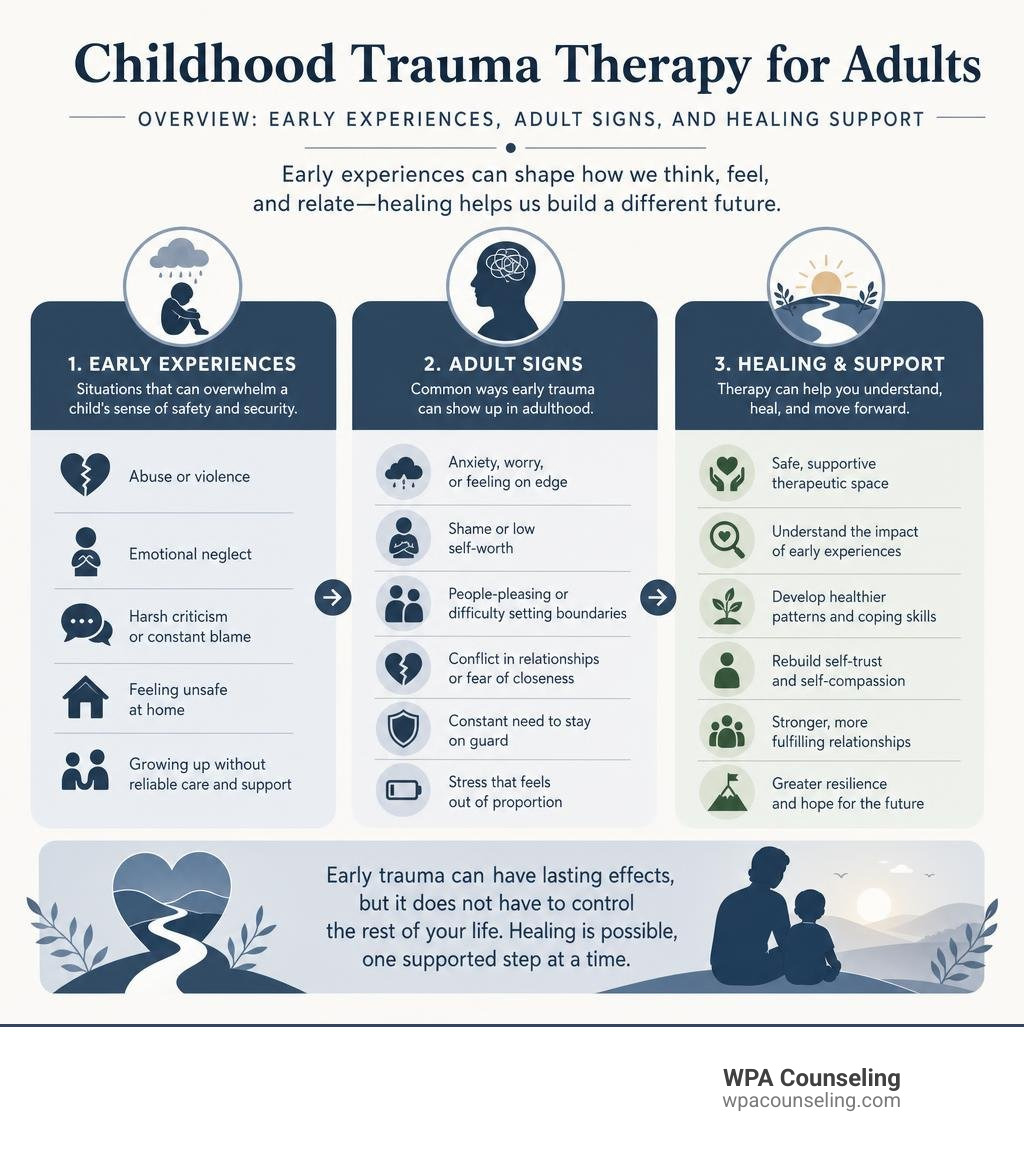
Childhood trauma is not limited to one clearly dramatic event. It can include abuse, violence, loss, or accidents. It can also include ongoing emotional neglect, harsh criticism, feeling unsafe at home, or growing up without reliable care and support.
You do not need to have every memory clear, or have a PTSD diagnosis, to deserve help. Many adults first notice the impact through anxiety, shame, people-pleasing, conflict in relationships, stress that feels out of proportion, or a constant need to stay on guard. Still sorting out whether past experiences are behind what you notice now? Start with our guide to how childhood trauma can show up in adult life.
At WPA Counseling, we provide trauma therapy and individual counseling in person in Western Pennsylvania, with offices in Irwin/North Huntingdon and Penn Hills. We also offer secure telehealth across Pennsylvania. Our licensed professional counselors offer a safe, steady space to explore what happened and what you need to move forward.
The good news: early trauma can have lasting effects, but it does not have to control the rest of your life. Healing is possible, one supported step at a time.
Understanding Childhood Trauma and Its Long-Term Impact
Childhood trauma happens when a young person experiences events or environments that overwhelm their ability to cope, process, or feel safe. Research shows that trauma exposure is exceptionally common: at least two out of every three persons worldwide experience a traumatic event in their life, and national studies in the United States show lifetime exposure rates reaching up to 90%. Furthermore, around 70% of U.S. adults report experiencing at least one traumatic event, with approximately 6% developing Post-Traumatic Stress Disorder (PTSD).
When we talk about childhood trauma, it helps to understand two distinct forms:
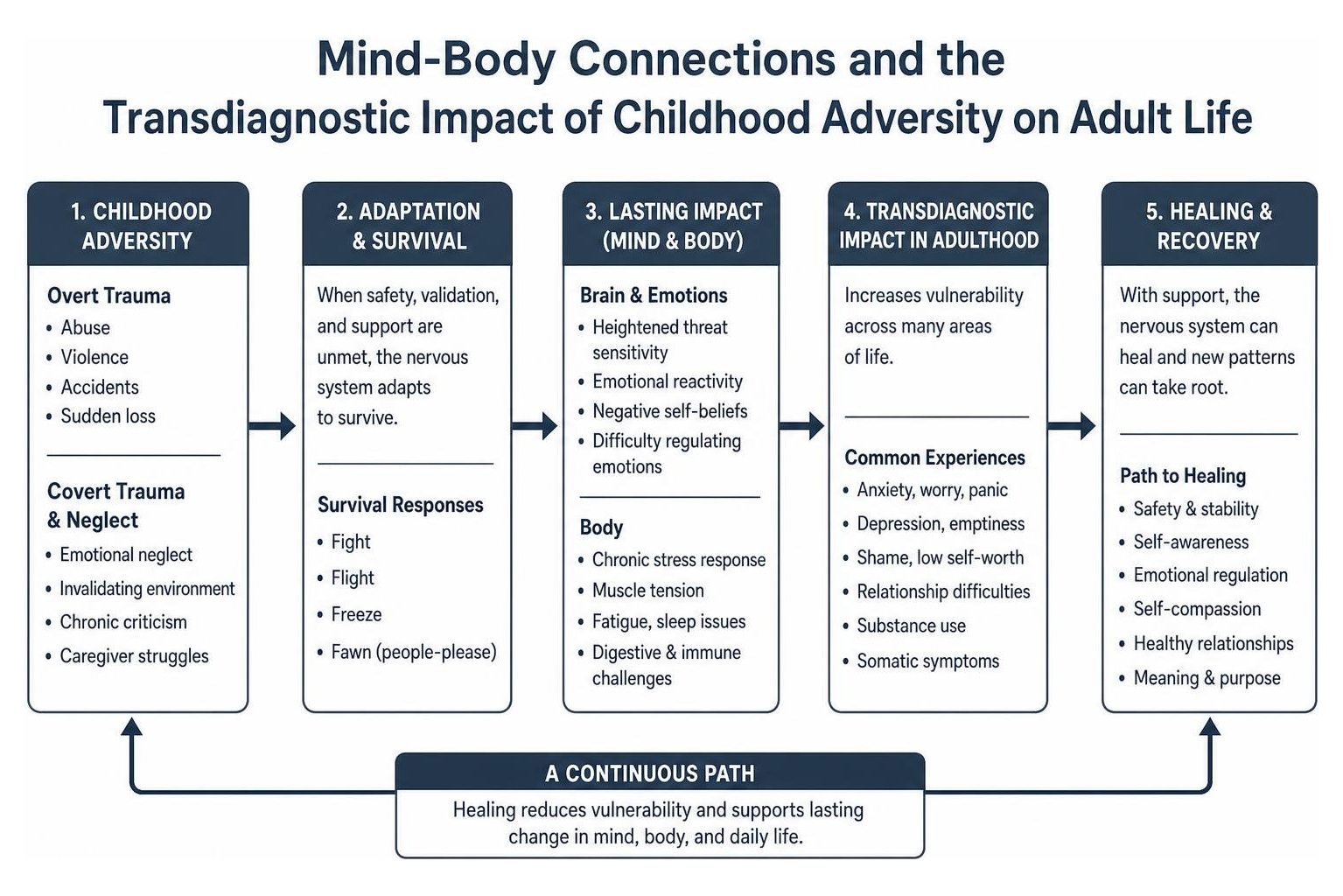
- Overt Trauma: Direct, distinct, or violent events, such as physical abuse, sexual abuse, domestic violence, living through a severe accident, or experiencing a sudden, tragic loss.
- Covert Trauma and Neglect: Chronic, subtle, or systemic experiences, such as emotional neglect, severe misattunement from primary caregivers, constant emotional invalidation, exposure to intense parental conflict, or growing up with a caregiver dealing with unmanaged addiction or mental illness.
While overt trauma is easily recognized, covert trauma can be equally damaging. When a child’s fundamental need for safety, validation, and attunement goes unmet, their nervous system adapts to survive. Over time, these survival adaptations follow us into adult life.
The landmark Adverse Childhood Experiences (ACE) study, which evaluated over 9,500 adults, demonstrated that as the number of childhood traumatic events increases, so does the risk for major adult health challenges, mental health struggles, and chronic medical conditions. You can read more about how early adversity impacts ongoing well-being in the ACE study research on health risks. Childhood adversity acts as a transdiagnostic factor, meaning unresolved early stress creates a broad vulnerability for anxiety, depression, substance misuse, and somatic physical distress throughout adulthood.
Recognizing Signs of Unresolved Childhood Trauma in Adults
Many adults carry the lingering weight of childhood trauma without realizing that their daily struggles are linked to early experiences. Because children rely on their caregivers for emotional regulation and survival, unaddressed early stress wires the adult brain to remain on perpetual high alert.
Common signs that unresolved early trauma may be affecting your present life include:
- Persistent Hypervigilance: Feeling constantly on edge, waiting for the “other shoe to drop,” or scanning room environments and people’s facial expressions for subtle signs of anger or rejection.
- Emotional Dysregulation: Experiencing intense mood swings, sudden outbursts of anger, or deep emotional shutdown (numbing) in response to minor everyday stressors.
- Relational Distress and Attachment Insecurity: Struggling to trust partners, fearing abandonment, over-explaining yourself, feeling compelled to please others at your own expense, or pushing people away when intimacy grows close.
- Chronic Shame and Inner Criticism: Holding an unspoken, deep-seated belief that you are fundamentally broken, flawed, or unworthy of love, often voiced by a harsh internal critic.
- Somatic and Physical Symptoms: Living with unexplainable chronic pain, gastrointestinal issues, tension headaches, or autoimmune flares that medical tests cannot fully explain.
If these patterns sound familiar, our guide on Understanding Childhood Trauma: A Guide for Healing and Growth offers deeper insight into how early emotional wounds manifest in day-to-day adult life.
Acute PTSD vs. Complex PTSD Stemming from Early Trauma
To understand effective childhood trauma therapy for adults, it is essential to distinguish between single-incident acute trauma and complex developmental trauma.
- Acute PTSD: Typically stems from a discrete, single-incident traumatic event occurring in adulthood or childhood (such as a car accident, a natural disaster, or a single physical assault). Symptoms center primarily on intrusive memories, nightmares, hyperarousal, and clear avoidance of trauma-related triggers.
- Complex PTSD (CPTSD): Results from chronic, repeated, or prolonged exposure to traumatic events, particularly within interpersonal, caretaking relationships during critical developmental stages. CPTSD includes the core symptoms of traditional PTSD alongside severe Disturbances in Self-Organization (DSO).
These Disturbances in Self-Organization manifest across three core areas:
- Affect Dysregulation: Severe difficulty calming down when upset, chronic emotional numbing, or intense distress reactivity.
- Negative Self-Concept: Deep feelings of worthlessness, persistent shame, and feeling permanently marked or defeated by past events.
- Relational Disturbances: Persistent difficulties maintaining meaningful closeness, feeling perpetually detached from others, or repeatedly experiencing relational friction.
As outlined in the APA Guidelines for Complex Trauma, treating complex trauma requires moving beyond simple symptom checklists to an integrative, person-centered approach that honors how deep attachment wounds impact full identity development.
Evidence-Based Approaches to Childhood Trauma Therapy for Adults

Healing early trauma requires structured, compassionate, and evidence-supported counseling approaches. Traditional “talk therapy” alone can sometimes leave trauma survivors feeling stuck, as early traumatic memories are often stored in sensory, implicit, and somatic parts of the brain that logic and talking cannot easily reach.
Effective adult trauma therapy combines cognitive reprocessing, emotional regulation, body awareness (somatic work), and relational healing. Recent clinical trials published in Research on Psychodynamic and CBT Outcomes demonstrate that both Cognitive Behavioral Therapy (CBT) and Short-Term Psychodynamic Psychotherapy (STPP) offer significant, comparable benefits for adults with depression stemming from childhood emotional abuse and neglect.
| Therapy Modality | Core Focus & Mechanism | Primary Benefits for Childhood Trauma |
|---|---|---|
| EMDR (Eye Movement Desensitization & Reprocessing) | Uses bilateral stimulation (eye movements or tapping) to reprocess trapped sensory memories without requiring detailed verbal storytelling. | Reduces emotional reactivity, shifts negative core beliefs, and integrates stored implicit memories. |
| Cognitive Behavioral Therapy (CBT) & CPT | Examines and restructures distorted beliefs (“stuck points”) regarding safety, control, trust, and self-worth. | Helps reframe persistent toxic shame and unhelpful automatic thoughts. |
| Internal Family Systems (IFS) | Explores the internal system of “parts” (Managers, Firefighters, Exiles) led by an undamaged core Self. | Reduces internal self-conflict, restores internal harmony, and gently unburdens exiled emotional pain. |
| AEDP (Accelerated Experiential Dynamic Psychotherapy) | Relational, emotion-focused modality that undoes emotional aloneness through real-time therapeutic attunement. | Transforms overwhelming affect into regulated, adaptive emotions within a safe therapeutic relationship. |
| STAIR Protocol (Skills Training in Affect & Interpersonal Regulation) | Two-phase approach combining practical emotional skill-building with modified exposure or schema work. | Establishes distress tolerance and relational safety before processing painful memories. |
EMDR Childhood Trauma Therapy for Adults
Eye Movement Desensitization and Reprocessing (EMDR) is one of the most widely researched and effective treatments for trauma. Developed in the late 1980s, EMDR is a structured eight-phase psychotherapy model designed to help the brain naturally process locked or improperly stored memories.
During childhood trauma, the brain’s natural processing mechanisms can become overwhelmed by intense fear or stress hormones. As a result, memories get stored in “raw,” isolated networks, complete with the original sights, sounds, physical sensations, and negative beliefs (“I am unsafe,” “It was my fault”) experienced at the time.
EMDR utilizes bilateral stimulation—typically side-to-side eye movements, auditory tones, or tactile tappers—to activate both hemispheres of the brain while holding a trauma memory lightly in mind. This dual-attention mechanism helps the brain reprocess the memory so it can be moved into long-term adaptive memory storage.
Key advantages of EMDR for childhood trauma include:
- No Need for Extensive Verbal Recounting: You do not have to describe every painful detail of past abuse out loud to process it successfully.
- Targeting Present Triggers: EMDR connects present-day emotional overreactions (such as panic over standard supervisor feedback) directly to the early childhood root memory where that fear was learned.
- Restoring Adaptive Beliefs: Shifts negative self-beliefs (“I am powerlessly trapped”) into positive, realistic truths (“I am an adult now, and I have choices”).
To explore how EMDR fits into a comprehensive counseling plan, check out our A-Z Guide to Trauma Therapy.
Relational and Phased Modalities in Childhood Trauma Therapy for Adults
Because complex childhood trauma occurs within caretaking relationships, the therapeutic relationship itself serves as a crucial engine for healing. Modalities like Accelerated Experiential Dynamic Psychotherapy (AEDP) stress that undoing emotional aloneness in the presence of a caring, attuned counselor allows deep emotional wounds to process safely.
Furthermore, leading clinical practice guidelines emphasize that complex trauma treatment should be sequenced or phased to prevent clients from becoming overwhelmed. Healing typically follows three structured stages:

- Phase 1: Safety, Stabilization, and Skill-Building: Focuses on establishing internal distress tolerance, nervous system regulation, grounding techniques, and mutual trust within the therapeutic alliance.
- Phase 2: Processing Trauma Memories: Gently approaches, reprocesses, and integrates painful childhood memories using trauma-focused modalities like EMDR, IFS, or modified exposure protocols.
- Phase 3: Integration and Reconnection: Focuses on consolidating progress, building healthy adult relationships, pursuing personal passions, and establishing a vibrant, present-focused identity.
To learn more about how these stages unfold in practice, read our guide to the stages of trauma recovery.
How to Choose a Qualified Therapist and Navigate the Stages of Healing

Selecting the right counselor is one of the most empowering steps in your recovery journey. Because working through early childhood trauma requires vulnerability, finding a practitioner who is specialized in complex trauma, trauma-informed, and a good personal fit is vital.
When looking for a counselor, ensure they hold an active state license (such as an LPC or LCSW) and possess advanced training in trauma-specific modalities like EMDR, CBT, DBT, or relational trauma approaches. You can read our detailed guide on How to Find the Right Therapist for Trauma in Pennsylvania for step-by-step matching advice.
At WPA Counseling, we use our Counseling Blueprint to help guide your journey:
- Take Off the Mask: Creating a safe, non-judgmental environment where you can drop survival defense mechanisms and be authentically seen.
- Heal the Wounds: Utilizing evidence-based trauma modalities to approach and gently resolve old emotional pain.
- Remove the Toxins: Identifying and releasing destructive patterns, toxic shame, and unhelpful relational habits.
- Replace with Truth: Establishing adaptive core beliefs, self-compassion, and grounded personal identity.
Questions to Ask a Potential Trauma Therapist
During an initial consultation or intake session, asking prospective therapists targeted questions can help you determine if their approach matches your unique needs:
- What formal training and clinical experience do you have in treating complex childhood trauma and CPTSD?
- Are you certified in specialized trauma protocols such as EMDR, CBT, or DBT?
- How do you structure treatment? Do you utilize a phased model that prioritizes safety and nervous system stabilization before memory processing?
- How do you adapt therapy if I feel overwhelmed, emotionally dysregulated, or dissociated during a session?
- What is your experience helping adults navigate attachment wounds, relational boundary challenges, and chronic shame?
Professional Trauma Counseling Services in Pennsylvania
At WPA Counseling, we understand that seeking help for childhood trauma takes immense courage. WPA Counseling is a group practice of licensed professional counselors based in Irwin/North Huntingdon and Penn Hills, Pennsylvania, providing in-person counseling in Western PA and secure telehealth across all of Pennsylvania.
Our Clinical Experience and Local Practice History
With years of clinical experience serving individuals and families across Western Pennsylvania, our professional background is rooted in compassionate, trauma-informed care. Our team of licensed PA counselors brings deep clinical expertise in helping adults navigate complex developmental trauma, emotional adversity, and relational healing. Throughout our history of practice in our Irwin/North Huntingdon and Penn Hills offices, we have provided structured, evidence-based support utilizing Cognitive Behavioral Therapy (CBT), Dialectical Behavior Therapy (DBT), attachment-based therapy, and trauma-informed strategies to foster long-term recovery.
Our experienced clinical team offers specialized care tailored to your unique goals. Whether you are dealing with unresolved childhood wounds, acute stress, or daily emotional hurdles, our comprehensive range of services includes:
- Individual Counseling & Trauma Therapy: Specialized care using evidence-based tools (including CBT, DBT, attachment-focused therapy, and trauma-informed care) to help you heal early wounds.
- Anxiety Therapy & Depression Counseling: Targeted support to ease chronic worry, panic, low mood, and emotional burnout.
- Couples Counseling & Family Counseling: Restoring communication, healing attachment wounds, and strengthening trust in meaningful relationships.
- Grief Support & Stress Management: Helping you navigate complex life transitions, loss, and overwhelm with practical coping tools.
- Faith-Sensitive Counseling: Respectful, value-aligned support for clients who wish to integrate their spiritual foundation into their psychological healing journey.
If you are ready to begin processing past burdens in a safe, supportive setting, explore our Trauma Therapy in Pittsburgh: Start Your Healing Today resources or connect directly with our team.
Frequently Asked Questions About Childhood Trauma Therapy for Adults
Can childhood trauma be fully healed in adulthood?
Yes. Thanks to neuroplasticity—the brain’s lifelong capability to re-wire itself and build new neural pathways—adults can achieve profound healing from early trauma. While therapy may not erase past history, childhood trauma therapy for adults strips past events of their overwhelming emotional charge. You can learn to respond to current life with calm authority rather than historical fear, developing healthy relationships and strong self-worth. Learn more in our article on Healing the Brain from Emotional Trauma One Step at a Time.
Do I have to talk in detail about my past abuse during therapy?
No. Modern trauma counseling does not require you to share graphic or detailed verbal descriptions of past abuse if doing so feels overwhelming. Approaches like EMDR, somatic regulation techniques, and parts-work modalities allow your brain and body to reprocess traumatic stress without force or re-traumatization. Your counselor will always work at your pace.
How long does childhood trauma therapy usually take for adults?
There is no universal timeline for trauma recovery. While targeted therapies for single-incident trauma might take several months, healing complex childhood trauma and deep attachment wounds typically unfolds over a longer timeframe—often ranging from six months to a year or more. Recovery is a personal journey focused on building lasting stability, self-compassion, and practical life balance.
Conclusion
Carrying unresolved childhood trauma into adulthood can feel isolating, exhausting, and overwhelming. Yet, the survival strategies that kept you safe as a child do not have to limit the rest of your life. Through structured, evidence-based childhood trauma therapy for adults, you can process early pain, break free from chronic shame, and reclaim a deep sense of peace and personal strength.
At WPA Counseling, our team of licensed professional counselors is here to walk alongside you in Western PA at our Irwin/North Huntingdon and Penn Hills offices, or anywhere in the state via secure telehealth. You do not have to carry the past by yourself any longer.
If you are ready to take the next step toward emotional freedom, visit our Pennsylvania Trauma Counseling page today to get matched with a supportive counselor who fits your goals. Healing is within your reach—one steady step at a time.
Stephen Luther is the Executive Director and Founder of WPA Counseling. He holds a Master’s degree in Education from the University of Georgia and a Master’s degree in Marriage and Family Therapy from Duquesne University. He is a licensed professional counselor in Pennsylvania (LPC).
Since 1997, Steve has been helping children, adolescents, adults, couples, and families overcome emotional and relational challenges. He specializes in working with hurting families, including those with foster, adopted, or traumatized children. Steve uses Attachment-Based Therapy, client-centered therapy, and Therapeutic Parent Coaching to support healing and relationship restoration.
This guide is for educational and spiritual encouragement and is not a substitute for personalized professional counseling. If you are in crisis, please reach out for immediate help.