

What Are the Judith Herman Stages of Trauma Recovery?
The judith herman stages of trauma recovery describe a three-stage framework for healing from trauma, introduced by Dr. Judith Herman in her landmark 1992 book Trauma and Recovery. The model gives both survivors and therapists a clear roadmap for moving through healing safely.
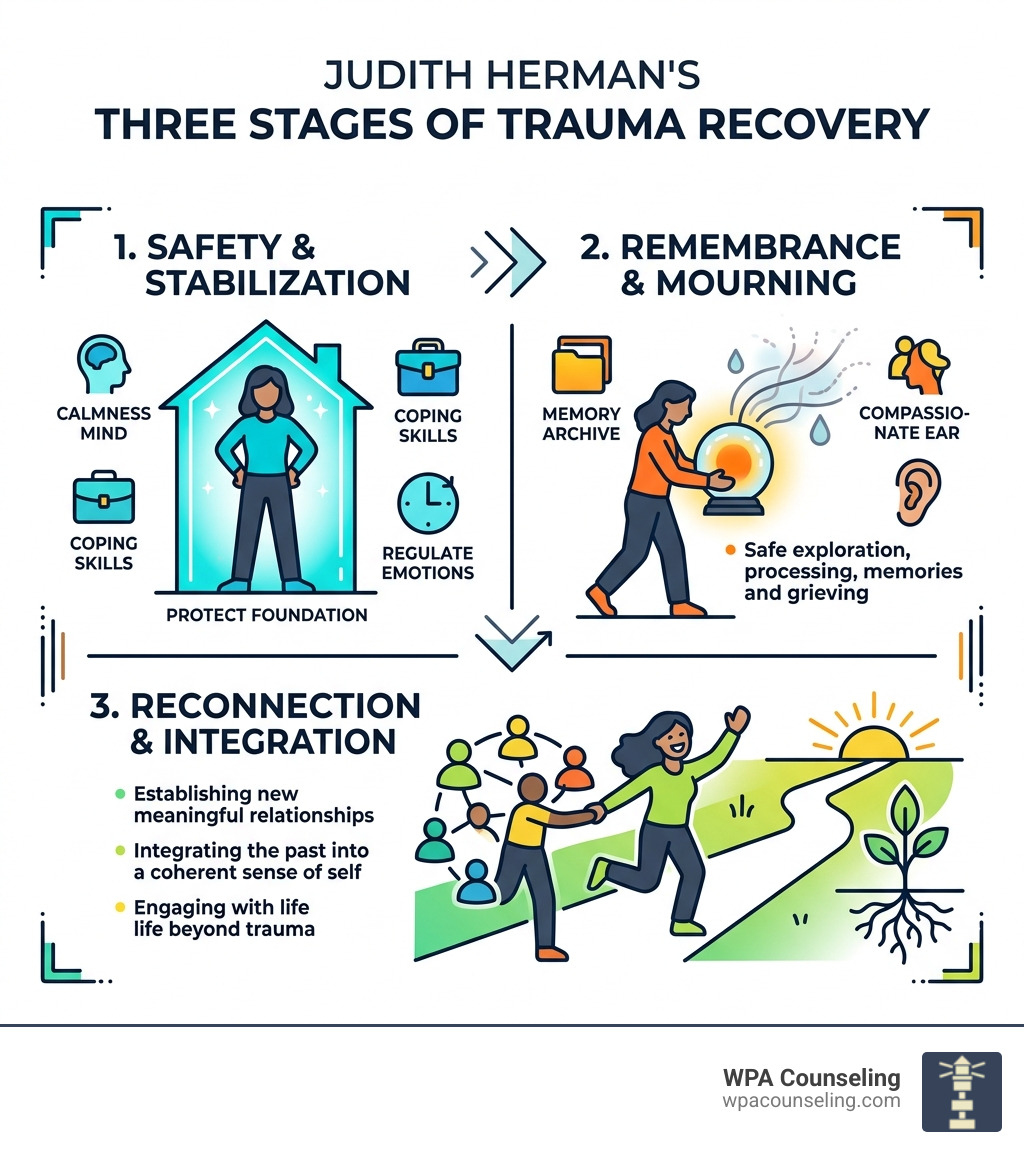
The three stages are:
- Safety and Stabilization – Building physical and emotional safety, learning to regulate emotions, and developing coping skills before processing traumatic memories
- Remembrance and Mourning – Revisiting and processing traumatic memories at a safe pace, grieving losses, and reducing the emotional intensity of what happened
- Reconnection and Integration – Rebuilding a sense of self, restoring meaningful relationships, and re-engaging with life beyond the trauma
These stages are not rigid steps. Recovery moves forward and backward between them – that’s completely normal.
Herman’s foundational insight was simple but powerful: trauma destroys two things above all else – a person’s sense of power and their connection to others. That means healing must restore both.
Her model has shaped trauma-informed care for over three decades, and it remains one of the most widely used frameworks in therapy today – including at practices like WPA Counseling, where licensed counselors in Western Pennsylvania use it to guide clients through trauma recovery with compassion and structure. With a deep history of clinical experience in the region, our practice is dedicated to providing expert, local care for those on the path to healing.
Recovery can take place only within the context of relationships – it cannot occur in isolation. — Judith Herman, Recovery from Psychological Trauma
Whether you’re a survivor trying to understand your own healing, or someone supporting a loved one, this guide breaks down each stage clearly – including what to expect, what helps, and what to watch out for.
Understanding the Judith Herman Stages of Trauma Recovery
To understand why the judith herman stages of trauma recovery are so revolutionary, we have to look at the landscape of mental health when her work was first published. Before Herman, many clinicians treated trauma as a series of “events” to be talked through. Herman argued that trauma is more than just a bad memory; it is a fundamental disruption of the self.
In Trauma and Recovery, Judith Herman explains that trauma often leaves people feeling powerless and cut off from others. Because of that, healing is not just about reducing symptoms. It is about rebuilding empowerment and connection. As Herman writes, the survivor must become the “author and arbiter of her own recovery.”
Herman was also a pioneer in identifying Complex PTSD (C-PTSD). While standard PTSD often results from a single “shock” trauma (Type I), C-PTSD stems from “strain” traumas (Type II)—prolonged, repeated experiences of chronic captivity or control, such as long-term domestic violence or childhood abuse. These experiences don’t just leave memories; they alter the personality and the nervous system.
At WPA Counseling, we use this model as a recovery roadmap. Whether we are meeting a client for Trauma Therapy in Pittsburgh or via telehealth across Pennsylvania, we prioritize this staged approach to ensure the healing process is manageable.
Simple PTSD vs. Complex PTSD: A Quick Comparison
| Feature | Simple PTSD (Type I) | Complex PTSD (Type II) |
|---|---|---|
| Cause | Single, discrete event (e.g., car accident) | Prolonged, repeated trauma (e.g., childhood neglect) |
| Core Experience | Fear and helplessness regarding the event | Disempowerment, captivity, and loss of identity |
| Self-Perception | Often remains intact but shaken | Frequently characterized by deep shame and guilt |
| Relationship Impact | May cause temporary withdrawal | Often leads to chronic distrust or “re-enactment” patterns |
By April 2026 standards, this distinction remains critical for Understanding Trauma Therapy: A Path to Healing, as it dictates how slowly we must move through the stages.
Stage 1: Safety and Stabilization
Stage 1 is the most important part of the judith herman stages of trauma recovery. We often tell our clients in Irwin and Pittsburgh that you can’t renovate a house while the foundation is still shaking.
The goal of Stage 1 is to establish bodily integrity and environmental safety. This means managing the “here and now” before we ever look at the “back then.” If a client is currently in an abusive relationship, struggling with active substance abuse, or engaging in self-harm, those crises must be addressed first.
Key tasks in Stage 1 include:
- Emotion Regulation: Learning skills to manage overwhelming feelings without shutting down or exploding.
- Self-Soothing: Developing a “toolbox” of grounding techniques to stay present.
- Psycho-education: Understanding how the nervous system responds to threat (fight, flight, freeze).
- Boundary Setting: Learning how to say “no” and protecting one’s physical and emotional space.

At WPA Counseling we often utilize Dialectical Behavior Therapy (DBT) skills. DBT provides practical tools for distress tolerance and interpersonal effectiveness. As we explain in our guide on Trauma Therapy Explained: What It Is, How It Works, and Why It Helps, the focus is on reducing chaos and building a “felt sense” of safety in the body.
Why Safety is the Priority in Judith Herman Stages of Trauma Recovery
Why can’t we just dive into the story? Because for a trauma survivor, the past is often living in the present. Without foundational stability, “talking about it” can lead to re-traumatization. If your nervous system can’t handle the emotional “charge” of a memory, you might experience a flashback that makes you feel just as unsafe as you did years ago.
According to Herman’s Stages of Recovery, Stage 1 is about reclaiming power over one’s own body and immediate environment. It’s about moving from a state of constant “survival mode” to a state of stability. Only when a client feels they have the skills to handle the “toxins” of traumatic memory can we move forward.
Stage 2: Remembrance and Mourning
Once safety is established, we move into the second of the judith herman stages of trauma recovery: Remembrance and Mourning. This is the stage where the survivor tells their story.
However, this isn’t just “venting.” It is a structured process of narrative reconstruction. The therapist acts as a “witness” and an ally, helping the survivor put words to experiences that were previously held only as sensory fragments or terrifying images.
Key components of Stage 2 include:
- Bearing Witness: Having the trauma acknowledged by a compassionate, non-judgmental other.
- Deconstructing Shame: Shifting the “blame” from the survivor to the perpetrator.
- Grief Work: This is the “Mourning” part. Survivors must grieve the losses trauma caused—the loss of a happy childhood, the loss of trust, or even the loss of the person they “could have been.”
- Transforming Memory: Moving the trauma from a “living nightmare” that triggers the body to a “historical event” that has a beginning, middle, and end.
At WPA Counseling, we may integrate Eye Movement Desensitization and Reprocessing (EMDR) during this stage. As noted in Healing from Trauma: Proven Steps for Emotional Recovery, EMDR helps process distressing memories so they no longer carry the same emotional weight.
This stage is often painful and involves facing difficult moral questions, such as “Why didn’t I leave?” or “Why did I let this happen?” A strong therapeutic alliance is essential here to help the survivor navigate these depths without drowning in guilt. You can learn more about this deep work on our Trauma Recovery page.
Stage 3: Reconnection and Integration
The final stage of the judith herman stages of trauma recovery is Reconnection and Integration. If Stage 1 was about the present and Stage 2 was about the past, Stage 3 is about the future.
In this stage, the trauma is no longer the defining principle of the person’s life. It becomes a part of their story, but not the whole book. The survivor begins to reclaim their identity—discovering hobbies, interests, and values that were suppressed by the need to survive.
Key milestones in Stage 3 include:
- Rebuilding Trust: Developing healthy, reciprocal relationships.
- Autonomy and Initiative: Feeling empowered to make choices and pursue goals.
- Survivor Mission: Some individuals find healing through social action or helping others, transforming their pain into a sense of purpose.
- Future Orientation: Planning for a life that is defined by what they want, not just what they are afraid of.
Whether through in-person sessions in Pittsburgh or Online Therapy for Trauma Recovery, our goal is to help clients move from “victim” to “survivor” to “thriving individual.”
Moving Toward Integration in Judith Herman Stages of Trauma Recovery
Integration means the survivor can say, “This happened to me, but it is not who I am.” It involves a return to self-determined living. This is where we see the most profound post-traumatic growth.
As we discuss in Engaging Life After Trauma, this stage involves resolving the isolation trauma creates. The survivor re-enters the world with a new sense of agency. They are no longer just “holding the rope” to stay safe; they are climbing toward a life they actually enjoy. For more on navigating this transition, see Navigating PTSD: Strategies and Support.
Frequently Asked Questions about Judith Herman Stages of Trauma Recovery
Is trauma recovery a linear process?
No, and this is a point we emphasize heavily at WPA Counseling. Recovery is often circular or spiral. You might be in Stage 3, feeling great, and then a major life stressor—like a job loss or a family illness—triggers old symptoms. You might need to “dip back” into Stage 1 for a few weeks to focus on safety and stabilization again. This is not a failure; it is a normal part of the healing process. Understanding this helps in Recognizing PTSD Symptoms as they ebb and flow.
What is the therapist’s role in this model?
The therapist’s role is to be a collaborative ally. We don’t “fix” the survivor; we empower them. This requires what Herman calls “moral solidarity”—taking a clear stance that what happened was wrong and that the survivor deserved better.
Because trauma is “contagious,” therapists must also be mindful of vicarious traumatization. At WPA Counseling, our therapists engage in regular professional supervision to ensure we stay healthy and present for our clients. If you’re looking for support, we have resources on How to Find the Right Therapist for Trauma in Pennsylvania.
Can Stage 2 be skipped?
Sometimes, yes. Some clients find that after achieving stability and safety in Stage 1, their memories are no longer disruptive. They may choose to move straight to Reconnection (Stage 3) without doing a deep dive into the past. As we note in 3 Powerful Stages of Trauma Recovery and How to Heal, the survivor is the “arbiter” of their own journey. If you don’t feel the need to process every memory to live a fulfilling life, that is your choice. However, for many, the “toxins” of the past must be removed before they can truly move forward.
Conclusion: Healing with WPA Counseling
The judith herman stages of trauma recovery offer more than just a clinical framework; they offer hope. They remind us that while trauma is devastating, it is not a life sentence.
At WPA Counseling, we are a compassionate group practice of licensed professional counselors based in Irwin, Pennsylvania. Our clinicians bring a wealth of clinical experience and diverse professional backgrounds to every session, rooted in a long history of serving the Western Pennsylvania community. We have established ourselves as a trusted local practice, understanding the unique challenges faced by survivors from the neighborhoods of Pittsburgh and Penn Hills to the communities in Westmoreland County.
Our approach integrates Herman’s wisdom with our own four-stage healing process:
- Rapport: Building a safe, trusting relationship where you feel heard.
- Wound Exploration: Gently identifying the impact of the trauma.
- Toxin Removal: Using evidence-based techniques like EMDR or DBT to process pain.
- Truth Restoration: Helping you reclaim your identity and your future.
Whether you prefer in-person counseling at our offices in Irwin and North Huntingdon or secure online therapy across Pennsylvania, we are here to support you. You don’t have to navigate these stages alone.
If you’re ready to start your journey toward safety, remembrance, and reconnection, we invite you to reach out. Trauma Therapy in Pittsburgh: Start Your Healing Today by contacting us for a thoughtful match with a counselor who understands your story.
This article was researched with AI and heavily edited by Stephen Luther for accuracy and relevance.
Stephen Luther (often called Steve) is the Executive Director and Founder of WPA Counseling. He holds a Master’s degree in Education from the University of Georgia and a Master’s degree in Marriage and Family Therapy from Duquesne University. He is a licensed professional counselor in Pennsylvania (LPC).
Since 1997, Steve has been helping children, adolescents, adults, couples, and families overcome emotional and relational challenges. He specializes in working with hurting families, including those with foster, adopted, or traumatized children. Steve uses Attachment-Based Therapy, client-centered therapy, and Therapeutic Parent Coaching to support healing and relationship restoration.
This guide is for educational and spiritual encouragement and is not a substitute for personalized professional counseling. If you are in crisis, please reach out for immediate help.
Marriage Counseling in Pennsylvania: Myths That Hold Couples Back