

What You Should Know Before Dating Someone with Relationship Trauma
Dating someone with relationship trauma means loving a person whose past pain still shapes how they connect, trust, and respond in your relationship today.
Here is a quick overview of what to expect and how to help:
- Recognize the signs: Emotional withdrawal, difficulty trusting, hypervigilance, fear of abandonment, and intense reactions to small stressors
- Understand the cause: Past betrayal, abuse, abandonment, or childhood neglect can rewire how a person experiences intimacy
- Build safety: Consistency, patience, and validation matter far more than grand gestures
- Avoid common mistakes: Never say “you’re overreacting” or “just get over it” — these phrases deepen the wound
- Know your limits: Supporting a partner with trauma is meaningful work, but it cannot come at the cost of your own mental health
- Encourage professional help: A trauma-informed therapist can help your partner heal in ways that love alone cannot
One moment everything feels close and connected. The next, your partner shuts down, pulls away, or reacts with an intensity that catches you completely off guard. It can feel confusing, even exhausting — like you’re always one wrong word away from a rupture you didn’t see coming.
That experience is real. And it makes sense.
When someone has been hurt in past relationships — whether through betrayal, emotional abuse, or abandonment — their nervous system learns to stay on guard. Even in a safe, loving relationship, their brain may still scan for danger. This is not a character flaw. It is a survival response.
At WPA Counseling, our licensed professional counselors in Western Pennsylvania bring extensive clinical experience to every session, working regularly with individuals and couples navigating exactly this kind of pain. Our practice has a long-standing history of providing trauma-informed care to the local community, helping partners understand how past wounds quietly shape the way they love, trust, and communicate today.
This guide will help you understand what relationship trauma looks like, how it affects your relationship, and what you can do — together and individually — to build something healthy and lasting.
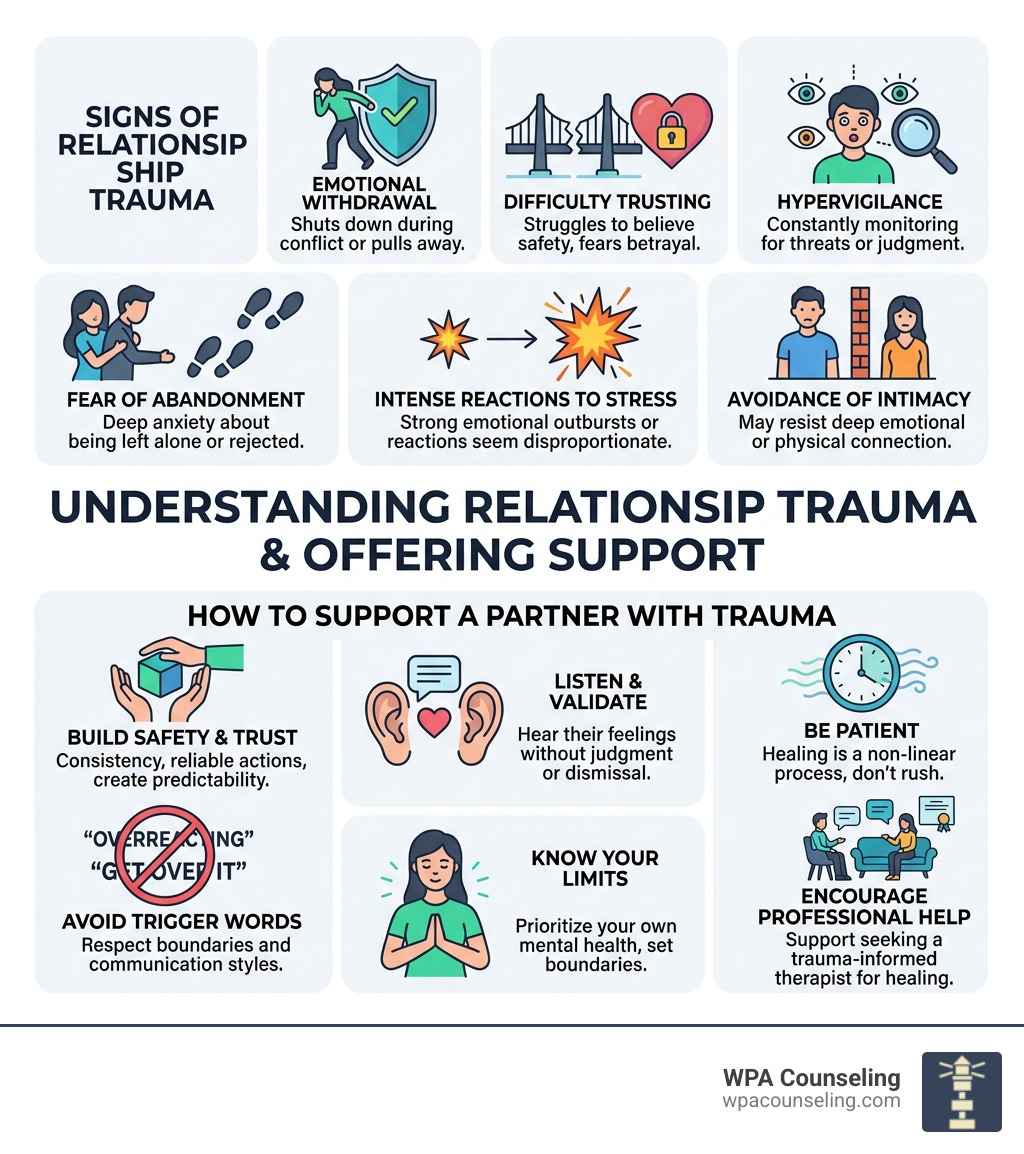
Understanding Relationship Trauma and Its Causes
Relationship trauma isn’t just a “bad breakup.” It is the psychological and emotional impact caused by harmful experiences within an intimate bond. This trauma can stem from a single catastrophic event or a long-term pattern of toxic behavior.
In our experience at WPA Counseling, we often see that relationship trauma is rooted in a fundamental breach of safety. When the person who is supposed to love and protect you becomes the source of pain, the brain’s “alarm system” (the amygdala) becomes hypersensitive.
Common causes include:
- Betrayal and Infidelity: Discovering a partner has been unfaithful can shatter a person’s sense of reality and self-worth.
- Emotional Abuse and Gaslighting: Being told your feelings aren’t real or being manipulated into doubting your own sanity creates deep Relationship Trauma and Emotional Abuse.
- Abandonment: Whether it was a sudden “ghosting” or a partner leaving during a time of crisis, abandonment creates a lasting fear that everyone will eventually leave.
- Physical or Sexual Abuse: These experiences leave physical and emotional scars that often require specialized trauma-informed care to process.
It is also important to recognize that adult relationship patterns are frequently influenced by early life experiences. If a person didn’t feel safe or seen as a child, they might develop an insecure attachment style, making them more vulnerable to trauma in adulthood. You can learn more about this in our guide on Understanding Childhood Trauma: A Guide for Healing and Growth.
Research highlights that individuals with PTSD from past abuse face unique dating experiences, often struggling with “trust wounds” that make it difficult to experience steady relationship growth (Russin et al., 2022). As noted by Blavity, dating someone with this history means navigating a landscape where the past often shadows the present.
Common Signs You Are Dating Someone with Relationship Trauma
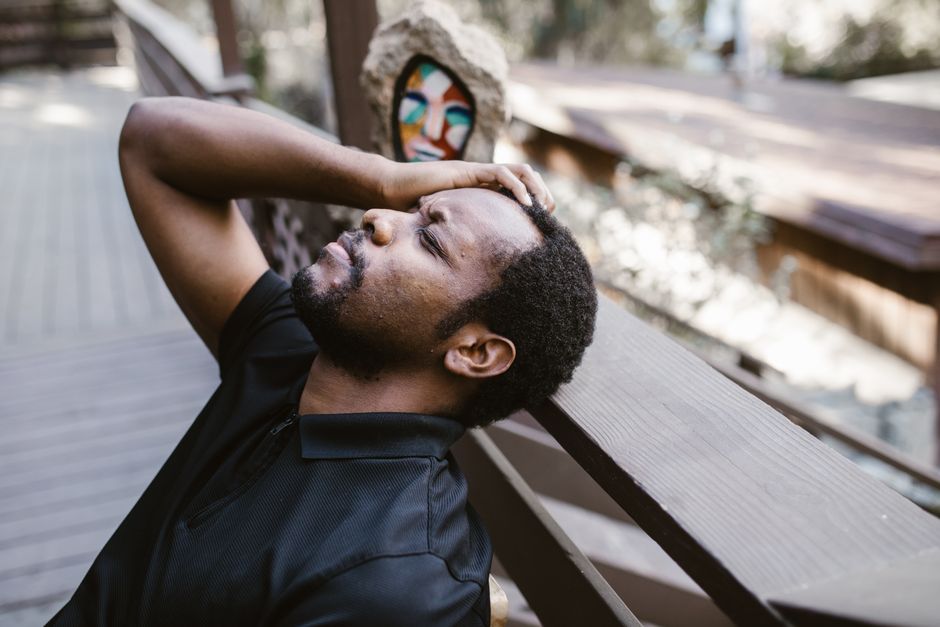
When you are dating someone with relationship trauma, the signs aren’t always obvious. They don’t always look like “sadness.” Often, they look like self-protection. Here are the most common indicators we see in our clinical practice:
- Trust Wounds: Your partner might be suspicious of “too good to be true” moments. If you are kind, they might wonder, “What do they want from me?” or “When will the other shoe drop?”
- Fear of Vulnerability: Opening up feels like handing someone a weapon to use against them. You might notice your partner keeps conversations surface-level or shuts down when things get “too deep.”
- Hypervigilance: They are constantly scanning for signs of trouble. A slightly shorter text message or a change in your tone of voice might be interpreted as a sign that you are angry or planning to leave.
- Emotional Numbness or Dissociation: During conflict, your partner might seem to “check out” or become robotic. This is a survival mechanism to avoid feeling the overwhelming pain of a perceived threat.
- Testing Boundaries: Sometimes, a person with trauma will push you away or act out to see if you will stay. It is an unconscious way of asking, “Are you actually safe, or will you leave like the others?”
Understanding the difference between Trauma Bonding Vs Healthy Attachment is crucial here. While a healthy attachment is built on mutual respect and safety, trauma-driven behaviors are often rooted in a desperate need to avoid further harm. As discussed by Recovery Ranch PA, these responses are survival mechanisms, not choices.
Identifying Behavioral Triggers when Dating Someone with Relationship Trauma
Triggers are specific events, words, or even smells that cause the brain to “flashback” to a traumatic moment. When someone is triggered, they aren’t just remembering the past; their body feels like it is happening right now.
- Hyper-reactivity: A small disagreement over the dishes might lead to an intense emotional outburst or deep sobbing. This happens because the brain associates “conflict” with “danger.”
- Over-apologizing: If your partner was previously in an abusive relationship where they were blamed for everything, they may apologize constantly for things that aren’t their fault to keep the peace.
- Need for Constant Reassurance: They may ask “Are we okay?” or “Are you mad at me?” multiple times a day. This stems from a fear of abandonment and a need to confirm that the relationship is still secure.
At WPA Counseling, we focus on Trauma Recovery by helping individuals identify these triggers and develop new, healthier ways of responding. We also help partners understand How Childhood Attachment Shapes Adult Relationships, providing a roadmap for why these behaviors occur in the first place.
How Past Pain Shadows New Love
It can feel confusing when your care is steady, but your partner still braces for hurt. The visual below shows the difference between healthy attachment and trauma responses in relationships.
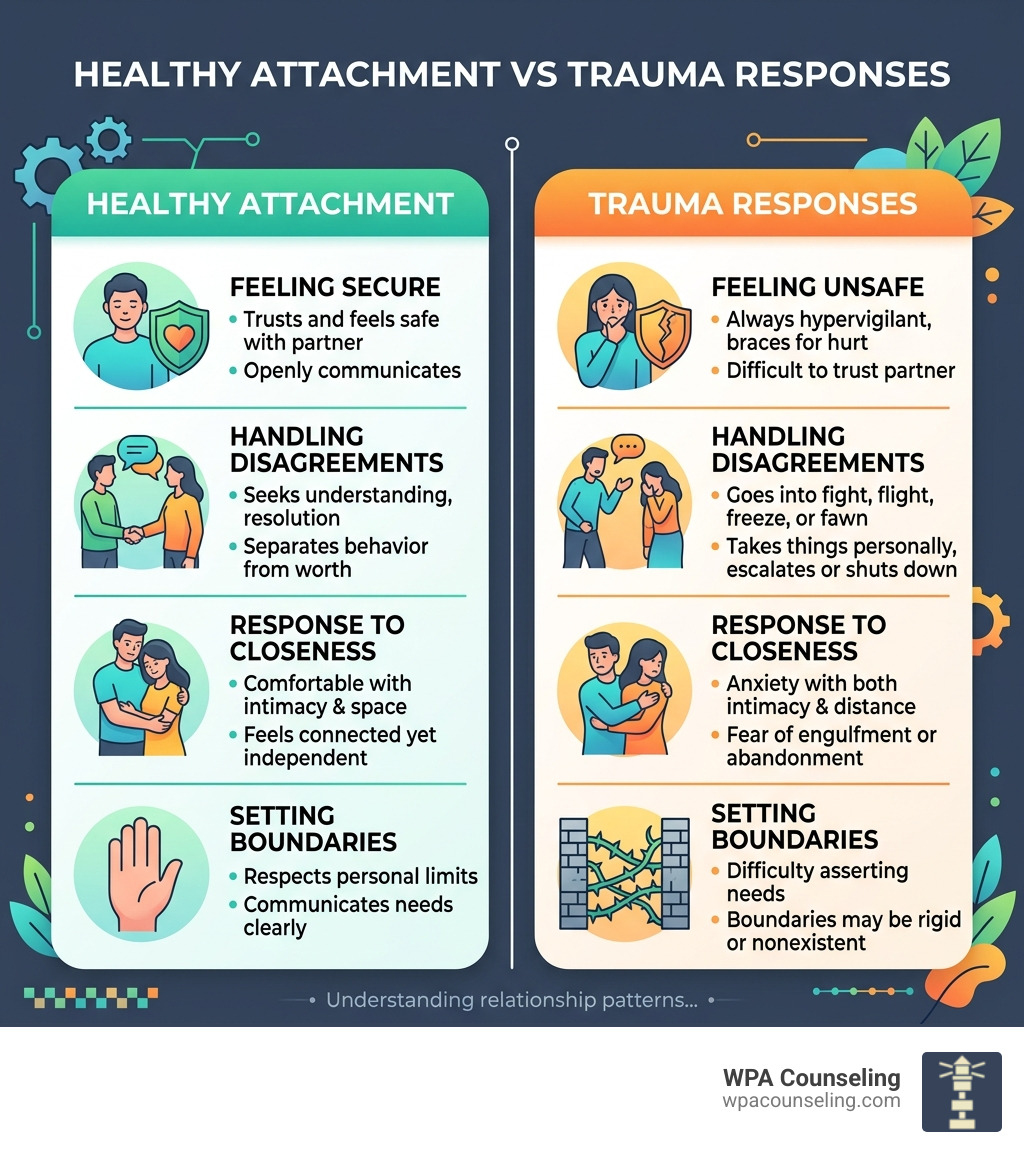
One of the most difficult aspects of dating someone with relationship trauma is witnessing self-sabotage. When things are going well, the person with trauma may unconsciously create conflict or pull away. Why? Because “good” feels unfamiliar and dangerous. If they ruin it first, they maintain a sense of control over the inevitable end they expect.
This fear of abandonment often creates a “push-pull” dynamic. They want closeness, but as soon as they get it, the fear of losing it becomes so great that they push you away to protect themselves. Differentiating between Emotional Abuse Vs A Difficult Relationship is vital. Trauma responses are usually about self-protection, whereas abuse is about power and control.
When past pain shadows your relationship, it can feel like there is a third presence in the room: an old wound, a past betrayal, or a traumatic memory.
Practical Strategies for Supporting Your Partner

You cannot “fix” your partner’s trauma, but you can create a “holding environment” where healing is possible. Here is how we recommend our clients in Pittsburgh and Irwin approach this:
- Be Consistent: Trust is built in the “small things.” If you say you’ll call at 6:00 PM, call at 6:00 PM. For someone with trauma, unpredictability equals danger. Consistency is the antidote.
- Practice Active Listening: When your partner is triggered, don’t try to use logic immediately. Instead, validate their feelings. Say, “I can see that you’re feeling really overwhelmed right now. I’m here with you.”
- Lead with Curiosity, Not Judgment: Instead of getting frustrated by a reaction, ask gently: “I noticed you pulled away when I mentioned [topic]. Is that something that feels heavy for you?”
- Respect Physical Boundaries: Trauma often affects how a person feels about touch. Always ask for consent, even for small things like a hug, especially if they seem distressed.
- Use “I” Statements: Instead of saying “You always shut down,” try “I feel lonely when we stop talking during an argument, and I want to make sure you feel safe enough to stay with me.”
Our team at WPA Counseling emphasizes Relationship Counseling as a way to build these skills. If you are in the local area, Couples Counseling In Pittsburgh can provide a neutral space to navigate these complex dynamics without the conversation devolving into a fight.
Protecting Your Own Mental Health and Setting Boundaries
Supporting a partner with trauma is an act of deep love, but it can also be emotionally draining. You cannot pour from an empty cup.
- Avoid the “Therapist” Role: You are their partner, not their counselor. Trying to “treat” your partner’s trauma often leads to an unhealthy power imbalance and burnout.
- Set Clear Boundaries: It is okay to say, “I want to support you, but I cannot stay in the room when you are yelling. I am going to take a 20-minute walk, and then I want to hear what you’re feeling.”
- Maintain Your Own Support System: Don’t let your world shrink to only include your partner’s needs. Keep up with your own friends, hobbies, and therapy.
- Watch for Codependency: If your happiness is entirely dependent on your partner having a “good day” trauma-wise, you may be slipping into codependency.
If you find yourself wondering Is It Too Late To Fix My Marriage or relationship because the trauma feels overwhelming, it may be time to seek individual support. Getting help for your own stress, boundaries, and emotional well-being can make it easier to show up with clarity and care.
Professional Guidance for Dating Someone with Relationship Trauma
At WPA Counseling, we are a compassionate group practice of licensed professional counselors based in Irwin, Pennsylvania. Our clinical background is rooted in years of specialized training in trauma recovery and relationship dynamics, and we have a proud history of serving the Western PA community, including Pittsburgh, North Huntingdon, Penn Hills, and Westmoreland County.
Our unique four-stage healing process is designed to address trauma at its core:
- Rapport Building: We create a secure, non-judgmental connection where you or your partner feel safe enough to be honest.
- Wound Exploration: We gently look at the past to understand how it is impacting the present. We don’t just look at the “what,” but the “how” it changed your nervous system.
- Toxin Removal: We identify and “flush out” unhealthy coping mechanisms, negative self-talk, and trauma-driven behaviors.
- Truth Restoration: We help you rebuild a sense of self and relationship based on who you are now, not who your trauma said you were.
Whether you need couples therapy or online sessions across Pennsylvania, we are here to help.
Frequently Asked Questions about Relationship Trauma
Can someone heal from trauma while in a new relationship?
Absolutely. In fact, a safe and consistent relationship can be one of the most powerful places for healing. It provides a “corrective emotional experience” where the person learns that not all intimacy leads to pain. However, the healing must be led by the person with trauma, often with the help of a professional.
What phrases should I avoid saying to a traumatized partner?
Avoid anything that minimizes their experience.
- Don’t say: “You’re overreacting,” “It wasn’t that bad,” or “Just get over it.”
- Instead, say: “I can see this is really hard for you,” or “What do you need from me right now to feel safe?”
How do I know if my partner’s reactions are trauma-based or just personality?
Trauma-based reactions are usually “disproportionate” to the current situation and often involve a physical response (shaking, rapid heartbeat, freezing). Personality traits are generally consistent across all areas of life, whereas trauma reactions are often triggered by specific relational cues like conflict or vulnerability.
Can a relationship with someone who has trauma be successful?
Yes. Many of the strongest couples we work with at WPA Counseling are those who have navigated trauma together. It requires more work, more patience, and more communication, but the depth of intimacy that comes from healing together is profound.
How do I encourage my partner to seek therapy without being pushy?
Frame it as a benefit for them and the relationship, rather than a “fix” for something “broken.” Try: “I love you and I see how much pain these memories cause you. I want you to feel the peace you deserve. Would you be open to talking to someone who specializes in this?”
Conclusion
Dating someone with relationship trauma is a journey that requires a special kind of heart. It demands a balance of fierce empathy and firm boundaries. It means understanding that while you didn’t cause the wounds, you can be a part of the environment that allows them to close.
Healing is not linear. There will be seasons of great progress and moments where it feels like you’ve taken three steps back. That is a normal part of the process. The goal isn’t “perfect” love; it’s safe love.
If you are in Western Pennsylvania and feeling overwhelmed by the shadows of the past, you don’t have to navigate this alone. Whether you are the one carrying the trauma or the one supporting a loved one, our team is ready to walk with you.
Start your healing journey with trauma therapy in Pittsburgh today and discover how to build a relationship rooted in truth, safety, and lasting joy.
This article was researched with AI and heavily edited by Stephen Luther for accuracy and relevance.
Stephen Luther (often called Steve) is the Executive Director and Founder of WPA Counseling. He holds a Master’s degree in Education from the University of Georgia and a Master’s degree in Marriage and Family Therapy from Duquesne University. He is a licensed professional counselor in Pennsylvania (LPC).
Since 1997, Steve has been helping children, adolescents, adults, couples, and families overcome emotional and relational challenges. He specializes in working with hurting families, including those with foster, adopted, or traumatized children. Steve uses Attachment-Based Therapy, client-centered therapy, and Therapeutic Parent Coaching to support healing and relationship restoration.
This guide is for educational and spiritual encouragement and is not a substitute for personalized professional counseling. If you are in crisis, please reach out for immediate help.
Safety First and Beyond with Judith Herman
Online Trauma Therapy That Works: Start Healing from Home in Pennsylvania