
When Anger Takes Over: What You Need to Know About Anger Management Marriage Counseling
Anger management marriage counseling is professional therapy that helps couples identify destructive anger patterns, understand the emotions beneath them, and build healthier ways to communicate and resolve conflict.
Here’s what it covers at a glance:
- What it is: A structured counseling process for couples where anger is damaging the relationship
- Who it’s for: Couples experiencing repeated arguments, emotional withdrawal, verbal aggression, or feeling like roommates instead of partners
- How it helps: Therapists use evidence-based methods like CBT, EFT, and the Gottman Method to teach communication skills, emotional regulation, and conflict resolution
- How long it takes: Most couples notice initial improvements within 3-6 sessions; significant progress typically comes after 3-6 months of regular therapy
- Can one partner attend alone? Yes — individual counseling still helps the motivated partner build coping strategies and set healthy boundaries
Anger is a normal human emotion. According to the American Psychological Association, anger is a completely normal, usually healthy, human emotion. Every couple argues. But there’s a real difference between occasional frustration and a pattern that leaves one or both partners feeling unsafe, exhausted, or hopeless.
When anger becomes the default response — through yelling, stonewalling, sarcasm, or even cold silence — it doesn’t just cause pain in the moment. It quietly erodes the trust and closeness that hold a relationship together.
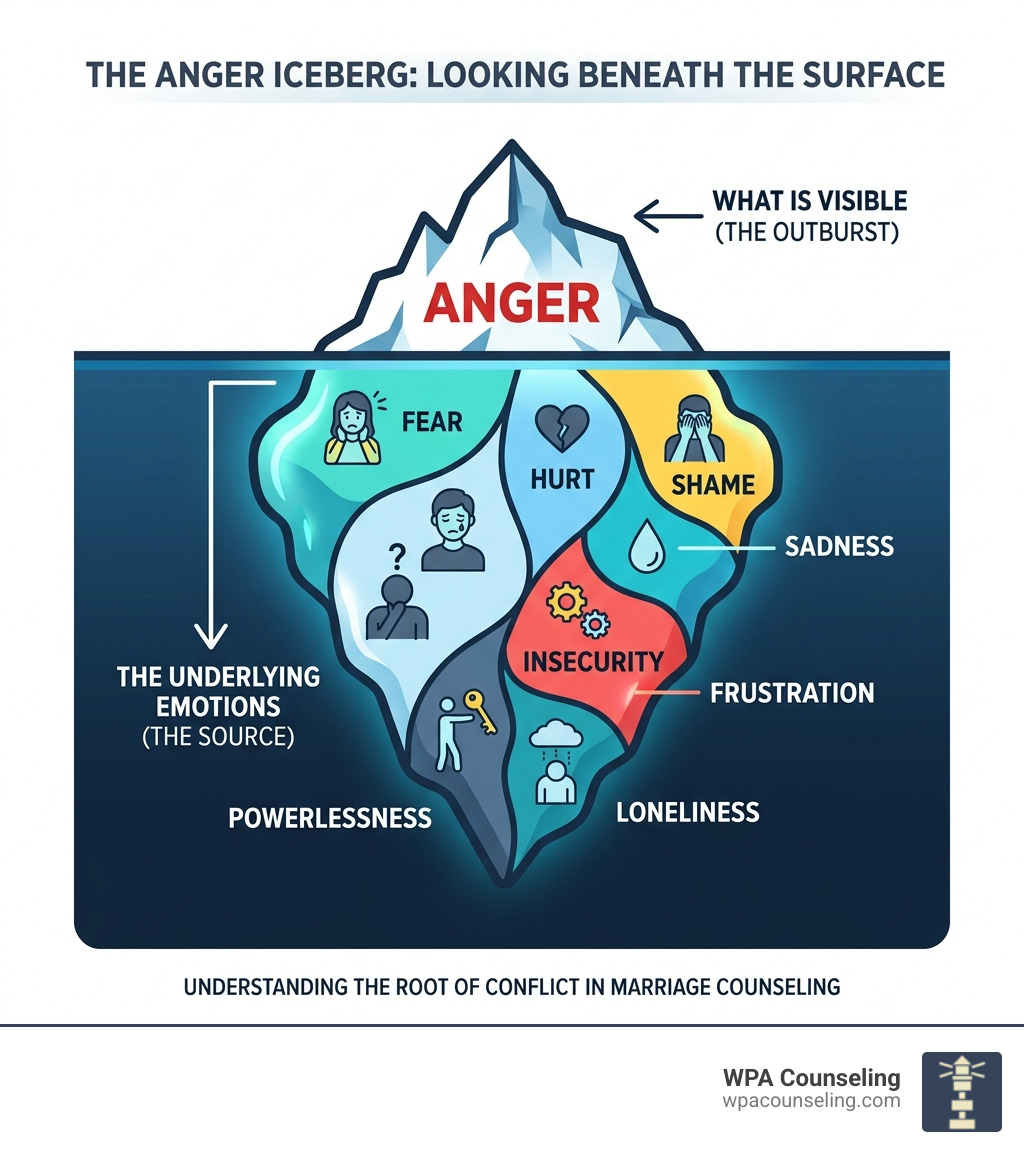
What most people don’t realize is that anger is rarely the whole story. It’s often the visible tip of something much deeper: hurt, fear, shame, or a feeling of not being heard. As one therapeutic framework puts it, anger is the iceberg above the waterline — but the real weight is hidden beneath the surface.
That’s exactly what anger management marriage counseling is designed to address. Not just the outbursts — but what’s driving them.
Understanding Destructive Patterns and Anger Management Marriage Counseling
In our work across Western Pennsylvania, we often see couples who feel like they are “walking on eggshells.” They stop sharing their day because they fear a tiny comment might trigger a massive blowout. This is when anger stops being a simple emotion and starts becoming a destructive force.
Destructive anger doesn’t always look like a Hollywood movie scene with broken plates and screaming matches. Sometimes, it’s the “silent treatment” that lasts for three days. It’s the sarcastic “digs” made in front of friends, or the constant eye-rolling during dinner. These behaviors are signals that the relationship’s emotional safety is under threat.
Warning Signs Your Relationship Needs Help
How do you know when it’s time to seek anger management marriage counseling? Look for these persistent red flags:
- Verbal Aggression: Frequent yelling, name-calling, or using “you always” and “you never” statements.
- Physical Manifestations: Even if there is no physical violence, things like slamming doors, punching walls, or looming over a partner are forms of physical intimidation.
- Emotional Withdrawal: Using silence as a weapon or “shutting down” to punish the other person.
- The “Emotional Thermostat” Effect: One partner is constantly adjusting their behavior to keep the other from boiling over.
- Impact on Daily Life: You find it hard to focus at work in Pittsburgh or enjoy your time in North Huntingdon because you’re dreading the next conflict.
When these patterns take root, they can feel impossible to break on your own. You can learn more about the transition from normal feelings to clinical concerns in our guide on Anger and Rage When Normal Emotions Become A Mental Health Concern.
When Individual Therapy is Necessary
While anger management marriage counseling focuses on the “we,” sometimes the “me” needs attention first. In some cases, one partner may have a trauma history, an underlying mental health condition like depression or anxiety, or issues with substance abuse that fuel their anger. Our approach to trauma recovery is strictly counseling-based, utilizing therapeutic strategies to process past experiences safely. If one partner struggles with emotional regulation regardless of what is happening in the marriage, individual therapy might be the necessary first step. This isn’t about blaming one person; it’s about making sure both individuals have the internal tools to show up for the relationship. We often combine individual work with Marriage Couples Counseling to ensure a holistic path to healing.
Identifying the Root of Marital Conflict
Anger is rarely about the “dishes in the sink.” Usually, it’s about the meaning behind the dishes. One partner might feel unappreciated, while the other feels controlled. These are the “past wounds” and “unmet expectations” that act as dry tinder for an angry spark.
External stressors—like financial pressure, job changes in the Pittsburgh area, or parenting struggles—can also lower our “anger threshold.” In therapy, we help you peel back these layers to see if the core of the relationship is still intact. If you find yourself wondering, Is It Too Late To Fix My Marriage, the answer is often found in how willing both partners are to look at these underlying roots.

Evidence-Based Approaches to Anger Management in Marriage
We don’t just “talk it out.” We use specific, science-backed methods to help you regain control. Different couples need different tools, which is why we specialize in several modalities.
| Therapeutic Approach | Primary Focus | Best For… |
|---|---|---|
| Cognitive Behavioral Therapy (CBT) | Identifying thought patterns and triggers. | Breaking the “trigger-response” cycle and learning regulation. |
| Emotionally Focused Therapy (EFT) | Underlying attachment needs and emotional safety. | Couples who feel disconnected or stuck in “pursue-withdraw” cycles. |
| Gottman Method | Strengthening friendship and managing conflict. | Couples needing practical communication scripts and repair rituals. |
Cognitive Behavioral Therapy (CBT)
CBT is fantastic for anger management marriage counseling because it focuses on the “here and now.” It helps you recognize the “automatic thoughts” that pop into your head right before you get angry. For example, if your spouse is late, your automatic thought might be, “They don’t respect my time.” CBT teaches you to challenge that thought and replace it with something more constructive, reducing the emotional “flooding” that leads to an outburst. There are many Marriage Counseling Myths In Pennsylvania about how therapy works, but CBT is very practical and goal-oriented.
How the Gottman Method Supports Anger Management Marriage Counseling
The Gottman Method is based on decades of research into what makes marriages succeed or fail. One of the most famous parts of this method is identifying “The Four Horsemen”—the four communication styles that The Gottman Institute has identified as predictors of divorce with startling accuracy:
- Criticism: Attacking your partner’s character rather than a specific behavior.
- Defensiveness: Making excuses or playing the victim to avoid responsibility.
- Contempt: The most destructive horseman; using sarcasm, name-calling, or mockery to make your partner feel inferior.
- Stonewalling: Withdrawing from the interaction and shutting down.
In therapy, we work on replacing these with “The Sound Relationship House” principles. This includes maintaining a 5-to-1 ratio (five positive interactions for every one negative interaction during a conflict) and creating “repair rituals.” A repair ritual is a pre-agreed way to say, “Hey, I’m sorry, let’s get back on track,” before the anger spirals out of control. You can read more about The Four Horsemen In A Marriage to see if they’ve moved into your home.
Emotionally Focused Therapy (EFT) for Deeper Connection
If the Gottman Method is the “manual” for communication, EFT is the “map” for the heart. EFT suggests that anger is often a “protest” against a loss of connection. When we feel our partner is pulling away, we might get angry to try and get their attention—even if it’s negative attention.
We help you identify your “negative cycle.” For example: “The more I yell, the more you shut down. The more you shut down, the more I yell.” By understanding this cycle, you can stop blaming each other and start teaming up against the cycle itself. This is a core part of our Relationship Counseling services.
Practical Strategies for Conflict Resolution and Emotional Regulation
Knowledge is great, but you need things you can actually do when you’re mid-argument in your kitchen in Irwin or Penn Hills.
Time-out Procedures: The “I Need a 20” Rule
When you are “flooded”—meaning your heart rate is over 100 beats per minute and your “lizard brain” has taken over—you cannot have a productive conversation. You literally lose the ability to think logically.
- The Signal: Agree on a signal or phrase like “I’m feeling flooded, I need a 20.”
- The Rule: You must walk away for at least 20 minutes (the time it takes for your body to metabolize stress hormones).
- The Commitment: You must return to the conversation within 24 hours. A time-out is not an escape; it’s a pause.
“I” Statements and Active Listening
It sounds cliché, but it works. Instead of “You always make me so mad when you ignore the bills,” try, “I feel overwhelmed and anxious when the bills aren’t discussed, and I need us to look at them together.” This shifts the focus from an attack to an expression of a need. Embracing Conflict As An Opportunity For Growth starts with changing how we speak.
Building a Self-Soothe Kit
In anger management marriage counseling, we often recommend creating a literal or mental “Self-Soothe Kit.” This is a collection of tools to help you ground yourself before you hit the “point of no return.”
- Grounding: The 5-4-3-2-1 technique (name 5 things you see, 4 you can touch, etc.).
- Sensory Tools: A cold glass of water, a specific scent (like lavender), or even a “worry stone” in your pocket.
- Mindfulness: Taking three deep, slow breaths into your belly. These tools are vital for Family Counseling For Conflict Resolution because they prevent the “contagion” of anger from spreading to children or other family members.
Communication Skills for De-escalation
- Reflective Listening: “What I hear you saying is that you feel unappreciated when I don’t help with dinner. Is that right?”
- Validating Feelings: You don’t have to agree with their perspective to validate their feeling. “I can see why that would make you feel frustrated.”
- Setting Boundaries: “I want to hear what you have to say, but I cannot continue this conversation if there is yelling.”
These skills are the bread and butter of our Couples Counseling In Pittsburgh.

WPA Counseling: Compassionate Care and Clinical Expertise in Pennsylvania
At WPA Counseling, we understand that seeking help for anger is a brave step. With over a decade of clinical experience serving the Western Pennsylvania community, our practice has a deep-rooted history of helping couples navigate high-conflict dynamics. Based in Irwin, Pennsylvania, our team of licensed professional counselors has provided thousands of hours of evidence-based therapy to residents across the entire Western and Central Pennsylvania region. Whether you prefer in-person sessions at our offices or secure telehealth from anywhere in the state, we are here to support you with the clinical expertise gained from years of local practice.
In the last year alone, 9,359 people sought help for anger management in Pennsylvania. You are not alone, and your situation is not hopeless.
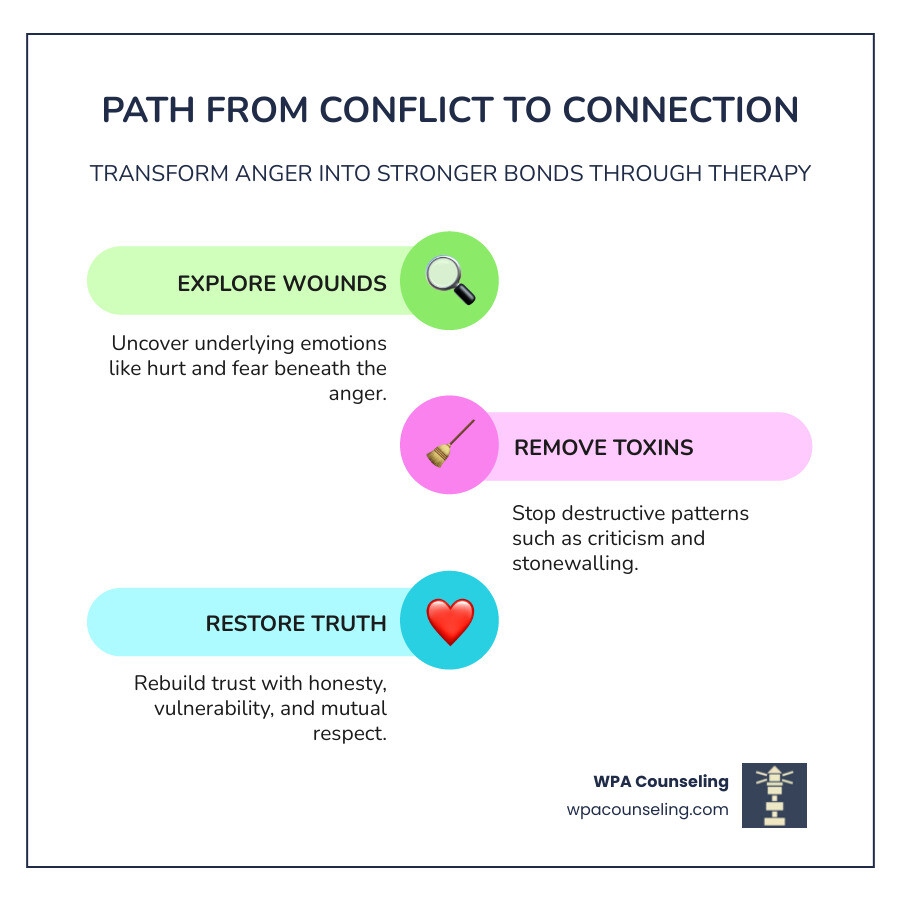
Our Four-Stage Healing Process
We don’t believe in “one-size-fits-all” therapy. We use a thoughtful, four-stage process to help couples navigate their journey:
- Rapport: Building a safe, non-judgmental relationship with your therapist. You both need to feel heard and supported.
- Wound Exploration: Identifying the “under the waterline” emotions. Where does this anger come from? Is it past trauma, unmet needs, or current stressors? We utilize counseling-based trauma recovery strategies to help individuals process these wounds through therapeutic dialogue and emotional regulation techniques.
- Toxin Removal: Identifying and stopping the “Four Horsemen” and other destructive behaviors. We help you clean out the “poison” in your communication.
- Truth Restoration: Rebuilding the relationship on a foundation of honesty, vulnerability, and mutual respect.
Our clinical experience shows that when couples commit to this process, they don’t just “stop fighting”—they actually start liking each other again. We bring this expertise to every session of Marriage Couples Counseling.
Frequently Asked Questions about Anger and Therapy
How long does marriage therapy take for anger issues?
Every couple is different, but we generally tell our clients to expect a “3 and 3” timeline. Most couples see initial improvements and a reduction in “explosive” moments within 3 to 6 sessions. However, to change long-standing habits and build a truly resilient relationship, significant progress typically happens over 3 to 6 months of regular work.
Can marriage counseling work if only one partner wants to attend?
Yes. While it is ideal for both partners to be in the room, if your partner refuses, you can still make a huge impact through individual counseling. By learning your own triggers, setting healthy boundaries, and changing your half of the “negative cycle,” you often influence the dynamic of the entire relationship. You can explore this further in our Relationship Counseling section.
Is it normal to feel worse before feeling better in therapy?
Actually, yes. In the first few weeks, we are often “opening up” old wounds and talking about things you’ve spent years avoiding. This can increase emotional intensity. Think of it like cleaning out a messy closet—it looks much worse when everything is on the floor than it did when the door was just shut. Your therapist will provide you with coping strategies and safety planning to help you navigate this phase.
Conclusion
Anger doesn’t have to be the end of your story. It is often just a very loud, very painful signal that something in your relationship needs to change. Through anger management marriage counseling, you can learn to turn that destructive force into a catalyst for deeper connection.
By intervening early, you can rebuild trust, restore safety, and find the lasting connection you both deserve. If you’re ready to take that first step, or if you feel you need to start with your own personal growth, we invite you to learn more about Individual Counseling or reach out to us today. Your marriage is worth the effort.
This article was researched with AI and heavily edited by Stephen Luther for accuracy and relevance.
Stephen Luther is the Executive Director and Founder of WPA Counseling. He holds a Master’s degree in Education from the University of Georgia and a Master’s degree in Marriage and Family Therapy from Duquesne University. He is a licensed professional counselor in Pennsylvania (LPC).
Since 1997, Steve has been helping children, adolescents, adults, couples, and families overcome emotional and relational challenges. He specializes in working with hurting families, including those with foster, adopted, or traumatized children. Steve uses Attachment-Based Therapy, client-centered therapy, and Therapeutic Parent Coaching to support healing and relationship restoration.
This guide is for educational and spiritual encouragement and is not a substitute for personalized professional counseling. If you are in crisis, please reach out for immediate help.