

When Anxiety Feels Stuck in Your Body, Your Body Is Where Healing Starts
Somatic exercises for anxiety can be a helpful, practical way to calm your nervous system when anxiety shows up in your chest, jaw, or gut – not just in your thoughts. If you want support that goes beyond self-help tools, learn more about anxiety therapy.
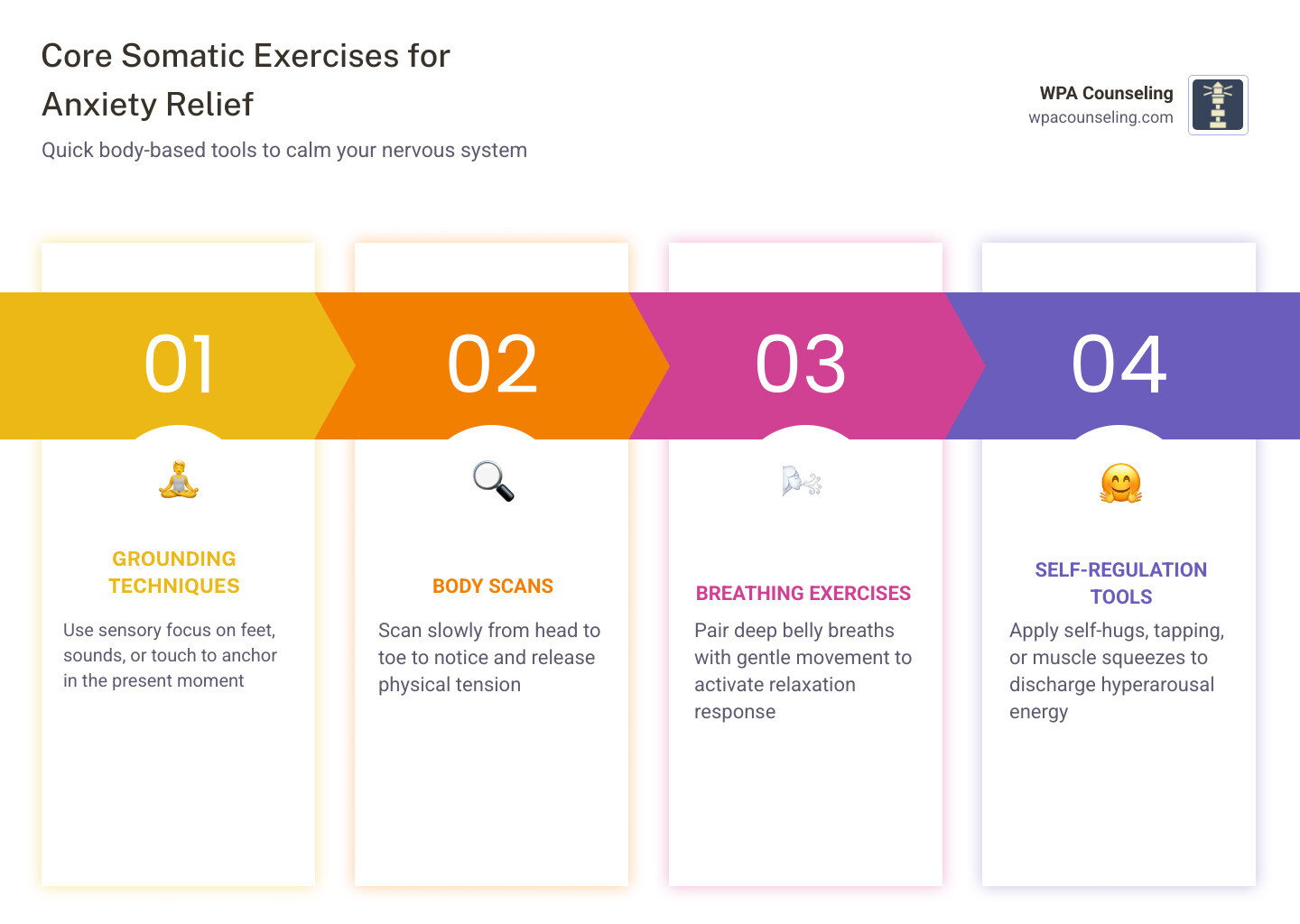
Here is a quick overview of what these guides typically include:
- Grounding techniques — sensory exercises to bring you back to the present moment
- Body scans — slow, focused attention on physical sensations to release tension
- Breathing exercises — controlled breathwork paired with movement to calm the nervous system
- Self-regulation tools — self-hugging, tapping, and muscle release to reduce hyperarousal
- Visualization practices — building a mental “safe place” to use during distress
- 30-day habit trackers — structured challenges to build a consistent daily practice
Most routines take 5 to 10 minutes and require no equipment.
Anxiety is not just a thought problem. For many people — especially those carrying trauma — it is a body problem. The nervous system gets stuck in a loop of fight-or-flight, and no amount of positive thinking breaks that cycle on its own.
Peter Levine, the founder of Somatic Experiencing, put it plainly: “Trauma is not what happens to us, but what we hold inside in the absence of an empathetic witness.”
That insight matters. It means healing often has to happen at the level of the body — through movement, breath, and sensation — not just through conversation.
This guide walks you through the most effective somatic exercises for anxiety, explains the science behind why they work, and shows you how to build a practice that fits your real life.
Understanding Somatic Therapy vs. Talk Therapy
When we think of therapy, we often imagine sitting on a couch and talking through our problems. This is known as “top-down” processing. It uses the neocortex—the thinking part of the brain—to manage emotions. While incredibly valuable for many, talk therapy sometimes hits a wall when anxiety is rooted deep in the nervous system.
Somatic therapy uses “bottom-up” processing. Instead of trying to think your way out of a panic attack, you use your body to signal to your brain that you are safe. By focusing on interoception—the ability to perceive internal bodily sensations—we can begin to discharge the “stuck” energy that keeps us in a state of hypervigilance.
The Role of the Nervous System
Our nervous system is designed for survival. When we face a threat, the sympathetic nervous system kicks into fight-or-flight. Once the threat passes, the parasympathetic nervous system should bring us back to “rest and digest.” However, unresolved trauma or chronic stress can cause the system to lose its flexibility. We might stay “on” (anxiety, panic) or “shut down” (depression, dissociation).
Somatic practices, as detailed in Scientific research on Somatic Experiencing efficacy, help complete these survival responses. For example, if you were in a situation where you wanted to run but couldn’t, your body might still be holding that “run” energy. Somatic exercises allow that energy to be released safely.
| Feature | Traditional Talk Therapy | Somatic Therapy |
|---|---|---|
| Primary Focus | Thoughts, beliefs, and narratives | Bodily sensations and movements |
| Direction | Top-down (Mind to Body) | Bottom-up (Body to Mind) |
| Goal | Insight and cognitive reframing | Nervous system regulation and release |
| Best For | Pattern recognition and logic | Trauma, panic, and chronic tension |
To learn more about how these two approaches complement each other, visit our page on Somatic Therapy vs Talk Therapy.
Why Use a Somatic Exercises for Anxiety PDF?
A physical or digital guide can make somatic practice much easier to stick with. In a high-anxiety moment, it is common to forget coping steps you know when calm. A somatic exercises for anxiety PDF gives you a simple plan you can return to right away. If you want more structured support, download this somatic exercises PDF and keep it handy for quick reference.
Strengthening the Vagus Nerve
Many of these exercises are designed for vagus nerve toning. The vagus nerve is the “superhighway” of the parasympathetic nervous system. By stimulating it through specific movements or breath patterns, you improve your emotional resilience. This increases your window of tolerance—the zone where you can handle stress without flipping into a panic or shutting down entirely.
Research into nervous system regulation shows that even 10 minutes of daily practice can significantly lower cortisol levels. This isn’t just about feeling better in the moment; it’s about habit formation. A 21-day or 30-day reset challenge helps rewire your baseline state from “anxious” to “secure.”
If you find that your anxiety is consistently interfering with your daily life, you might benefit from specialized anxiety therapy to help guide your somatic journey.
Top Somatic Exercises for Immediate Relief
If you feel a panic attack rising or your chest tightening, you need tools that work now. These exercises are designed to be done anywhere—at your desk, in your car, or at home.

- The Self-Hug (Containment): Developed by Peter Levine, this involves placing your right hand under your left armpit and your left hand on your right shoulder. Squeeze gently. This creates a sense of “containment,” helping you feel where your body ends and the world begins.
- Body Tapping: Gently tap your skin from your feet up to your head. This activates the nervous system and helps you “come back” to your body if you feel like you are dissociating or floating away.
- The 5-4-3-2-1 Grounding Technique: Name 5 things you see, 4 things you can touch, 3 things you hear, 2 things you can smell, and 1 thing you can taste. This shifts your focus from internal panic to external reality.
- Somatic Body Scan: Sit comfortably. Starting at your toes, notice any sensation—temperature, tightness, or tingling. Don’t judge it; just notice. As you move up to your calves, knees, and thighs, breathe into the areas of tension and imagine them softening.
For those in Pennsylvania seeking more structured support, we offer online anxiety therapy in Pennsylvania to help you master these techniques.
Quick Routines in Your Somatic Exercises for Anxiety PDF
You don’t need an hour-long yoga class to regulate your nervous system. In fact, shorter, frequent “micro-doses” of regulation are often more effective for chronic anxiety.
- The Wall Push (2 Minutes): If you feel “fight” energy (anger or agitation), stand facing a wall. Put your hands on it and push as hard as you can for 10 seconds, then release. This gives your muscles the “completion” they are looking for.
- Standing Somatic Yoga (5 Minutes): Simple movements like “shaking” (literally shaking your arms and legs like you’re shaking off water) can help discharge excess adrenaline.
- Vagus Nerve Eye Tracking: Keep your head still and move your eyes as far to the right as possible until you feel a natural urge to yawn, sigh, or swallow. Repeat on the left. This is a direct “hack” to signal safety to the brainstem.
These quick routines are essential for managing panic disorder therapy and preventing symptoms from escalating.
How to Use Your Somatic Exercises for Anxiety PDF Daily
The goal of a somatic exercises for anxiety pdf is to move from “crisis management” to “lifestyle.”
- Morning Affirmations with Movement: Pair a positive statement like “I am safe in my body” with a physical stretch or a gentle tap on the chest.
- 30-Day Challenge: Use a habit tracker to check off your 10-minute somatic routine each day. Consistency builds the neural pathways that make regulation “second nature.”
- Sensory Focus: Throughout the day, pick one sense to focus on for 60 seconds. What is the texture of your shirt? What is the exact temperature of the air on your skin?
This level of awareness is particularly helpful for those navigating social anxiety treatment, as it provides an internal anchor in social settings.
Advanced Techniques: Somatic Experiencing and Trauma Recovery
For those dealing with deep-seated trauma, somatic work involves more nuanced, counseling-based strategies like titration and pendulation.
- Titration: This is the process of experiencing small “drops” of the traumatic charge at a time so you don’t become overwhelmed.
- Pendulation: This involves shifting your attention between a place in your body that feels tense (the “vortex”) and a place that feels calm or neutral (the “resource”). This teaches your nervous system that it can move in and out of distress without getting stuck.
The SCOPE tool is a fantastic framework for this:
- Slow Stepping/Breathing
- Connected Loop (crossing arms/ankles)
- Orient to the environment
- Pendulate between sensations
- Engage with others
Research on SE for PTSD highlights that these techniques help individuals reclaim their lives after significant trauma. If you are struggling with the weight of the past, our counseling-based trauma therapy services provide a safe container for this deep work.
Somatic Exercises for Jaw, Neck, and Shoulder Tension
Anxiety often settles in the same places: a clenched jaw, raised shoulders, or a tight neck. These gentle exercises can help release it:
- Jaw release: let your teeth part and your tongue rest on the floor of your mouth. Place your fingertips just in front of your ears and make slow, small circles for 30 seconds while breathing out through your mouth.
- Yawn and sigh: allow a big, slow yawn, then a long audible exhale. This simple reset relaxes the jaw and signals safety to the nervous system.
- Shoulder drop: on an inhale, lift your shoulders toward your ears; on the exhale, let them fall heavily. Repeat three to five times.
- Neck orienting: slowly turn your head to look around the room, letting your eyes rest on a few neutral or pleasant objects. Orienting tells your brain that your surroundings are safe.
How Can I Build a Daily Somatic Practice on My Own?
Short, regular practice works better than occasional long sessions. Try pairing two or three minutes of grounding or breathing with something you already do each day, such as your morning coffee, your commute, or getting into bed. Notice what helps and what does not, and keep a simple log of how your body feels before and after.
Go slowly. If an exercise brings up strong memories, panic, or numbness, pause, open your eyes, feel your feet on the floor, and return to something that feels steady. People with a trauma history often benefit from learning somatic skills with a trained counselor first, so the practice stays within their window of tolerance.
WPA Counseling’s Clinical Expertise in Pennsylvania
At WPA Counseling, we understand that anxiety isn’t a “one-size-fits-all” experience. With a rich history of clinical practice and a deep commitment to the local community, our practice has established itself as a leader in trauma-informed care across Western and Central Pennsylvania. Based in Irwin, Pennsylvania, and serving residents in Pittsburgh, North Huntingdon, Irwin, and Penn Hills, our licensed professional counselors bring decades of collective clinical experience to help clients navigate complex emotional landscapes. Our practice history is rooted in providing accessible, high-quality mental health services that prioritize the individual’s journey toward wellness.
We utilize a unique four-stage healing process designed to move you from crisis to clarity through counseling-based strategies:
- Rapport: Building a foundation of safety and trust.
- Wound Exploration: Identifying where trauma or anxiety is stored.
- Toxin Removal: Releasing the “stuck” energy and limiting beliefs through counseling-based strategies.
- Truth Restoration: Reconnecting with your authentic, regulated self.
Whether you prefer in-person sessions in Westmoreland County or secure telehealth therapy from anywhere in the state, our goal is to match you with a counselor who truly “gets” it. If you’re looking for anxiety counseling in Pittsburgh, our clinicians are trained to help you integrate somatic tools into your daily life.
Frequently Asked Questions about Somatic Exercises for Anxiety PDF

What is the ‘window of tolerance’ in somatic therapy?
The “window of tolerance” is the sweet spot where you can process emotions effectively. Above the window is hyper-arousal (panic, rage, anxiety). Below the window is hypo-arousal (numbness, depression, dissociation). Somatic exercises help you stay within this window or return to it when you’ve been pushed out.
Can somatic exercises be done in under 10 minutes?
Absolutely. Most effective somatic “resets” take between 2 and 5 minutes. The key is not the length of time, but the quality of your attention. Toning the vagus nerve through a quick eye-tracking exercise or a “wall push” can be done during a bathroom break or between meetings.
How do grounding techniques help with flashbacks or dissociation?
Flashbacks and dissociation happen when the brain thinks a past threat is happening now. Grounding techniques use sensory details—like the coldness of an ice cube or the texture of a chair—to signal to the brain that you are physically present in the current, safe environment.
Conclusion
Healing from anxiety is a journey of coming home to yourself. By using a somatic exercises for anxiety pdf, you are giving your body the language it needs to communicate safety to your brain. This mind-body healing builds long-term resilience, allowing you to face life’s challenges without losing your center.
If you’re ready to take the next step in your mental health journey, we are here to help. Stop letting anxiety hold you back and reach out to WPA Counseling today to find a therapist who can support your path to peace.
This article was researched with AI and heavily edited by Stephen Luther for accuracy and relevance.
Stephen Luther is the Executive Director and Founder of WPA Counseling. He holds a Master’s degree in Education from the University of Georgia and a Master’s degree in Marriage and Family Therapy from Duquesne University. He is a licensed professional counselor in Pennsylvania (LPC).
Since 1997, Steve has been helping children, adolescents, adults, couples, and families overcome emotional and relational challenges. He specializes in working with hurting families, including those with foster, adopted, or traumatized children. Steve uses Attachment-Based Therapy, client-centered therapy, and Therapeutic Parent Coaching to support healing and relationship restoration.
This guide is for educational and spiritual encouragement and is not a substitute for personalized professional counseling. If you are in crisis, please reach out for immediate help.
Western PA Anxiety Therapy That Helps You Breathe Easy
Anxiety Counseling in Pennsylvania