

The Best Trauma Bond Books to Help You Finally Break Free
The best trauma bond books available right now include:
- The Betrayal Bond — Patrick J. Carnes, Ph.D.
- Breaking Trauma Bonds with Narcissists and Psychopaths — Shahida Arabi
- Why Can’t I Let You Go? — Michelle Skeen & Kelly Skeen
- Trauma Bonding: Understanding and Overcoming the Trauma Bond in a Narcissistic Relationship — Lauren Kozlowski
- Run Like Hell — Dr. Nadine Macaluso
- Loving You Is Hurting Me — Dr. Laura Copley
- The Body Keeps the Score — Bessel van der Kolk, M.D.
You know something is wrong. You’ve tried to leave. You’ve told yourself it’s over. But somehow you keep going back — or you can’t stop thinking about them, even when you’re gone.
That’s not weakness. That’s a trauma bond.
A trauma bond is a powerful psychological attachment that forms in relationships where danger, betrayal, or a severe power imbalance exists. It’s driven by brain chemistry — not by choice. As one clinical framework describes it, the distress you feel is not an overreaction. It is a neurobiological response.
The right book can be the first step toward understanding what’s happening inside you. And understanding is where healing begins.
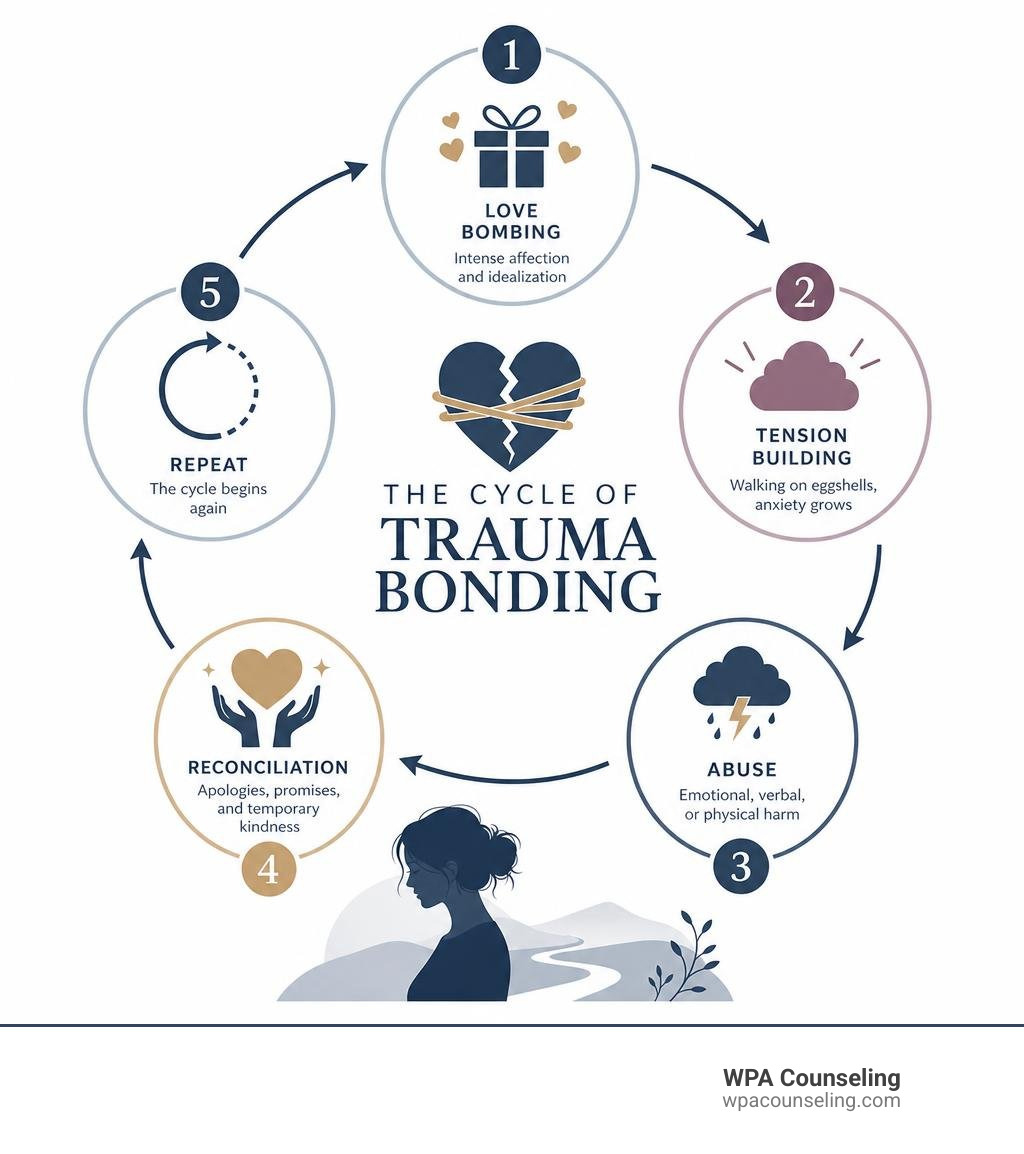
What is a Trauma Bond and How Does It Form?
To understand why it is so incredibly difficult to walk away from a toxic relationship, we have to look beneath the surface. It is easy for outsiders to ask, “Why don’t you just leave?” However, that question represents a fundamental misunderstanding of how trauma bonds alter our psychological and biological wiring.
A trauma bond is not a healthy, mutual connection; it is a deep, addictive attachment formed between an abused individual and their abuser. It develops through a highly predictable cycle of intense emotional highs and devastating lows. When you are in a toxic partnership, you are not merely experiencing emotional conflict—you are navigating a neurochemical roller coaster.
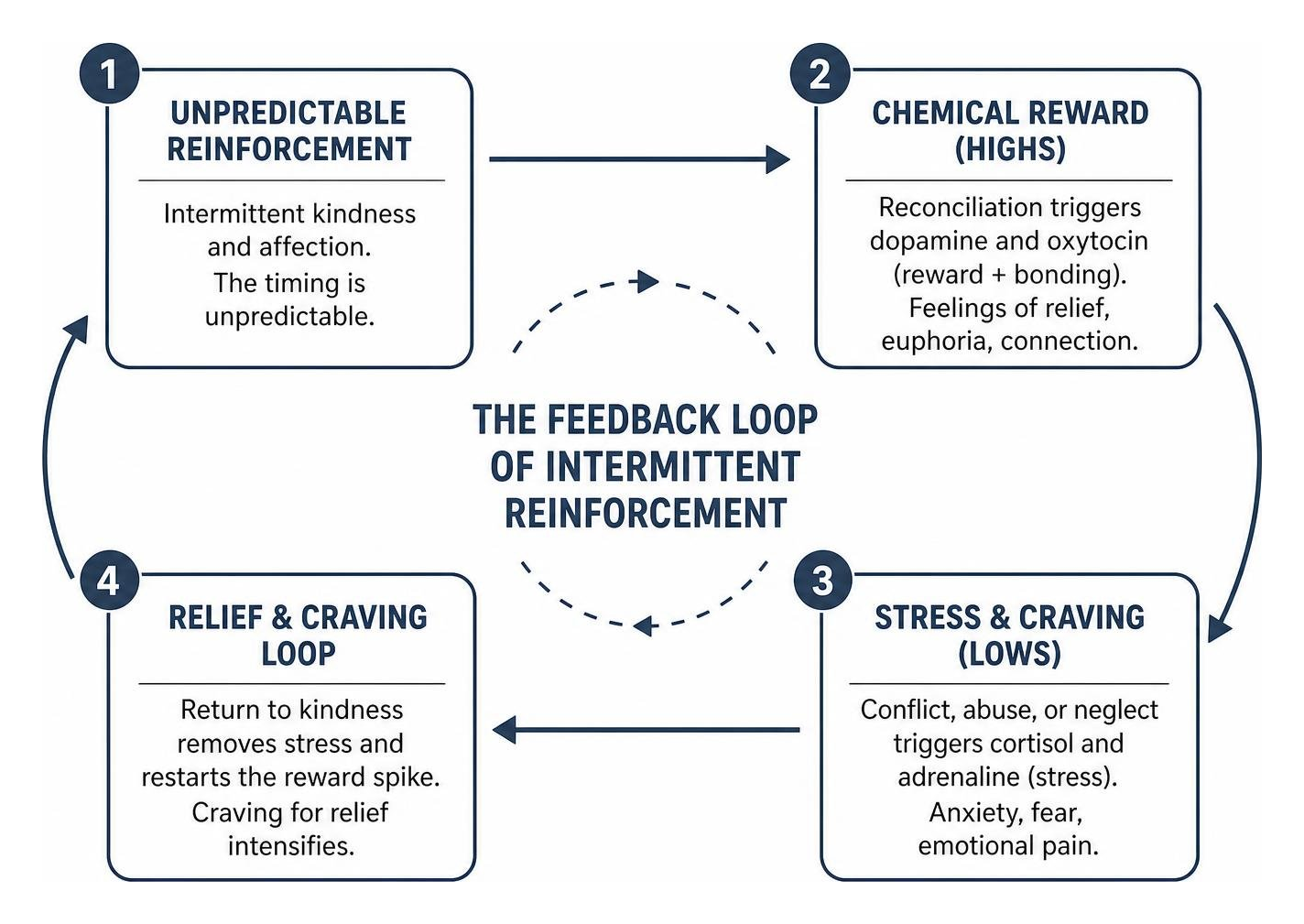
At the heart of this connection is intermittent reinforcement. This is the exact same psychological mechanism that makes slot machines so addictive. If a partner were cruel 100% of the time, leaving would be relatively straightforward. But they aren’t. Instead, periods of hostility, neglect, or psychological abuse are unpredictable and punctuated by sudden bursts of affection, gift-giving, or intense apologies (often referred to as “love-bombing”).
This unpredictable cycle physically alters your brain chemistry:
- The Highs (Dopamine & Oxytocin): During the reconciliation or “sweet seduction” phase, your brain is flooded with dopamine (the reward chemical) and oxytocin (the bonding hormone). This creates a sense of safety, euphoria, and intense relief.
- The Lows (Cortisol & Adrenaline): During periods of conflict, emotional abuse, or threat, your system is flooded with stress hormones. You enter a permanent state of survival-driven alarm.
- The Addiction: When the abuser suddenly restores affection, the sudden drop in stress hormones and spike in reward chemicals creates an intense biological craving. Over time, you become literally addicted to the cycle of relief.
This constant fluctuation leads to profound cognitive dissonance—a state of mental discomfort where you hold two opposing beliefs at the same time (e.g., “This person is destroying my self-esteem” vs. “This person is the only one who can make me feel safe”). To survive this psychological tension, your mind minimizes the abuse and maximizes the good moments. You find yourself constantly making excuses for your partner’s behavior, protecting them from friends and family, and ignoring your own boundaries.
For a deeper dive into how this sticky dynamic takes root, read our guide on The Sticky Truth About Trauma Bonding. To help clarify what you are currently experiencing, you can also explore our breakdown of Trauma Bonding vs Healthy Attachment: How to Tell the Difference.
The Best Trauma Bond Books for Healing and Recovery

When you are trapped in a cycle of emotional abuse, finding the right words to describe your experience is incredibly validating. Reading high-quality, research-backed literature can act as an external anchor for your reality, helping you overcome gaslighting and regain your footing.
Below is a comparison table of some of the most highly rated and widely read trauma bond books available today. These resources combine clinical expertise with practical recovery guides to help survivors map out their healing journeys.
| Book Title | Author | Amazon Ratings (Approx.) | Core Focus & Approach | Best For |
|---|---|---|---|---|
| The Body Keeps the Score | Bessel van der Kolk, M.D. | 79,258 | Neuroscience, somatic processing, and physical trauma storage. | Understanding how trauma affects the physical body and brain. |
| It Didn’t Start with You | Mark Wolynn | 12,630 | Inherited family trauma and systemic generational cycles. | Uncovering family origins and ancestral trauma patterns. |
| The Betrayal Bond | Patrick J. Carnes, Ph.D. | 923 | Exploitive relationships, trauma addiction, and biological cravings. | Deep psychological analysis of betrayal and toxic loyalty. |
| Trauma Bonding: Understanding and Overcoming the Trauma Bond… | Lauren Kozlowski | 795 | 7 stages of trauma bonding; 5 stages of acceptance. | Spotting narcissistic manipulation and accepting the reality of the bond. |
| Breaking Trauma Bonds with Narcissists and Psychopaths | Shahida Arabi | 27 (Newer Release) | Neurobiology of abuse, validation of outrage, and safety planning. | Escaping highly manipulative romantic relationships safely. |
| Loving You Is Hurting Me | Dr. Laura Copley | 172 (Previous Ed.) | Depth-oriented exploration, self-compassion, and authentic intimacy. | Moving past surface solutions to transform toxic patterns. |
| Why Can’t I Let You Go? | Michelle Skeen & Kelly Skeen | 19 | Acceptance and Commitment Therapy (ACT), core beliefs, and attachment. | Identifying childhood wounds and changing adult attachment patterns. |
| Run Like Hell | Dr. Nadine Macaluso | N/A (Newer Release) | Somatic psychotherapy, boundary-setting, and personal manifestos. | Survivors of pathological partners seeking clinical and personal guidance. |
Top Trauma Bond Books for Understanding Narcissistic Abuse
If you are dealing with a partner who exhibits narcissistic or psychopathic traits, the psychological manipulation can be incredibly disorienting. In these dynamics, the abuser systematically dismantles your sense of self through gaslighting, projection, and continuous manipulation. Fortunately, specialized literature can help you make sense of the madness.
An excellent starting point is the book Breaking Trauma Bonds with Narcissists and Psychopaths by Shahida Arabi (also available through Breaking Trauma Bonds with Narcissists and Psychopaths by Shahida Arabi | Hachette UK). Arabi utilizes a powerful blend of neuroscience and compassionate validation to help readers understand that their pain is not an “overreaction” but a measurable neurobiological response. The book is highly regarded for its focus on validating “authentic outrage” as a necessary tool to break the survival-driven instinct to protect your abuser. It offers actionable strategies to spot manipulation tactics, set firm boundaries, and safely plan your exit.
Another highly accessible resource is Trauma Bonding : Understanding and Overcoming the Trauma Bond in a Narcissistic Relationship by Lauren Kozlowski. Kozlowski breaks down the complex mechanics of how these attachments form into a structured, easy-to-follow guide. She walks the reader through the seven distinct stages that lead to becoming trauma-bonded, alongside the five stages of accepting your reality. This book is particularly validating for survivors who struggle with self-blame, as it explains the direct evolutionary and psychological parallels between trauma bonds and captive dynamics like Stockholm syndrome.
How to Choose the Right Trauma Bond Books for Your Journey
With so many excellent resources available, choosing where to start can feel overwhelming. The best book for you depends heavily on your current stage of recovery and the specific focus you need.
If you are looking for a deep, compassionate, and systemic approach to healing, consider Loving You Is Hurting Me by Laura Copley | Hachette Book Group (also featured as Loving You Is Hurting Me: A New Approach to Healing Trauma Bonds and Creating Authentic Connection | Harvard Book Store). Dr. Copley, a trauma therapist and survivor herself, criticizes the traditional mental health community’s tendency to quickly label individuals in toxic bonds as simply “victims” or “abusers.” Instead, she invites readers to go “down” into the relationship’s “emotional underground.” By combining cutting-edge trauma science with self-compassion and creative exercises, she guides you to transform toxic patterns into authentic self-connection and safe intimacy.
If you are currently trying to plan a safe exit from a highly manipulative or volatile partner, Run Like Hell – Dr. Nadine Macaluso’s New Book | Dr Nae is an invaluable guide. Dr. Macaluso combines her clinical expertise as a somatic psychotherapist with her highly publicized personal history as the ex-wife of Jordan Belfort (the real-life “Wolf of Wall Street”). She outlines the specific phases of trauma bonding—including the “sweet seduction” and the manipulative “mind-mapping” phases—and offers practical tools like “Jekyll and Hyde” charts to help survivors see that their partner’s loving side is just as pathological as their abusive side. It also includes essential, real-world safety tips (such as never telling an intoxicated partner that you are leaving them) and guides you in writing personal manifestos to protect your boundaries.
‘The Betrayal Bond’ vs. ‘Why Can’t I Let You Go?’: Comparing Approaches
Two of the most influential trauma bond books take distinctly different, yet complementary, approaches to recovery. Understanding how they differ can help you select the one that aligns with your healing needs.
The Betrayal Bond by Patrick J. Carnes, Ph.D.
Dr. Carnes’ work is a clinical masterpiece that views trauma bonds primarily through the lens of addiction and neurobiology. He argues that severe betrayal moves relationships into the realm of trauma by inducing a permanent state of biological alarm.
- Core Philosophy: Trauma bonds are literal biological and neurochemical addictions wired into the brain’s temporal lobes. When the source of fear (the abuser) is removed, you experience physical withdrawal and intense cravings, driving you back to the relationship.
- Key Concepts: Explores “trauma blocking” (using substances, work, or toxic relationships to numb pain) and “trauma shame.”
- Best For: Readers seeking a rigorous, clinical explanation of the biological forces keeping them stuck, and those recovering from long-term, highly exploitive dynamics.
Why Can’t I Let You Go? by Michelle Skeen & Kelly Skeen
This book takes an interpersonal, attachment-focused approach, utilizing the principles of Acceptance and Commitment Therapy (ACT).
- Core Philosophy: Unhealthy adult relationships and trauma bonds are often rooted in early childhood experiences of emotional abuse, neglect, or abandonment. These early wounds shape our unconscious core beliefs and adult attachment styles.
- Key Concepts: Focuses on bringing conscious awareness to deeply held core beliefs, identifying attachment styles, interrupting harmful behavioral loops, and aligning actions with personal relationship values.
- Best For: Individuals who want to understand why they are repeatedly drawn to toxic partners and those looking for active, reflective exercises to build secure, healthy attachments in the future.
Both books offer incredible value. While Carnes helps you understand the immediate, addictive grip of the bond, Skeen and Skeen provide the roadmap to heal the underlying childhood vulnerabilities that made you susceptible to the bond in the first place.
If you are looking for structured healing that addresses these deep betrayal dynamics right here in Pennsylvania, you can explore our resources on Trauma Systems Therapy: Healing from Betrayal Bonds in Pennsylvania.
Moving Beyond Reading: Professional Support in Pennsylvania
While reading trauma bond books is an incredibly powerful first step, self-help books can only take you so far. Because trauma bonds are physically wired into your nervous system, true recovery often requires a safe, therapeutic relationship to help you unpack, process, and release the trauma.
WPA Counseling has a rich history of serving the Western Pennsylvania community, providing dedicated, clinical mental health services to individuals struggling with relational trauma, emotional abuse, and complex PTSD. Over years of local practice, our clinic has established a reputation for clinical excellence and compassionate care. Our licensed professional counselors bring decades of combined clinical experience, utilizing evidence-based, counseling-focused strategies to help clients safely navigate the difficult process of breaking trauma bonds.
Based in Irwin/North Huntingdon, Pennsylvania, with an additional office in Penn Hills, we provide warm, welcoming, in-person counseling at our Western Pennsylvania offices, as well as secure telehealth therapy across the entire state of Pennsylvania. Our deep roots in the local community allow us to understand the unique needs of our clients, offering a trusted clinical anchor for those seeking to reclaim their lives.
Our team utilizes evidence-based, trauma-informed modalities—including Cognitive Behavioral Therapy (CBT), Dialectical Behavior Therapy (DBT), attachment-based therapy, and somatic psychotherapy—to help you safely process emotional and relational wounds.
We guide our clients through our signature Counseling Blueprint, a thoughtful, four-stage healing journey designed to help you rebuild your life from the ground up:
- Take Off the Mask: We begin by building a genuine, trusting, and non-judgmental relationship. You don’t have to pretend everything is okay here. We provide a safe space where you can drop your defenses and speak your honest truth.
- Heal the Wounds: We gently explore the emotional and relational hurts of your past and present. Together, we look at how childhood experiences or relationship trauma have shaped your current patterns.
- Remove the Toxins: We help you identify the lingering lies, unhelpful core beliefs, and cognitive distortions that the trauma bond left behind (such as “I am not enough” or “I can’t survive without them”).
- Replace with Truth: Finally, we work to install empowering, accurate, and healthy perspectives about yourself, others, and the world. We help you rebuild your self-worth, establish rock-solid boundaries, and open the door to safe, authentic intimacy.
You do not have to carry this heavy burden alone. To learn more about how we can support you, read our guide on Understanding Trauma Therapy: A Path to Healing or discover How to Find the Right Therapist for Trauma in Pennsylvania.
Frequently Asked Questions About Trauma Bonding
What is the difference between a trauma bond and a healthy attachment?
The primary difference lies in consistency, safety, and the underlying neurobiology. A healthy, secure attachment is built on mutual respect, consistency, open communication, and safety. It allows both partners to grow individually and feel emotionally stable.
In contrast, a trauma bond is fueled by intermittent reinforcement—an unpredictable cycle of cruelty followed by intense affection. This cycle creates an addictive, neurochemical dependency that leaves you feeling anxious, off-balance, and desperate for your partner’s validation. To learn more about how emotional abuse distorts your relationship dynamics, read our article on Relationship Trauma and Emotional Abuse.
Can you heal from a trauma bond without professional therapy?
While self-help books, journaling, and a strong support network of friends and family are incredibly valuable, healing completely from a trauma bond without professional support can be exceptionally difficult. Because trauma bonds alter your brain chemistry and trigger survival-driven alarm states, a professional therapist is often needed to help you safely navigate the physiological withdrawal, process the underlying pain, and prevent you from falling back into similar toxic cycles.
If you are looking for actionable steps to begin your journey, check out our guide on Healing from Trauma: Proven Steps for Emotional Recovery.
How do childhood experiences influence adult trauma bonds?
Our early relationships with caregivers lay the foundational blueprint for how we expect to give and receive love as adults. If you experienced childhood emotional neglect, abandonment, physical abuse, or unpredictable affection, your nervous system may have learned to associate love with struggle, pain, or instability.
As an adult, you might unconsciously seek out partners who replicate these familiar, chaotic dynamics, making you highly susceptible to forming trauma bonds. For advice on navigating these patterns, read our article on Signs You Are Dating Someone with Relationship Trauma and How to Help.
Conclusion
Breaking free from a trauma bond is one of the most challenging emotional hurdles you will ever face. It requires immense courage to look at a painful relationship, recognize that it is destroying your peace, and decide that you deserve better.
Remember: experiencing a trauma bond is not a reflection of your character, your intelligence, or your strength. It is a biological response to a highly manipulative cycle. By educating yourself through the best trauma bond books and seeking professional, compassionate guidance, you can begin to untangle the invisible chains keeping you stuck.
At WPA Counseling, we are ready to stand by your side, help you take off the mask, heal your wounds, and step into a life of genuine emotional healing, empowerment, and peace.
If you are ready to take that courageous first step, we invite you to Start Your Healing Journey Today by reaching out to get thoughtfully matched with a licensed Pennsylvania counselor. Your recovery is possible—let’s begin it together.
Stephen Luther is the Executive Director and Founder of WPA Counseling. He holds a Master’s degree in Education from the University of Georgia and a Master’s degree in Marriage and Family Therapy from Duquesne University. He is a licensed professional counselor in Pennsylvania (LPC).
Since 1997, Steve has been helping children, adolescents, adults, couples, and families overcome emotional and relational challenges. He specializes in working with hurting families, including those with foster, adopted, or traumatized children. Steve uses Attachment-Based Therapy, client-centered therapy, and Therapeutic Parent Coaching to support healing and relationship restoration.
This guide is for educational and spiritual encouragement and is not a substitute for personalized professional counseling. If you are in crisis, please reach out for immediate help.