

Can a Damaged Relationship Actually Heal? Here’s What the Research Says
The relationship healing process is one of the most important — and most misunderstood — journeys two people can take together.
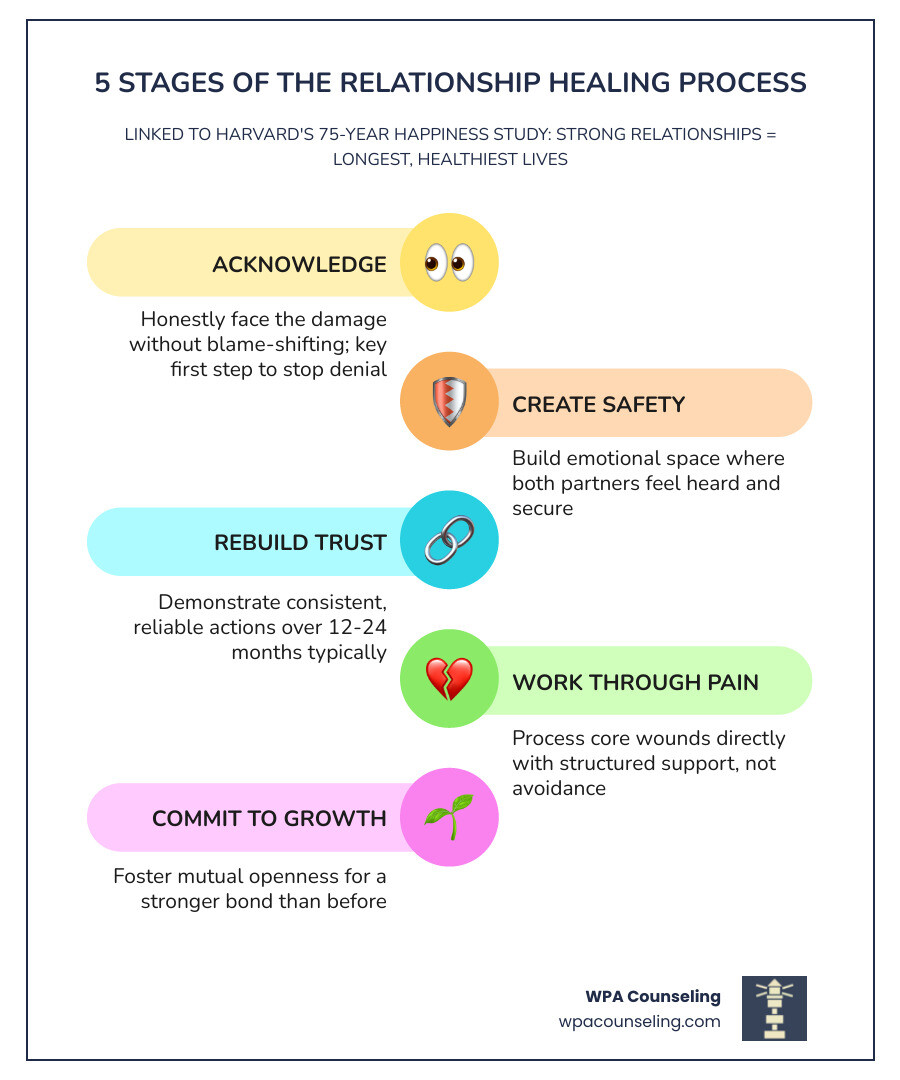
If you’re looking for a quick answer, here it is:
- Acknowledge the damage honestly, without blame-shifting
- Create safety so both partners can speak and be heard
- Rebuild trust through consistent, reliable behavior over time
- Work through the pain — not around it — with structured support
- Commit to growth together, even when progress feels slow
This process is rarely fast. But it is possible — and the outcome can be a stronger bond than you had before.
A 75-year Harvard study on happiness found something that should stop us all in our tracks: the single greatest predictor of a long, healthy life isn’t wealth, career success, or even physical fitness. It’s the quality of your close relationships.
That finding matters here. Because if our connections to the people we love are that central to our well-being, then repairing a damaged bond isn’t just an emotional choice — it’s a health decision.
Relationships break down for many reasons. Betrayal. Repeated hurt. Poor communication. Unresolved trauma. And sometimes, the damage builds so slowly that couples don’t notice how bad things have gotten until they feel completely stuck.
If that’s where you are right now, you’re not alone — and this guide is for you.
Understanding the Relationship Healing Process

When we talk about the relationship healing process, we aren’t just talking about “getting over it.” True healing is an active reconstruction of emotional safety. It is the transition from a state of hyper-vigilance and defense to a state of openness and connection.
At WPA Counseling, we often see couples trapped in what neurobiologists call an “Amygdala Hijack.” This happens when the brain’s alarm center—the amygdala—takes over during a conflict. Instead of listening to your partner, your brain perceives them as a threat, triggering a fight, flight, or freeze response. This is why a simple disagreement about the dishes can suddenly feel like a life-or-death battle.
To move past this, we must address Relationship Trauma And Emotional Abuse by understanding the neurobiology of conflict. When a relationship is damaged, the hippocampus (responsible for memory) and the prefrontal cortex (responsible for logic) struggle to communicate. This leaves partners stuck in a loop of reactive pain.
Clinical research, particularly the work of Dr. John Gottman, identifies The Four Horsemen In A Marriage—criticism, defensiveness, contempt, and stonewalling—as the primary predictors of relationship failure. Healing involves identifying these patterns and replacing them with de-escalation strategies that prioritize the “emotional air” of the room over winning an argument.
Why the Relationship Healing Process Matters in 2026
As we navigate May 2026, the stressors on modern couples have shifted. We are dealing with post-pandemic connection shifts and digital fatigue. Constant connectivity through social media often creates a “comparison trap” or leads to digital betrayal, making it harder to maintain focus on the person sitting right across from us.
Many couples wonder, Is It Too Late To Fix My Marriage?. The answer often lies in the willingness to seek professional guidance. In Western PA, we’ve seen a rise in couples seeking help not because they have “failed,” but because they recognize that the skills needed for a long-term partnership aren’t always intuitive. Long-term psychological health is inextricably linked to how we handle these ruptures.
Signs That a Bond is Progressing Positively
How do you know if the relationship healing process is actually working? It’s rarely a “lightbulb” moment; it’s more of a quiet softening. You might notice:
- Softened Communication: Instead of starting with an accusation, you start with an “I” statement.
- Successful Repair Attempts: When an argument starts, one partner makes a joke or offers a touch that successfully breaks the tension.
- Embracing Conflict As An Opportunity For Growth: You stop viewing disagreements as “war zones” and start seeing them as data points for what needs to change.
- Reduced Defensiveness: You can hear your partner’s pain without immediately listing all the reasons they are wrong.
- Mutual Accountability: Both partners take “Radical Responsibility” for their 50% of the dynamic.
The 4 Stages of Restoring Your Connection
At WPA Counseling, we utilize a specific four-stage healing process designed to move couples from crisis to connection. Understanding these stages helps normalize the “messy” parts of recovery.
| Feature | Healthy Attachment | Trauma Bonding |
|---|---|---|
| Foundation | Trust, safety, and mutual respect | Power imbalance and unpredictability |
| Conflict | Resolved through repair and empathy | Followed by a “honeymoon” but no change |
| Growth | Encourages individual autonomy | Creates emotional dependency and fear |
| Communication | Open, honest, and non-defensive | Characterized by gaslighting or eggshells |
Understanding Trauma Bonding Vs Healthy Attachment How To Tell The Difference is vital because healing from a toxic bond requires a different protocol than repairing a healthy but “bruised” one.
1. Rapport Building The first stage is about establishing a “cease-fire.” We help couples build a baseline of safety so they can sit in a room together without the amygdala taking over. This involves setting ground rules for communication and rediscovering small “rituals of connection.”
2. Wound Exploration Here, we go deeper. We look at the “fractures”—whether they are attachment wounds from childhood or specific betrayals like infidelity. We name what happened using factual descriptions without blame.
3. Toxin Removal This is the “detox” phase. We identify the behaviors that act as poison to the relationship—like contempt or chronic dishonesty. We work on stopping the damage before we try to build anything new.
4. Truth Restoration Finally, we rebuild the narrative of the relationship. This is where “post-traumatic growth” happens. The couple creates a new, more authentic version of their partnership based on radical honesty and shared values.
Navigating the Individual Relationship Healing Process
You cannot have a healthy “we” without a healthy “me.” Often, one partner’s personal growth triggers a shift in the entire dynamic. If you are struggling, The Ultimate Guide To Healing From Trauma In A Relationship emphasizes that self-care isn’t selfish—it’s foundational.
Individual therapy can be a game-changer here. It helps you identify Signs You Are Dating Someone With Relationship Trauma And How To Help and teaches you how to regulate your own nervous system. Much of our adult behavior is rooted in the past; How Childhood Attachment Shapes Adult Relationships explains why some of us “pursue” while others “withdraw” when things get tough.
Rebuilding Trust and Emotional Safety

Trust is not a binary switch; it’s a physiological state where your nervous system feels safe enough to relax. When trust is broken—through From Shock To Acceptance In Betrayal Recovery—the brain enters a state of hyper-vigilance.
To rebuild, the partner who broke trust must demonstrate behavioral reliability. Apologies are a start, but trust is restored through repeated, predictable actions over 12 to 24 months. This might include transparency with technology, consistent check-ins, and showing genuine remorse without asking for a “timeline” on forgiveness.
We also use Family Counseling For Conflict Resolution to help couples establish new boundaries. These aren’t punishments; they are agreements that create a “safety fence” around the relationship. Forgiveness rituals—like writing a letter of unexpressed pain and safely burning it—can also help symbolize the end of an old, painful chapter.
How Do You Rebuild Trust After Lying?
Trust grows back through consistent actions over time, not through a single apology. When one partner has lied, repair usually involves:
- Full accountability: acknowledging what happened without minimizing, blaming, or rushing the hurt partner to move on.
- Transparency: voluntarily offering information, such as schedules or access to shared accounts, for an agreed period while trust is rebuilt.
- Consistency: small promises kept day after day, which matter more than grand gestures.
- Patience with triggers: the hurt partner may have setbacks, and responding with empathy rather than frustration helps healing move forward.
What If I Struggle to Trust Anyone?
Sometimes trust problems are not about one partner’s behavior but about earlier experiences: a past betrayal, a chaotic childhood, or a relationship that involved emotional abuse. You might find yourself checking for signs of deception, expecting to be let down, or keeping people at a distance. Individual counseling can help you understand where these patterns began, calm the fear underneath them, and practice trusting in small, safe steps. Learn more about how childhood attachment shapes adult relationships.
Professional Support: WPA Counseling in Pennsylvania
When you are in the thick of a crisis, it’s hard to see the roadmap. That’s where professional support comes in.
WPA Counseling’s Clinical Experience: Our practice is comprised of Licensed Professional Counselors (LPCs) with extensive clinical experience in relationship dynamics and trauma recovery. We utilize evidence-based, counseling-focused strategies such as the Gottman Method and attachment theory to help couples rebuild trust. Our approach is grounded in clinical psychology and neurobiology, ensuring that every intervention is backed by research and professional expertise. We focus exclusively on counseling-based strategies for trauma recovery, helping clients regulate their nervous systems through therapeutic dialogue and behavioral change.
Our History in Irwin, Pennsylvania: WPA Counseling has deep roots in the Westmoreland County community. We began our journey in Irwin, Pennsylvania, with a mission to provide high-quality, accessible mental health care to our neighbors in Irwin and North Huntingdon. Over the years, we have grown to serve couples across the state, but we remain dedicated to our local history and the community that supported our start.
Service Areas: We offer in-person counseling at our offices in Irwin, North Huntingdon, and Greensburg, making it easy for residents of Western and Central PA to get the face-to-face support they need. For those further afield or with busy schedules, we provide secure, HIPAA-compliant telehealth therapy across all of Pennsylvania. Whether you are searching for Relationship Counseling For Long Distance Couples In Pennsylvania or local marriage support, we are here.
Clinical Focus: Our expertise lies in trauma recovery, anxiety, and complex relationship dynamics. We help couples debunk Marriage Counseling Myths In Pennsylvania—such as the idea that therapy is only for “couples about to divorce.” In reality, therapy is most effective when used as a proactive tool for growth.
Frequently Asked Questions about Relationship Healing
Can a relationship survive if only one partner is committed?
This is a common question. While lasting relationship healing eventually requires both people to pull the oars, change can start with one person. By changing your own reactions and setting firm boundaries, you shift the entire “dance” of the relationship.
However, there are limits. If you are dealing with Emotional Abuse Vs A Difficult Relationship How To Tell The Difference, and the other partner refuses to acknowledge harm or change their behavior, the goal may shift from “relationship repair” to “personal peace.” You cannot heal a bond with someone who is actively causing you trauma.
How long does it take to rebuild trust after betrayal?
There is no “quick formula,” but research suggests that for major betrayals like infidelity, a 12-24 month timeline is standard for full emotional reconciliation. This period allows for the “consistency markers” to take root.
During this time, you may experience Grief After Divorce Healing Beyond Separation—even if you stay together. You are grieving the “old” relationship so you can build a new one. Healing is not linear; expect waves of doubt followed by periods of closeness.
What are the biggest mistakes to avoid during repair?
- Stonewalling: Shutting down or walking away during a conversation prevents repair.
- The Sticky Truth About Trauma Bonding: Mistaking the “high” of a reconciliation for actual behavioral change.
- Rushing the Process: Trying to force a partner to “get over it” before they feel safe.
- Lack of Accountability: Using “but” or “if” in an apology. (e.g., “I’m sorry I lied, but you were being so controlling.”)
- Avoiding Core Wounds: Only fixing surface-level problems while ignoring the underlying trauma.
Conclusion
The relationship healing process is a journey of a thousand small steps. It requires courage, radical honesty, and, often, a helping hand. Whether you are in the heart of Pittsburgh or the quiet suburbs of North Huntingdon, you don’t have to navigate this alone.
At WPA Counseling, we believe that every relationship has the potential for growth if both partners are willing to do the work. If you’re ready to start your roadmap to repair, we invite you to explore Marriage Couples Counseling or connect with our team for Couples Counseling In Pittsburgh.
Your relationship is the foundation of your happiness. Let’s work together to make it strong, safe, and resilient.
This article was researched with AI and heavily edited by Stephen Luther for accuracy and relevance.
Stephen Luther is the Executive Director and Founder of WPA Counseling. He holds a Master’s degree in Education from the University of Georgia and a Master’s degree in Marriage and Family Therapy from Duquesne University. He is a licensed professional counselor in Pennsylvania (LPC).
Since 1997, Steve has been helping children, adolescents, adults, couples, and families overcome emotional and relational challenges. He specializes in working with hurting families, including those with foster, adopted, or traumatized children. Steve uses Attachment-Based Therapy, client-centered therapy, and Therapeutic Parent Coaching to support healing and relationship restoration.
This guide is for educational and spiritual encouragement and is not a substitute for personalized professional counseling. If you are in crisis, please reach out for immediate help.
Anger and Rage: When Normal Emotions Become a Mental Health Concern