

When Divorce Feels Like a Storm You Can’t Escape
CBT for divorce anxiety is one of the most effective, evidence-based ways to manage the overwhelming thoughts, fears, and emotional chaos that come with separation.
Here’s a quick look at how CBT helps:
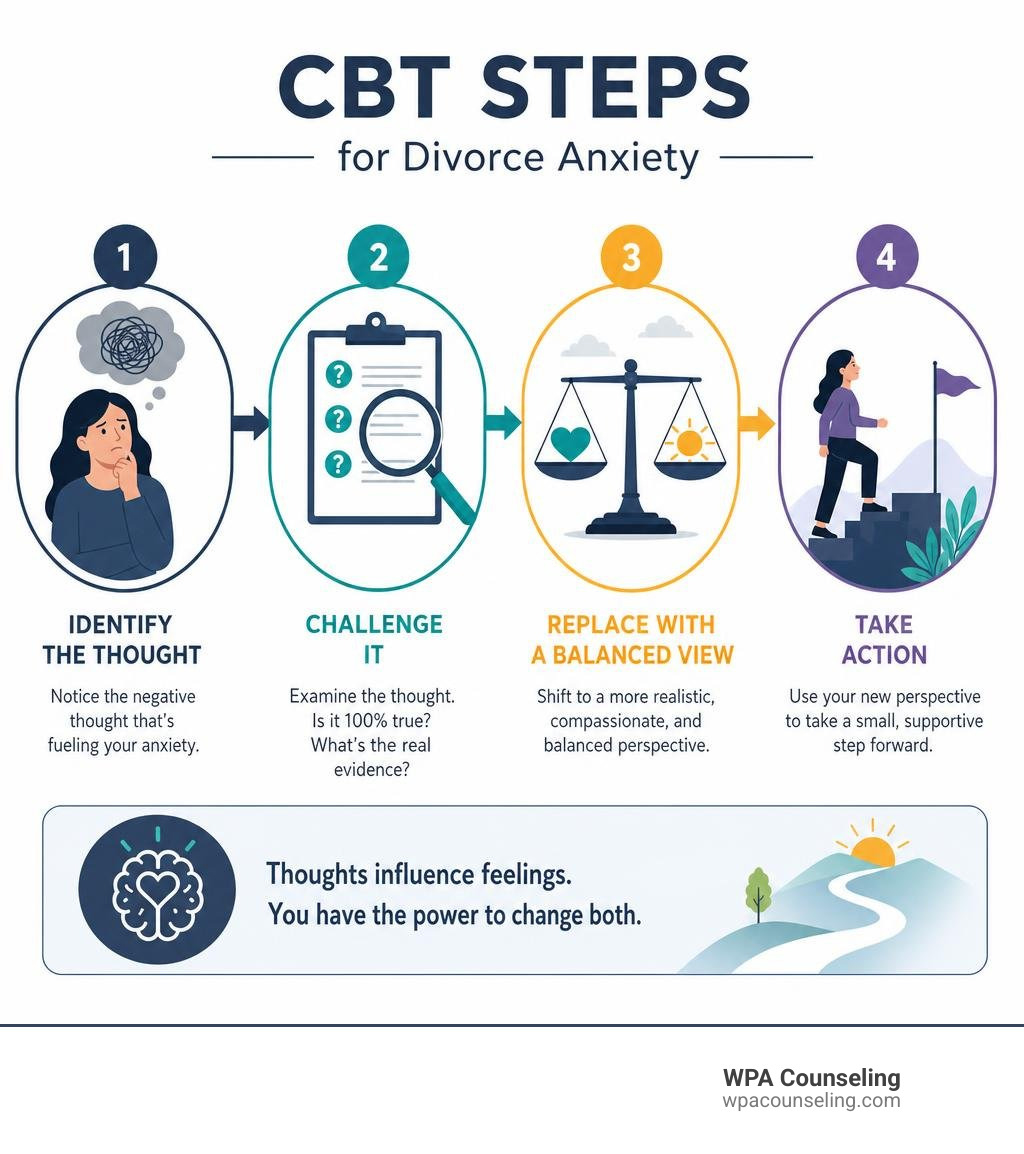
- Identifies negative thought patterns like “I’ll never be happy again” or “This is all my fault”
- Challenges those thoughts by testing them against real evidence
- Replaces distorted thinking with balanced, realistic perspectives
- Teaches coping skills for panic, worry spirals, and low mood
- Works across all stages of divorce — before, during, and after separation
Divorce is more than a legal process. It’s a full emotional upheaval that can shake your sense of identity, your daily routines, and your hope for the future. According to the U.S. Surgeon General, 30 to 40% of people going through divorce experience a significant increase in depression and anxiety symptoms. That’s not a personal failing — it’s a very human response to one of life’s most disorienting losses.
At WPA Counseling, we work with people across Western Pennsylvania who are living inside that storm right now. The racing thoughts at 3am. The dread before every legal email. The grief that hits you out of nowhere in the cereal aisle.
You don’t have to just survive this. With the right tools — especially Cognitive Behavioral Therapy — you can start to make sense of what you’re feeling and find steadier ground.
This guide walks you through exactly how CBT works for divorce anxiety, which techniques help the most, and how professional support can make the difference.
Basic cbt for divorce anxiety glossary:
Understanding Divorce Anxiety and Its Manifestations
When we talk about divorce anxiety, we are looking at a highly complex emotional response. It is not just “worrying about the future.” It is a profound nervous system response to the breakdown of your primary attachment relationship.
This anxiety manifests in several distinct ways:
- Physical Symptoms: Your body does not know the difference between a legal battle and a physical threat. Many individuals experience sweating, chills, chest tightness, shaking, tingling or numbness, chronic fatigue, and severe sleep disturbances. It is incredibly common to feel a sense of physical panic when opening an email from a lawyer or seeing your ex-partner’s name on your phone.
- The Emotional Toll: The emotional landscape of divorce is a rollercoaster of grief, anger, panic, and relief. You might feel fine on Tuesday morning and find yourself completely incapacitated by sadness by Tuesday afternoon. This is a natural part of The Complete Guide to Divorce Grief, where we must grieve not only the loss of the partner, but the loss of the life, family structure, and future we had planned.
- Anticipatory Loss: Long before the physical separation or legal filing takes place, anticipatory loss begins. This is the anxiety that builds when a relationship starts to fracture, and you begin anticipating the pain of the end. It can linger for months or even years, keeping your body in a constant state of high alert.
Understanding that these experiences are normal is the first step in finding relief. Your brain is trying to protect you from a massive life transition, but its alarm system is turned up too high.
The Core Principles of CBT for Divorce Anxiety
Cognitive Behavioral Therapy (CBT) is an active, structured approach that focuses on the powerful connection between our thoughts, our feelings, and our behaviors. When you go through a divorce, this loop can easily spin out of control.
For example, receiving a legal document (Situation) triggers the automatic thought: “I am going to lose everything and end up alone forever” (Thought). This thought immediately causes chest tightness and intense fear (Feeling), which leads you to avoid opening the document and isolate yourself in your bedroom (Behavior).
CBT targets this loop by teaching a fundamental truth: your thoughts are not facts. They are simply mental hypotheses.
During divorce, our brains are highly susceptible to cognitive distortions — systematic biases in the way we process information. Common distortions include:
- Catastrophizing: Imagining the absolute worst-case scenario and treating it as an inevitable reality.
- All-or-Nothing Thinking: Viewing the marriage as a “complete failure” and believing you are “unlovable” because it ended.
- Mind-Reading: Assuming you know exactly what your ex, your family, or your friends are thinking about you.
CBT is highly effective at reducing “anxiety sensitivity” — the fear of anxiety-related sensations (such as a racing heart or dizziness) and the belief that these sensations will cause physical or psychological harm. Clinical studies have shown that CBT significantly improves emotional resilience in individuals navigating relational loss. In fact, a study published in The Journal of Agricultural Research and Clinical Medicine evaluated The Effectiveness of Cognitive-Behavioral Therapy on Psychological Distress and found that structured CBT protocols lead to statistically significant improvements in distress tolerance, helping individuals effectively regulate their emotional responses during major life crises.
Practical CBT Exercises to Reframe Negative Thought Patterns
The heart of using cbt for divorce anxiety lies in cognitive restructuring — the process of identifying, challenging, and reframing unhelpful thoughts.
When you find yourself spiraling into self-blame (“I ruined our family”) or catastrophizing (“My kids will never recover from this”), you can use a structured thought record to bring your brain back to reality.

Here is how you can compare and reframe these automatic negative thoughts:
| Automatic Negative Thought (The Distortion) | The Realistic Reframe (The Balanced Truth) |
|---|---|
| “I am a complete failure because my marriage ended.” | “The end of my marriage is painful, but a relationship’s ending does not define my personal worth or capabilities.” |
| “I will never be happy or feel secure again.” | “I am in deep pain right now, but emotions change. I will build a new, stable life step-by-step.” |
| “This divorce is entirely my fault; I should have done more.” | “Relationships require two people. While I made mistakes, the responsibility for the relationship breakdown is shared.” |
| “My children’s lives are permanently ruined by this split.” | “This is a hard adjustment for my kids, but with consistent love, routine, and support, they can build resilience.” |
By actively engaging in Anxiety Therapy, you learn to spot these distortions before they drive you into a state of panic.
Can I practice CBT for divorce anxiety at home?
Absolutely. While working with a licensed therapist provides the deepest healing, there are several practical, evidence-based CBT exercises you can practice on your own:
- Spotting Patterns Through Journaling: Don’t just write down what happened today. Write down the situation, what you thought about it, how it made you feel, and what you did. Over time, you will see clear patterns in what triggers your anxiety.
- The 5:1 Ratio Exercise: When your mind generates a harsh, absolute negative statement (e.g., “I will always be alone”), challenge yourself to write down five neutral, realistic alternative statements (e.g., “I have close friends who love me,” “I enjoy my own company sometimes,” “I cannot predict the future,” “I am capable of forming new connections,” “Right now, I am safe”).
- The Pie Chart of Blame: When we feel overwhelming guilt, we tend to take 100% of the responsibility. Draw a physical circle on a piece of paper. Distribute the pieces of the pie to all contributing factors: your actions, your partner’s actions, communication barriers, external stressors (like financial pressure or family interference), and simple incompatibility. Visually seeing that your slice is only a portion of the whole can dramatically reduce toxic self-blame.
- The Thoughts-Feelings-Behavior Triangle: Draw a triangle. Label the corners “Thoughts,” “Feelings,” and “Behaviors.” Write down your current state in each corner. Then, write down how changing just one corner (e.g., changing the behavior of staying in bed to taking a 10-minute walk) shifts the other two corners.
- Imagining a Stop Sign: When you notice your mind beginning to spin into a catastrophizing loop at 3am, visualize a bright, solid red STOP sign. Say the word “Stop” out loud or in your mind, and immediately redirect your attention to a physical sensation, like the feeling of your feet on the floor or the rhythm of your breath.
- Worry Time: Instead of letting divorce-related worries consume your entire day, schedule a dedicated 15-minute “Worry Time” (e.g., 4:00 PM to 4:15 PM). If a worry pops up at 10:00 AM, write it down on a notepad and tell yourself, “I will think about that at 4:00 PM.” When Worry Time arrives, go through your list. You will find that many of the worries have lost their emotional sting by the time you sit down to address them.
Tailoring CBT Across the Stages of Divorce
Divorce is not a single event; it is a multi-stage journey. The psychological challenges you face will shift dramatically depending on where you are in the timeline, requiring tailored CBT interventions. Understanding where you are on both the legal and psychological tracks is essential, as outline in From I Do to I’m Done: Understanding Divorce Recovery Stages.
- Before Separation (Pre-Separation): In this phase, the primary challenges are anticipatory loss, high uncertainty, and the lingering hope for reconciliation. CBT helps you explore your prior beliefs about marriage and divorce. We evaluate the evidence for and against reconciliation objectively, helping you navigate the painful space between holding on and letting go without falling into self-sabotage.
- During the Separation: This is often the most chaotic phase, dominated by court dates, mediation, housing changes, and acute emotional distress. Here, CBT focuses heavily on emotional regulation and distress tolerance. We teach grounding exercises to use during high-stress legal meetings and help you manage the cognitive distortions that arise when negotiating assets or custody.
- After the Separation (Post-Divorce): Once the legal dust settles, the focus shifts to rebuilding your identity, processing lingering Grief After Divorce: Healing Beyond Separation, and planning for the future.
In this post-separation phase, we emphasize a specific sequencing of emotional skills:
- Forgiveness: First, working to release the toxic grip of resentment toward your ex-partner and yourself.
- Kindness: Next, cultivating deep self-compassion for the version of you that was just trying to survive.
- Gratitude: Finally, building the capacity to appreciate the new opportunities, peace, and growth that this next chapter brings.
How CBT for divorce anxiety helps with co-parenting conflict
If you have children, the end of the marriage does not mean the end of the relationship; it simply changes the format. Co-parenting requires constant communication with a person who may be a primary trigger for your anxiety.
CBT tools can be highly effective in improving communication during co-parenting and mediation. By teaching you to identify your emotional triggers, CBT helps you pause before responding to a hostile text or email. You learn to separate the practical details of co-parenting (e.g., pick-up times, school forms) from the emotional history of your relationship.
Furthermore, CBT helps parents model emotional stability and maintain predictable, healthy routines for their children, ensuring the kids’ best interests remain the priority throughout the transition.
Integrating CBT with DBT, Mindfulness, and Family-Based Support
While CBT is incredibly powerful on its own, integrating it with Dialectical Behavior Therapy (DBT), mindfulness, and family-based approaches offers a comprehensive toolkit for healing.
- DBT Skills for Crisis Moments: DBT is a branch of CBT that focuses heavily on distress tolerance and interpersonal effectiveness. When you are facing an overwhelming wave of anxiety before a court hearing, DBT skills like “TIPP” (Temperature, Intense exercise, Paced breathing, Paired muscle relaxation) can physically reset your nervous system.
- Mindfulness and Grounding: Integrating mindfulness helps you stay anchored in the present moment. Exercises like the 5-4-3-2-1 sensory method (naming five things you see, four you can touch, three you hear, two you smell, and one you taste) are highly effective at halting panic attacks.
- Evidence for Online and Family-Based Interventions: Research consistently supports the efficacy of structured psychological interventions for divorce recovery. A clinical trial published in the Asian Journal of Social Health and Behavior demonstrated that online, family-based CBT significantly reduced anxiety and depression scores in divorced head-of-household women, while simultaneously improving family cohesion and adaptability.
Additionally, a study in the Journal of Jiroft University of Medical Sciences compared the effectiveness of CBT and motivational interviewing, proving that both modalities significantly reduced symptoms of anxiety sensitivity in divorced women compared to control groups. These studies emphasize that whether you engage in individual therapy or family-based programs, structured cognitive interventions provide measurable, lasting relief.
Professional Support: How WPA Counseling Guides Your Healing Journey
At WPA Counseling, we understand that trying to apply these tools on your own when you are exhausted and overwhelmed can feel like trying to build a boat while you are drowning.
We are a compassionate group practice of licensed professional counselors based in Irwin/North Huntingdon, Pennsylvania, with an additional office in Penn Hills. We provide warm, evidence-based in-person counseling at our Western PA offices, as well as secure, convenient telehealth therapy across the entire state of Pennsylvania.
With years of dedicated local practice history in Westmoreland and Allegheny counties, WPA Counseling has established itself as a trusted clinical resource in Western Pennsylvania. Our team of licensed therapists brings decades of combined clinical experience in evidence-based psychotherapies, specializing in cognitive behavioral strategies, grief counseling, and trauma-informed care. We focus exclusively on counseling-based strategies for trauma recovery, helping individuals process the deep emotional wounds of relational breakdown without relying on alternative or medicalized interventions. Over our years of service, we have helped hundreds of local residents navigate the complexities of divorce, custody transitions, and anxiety, providing a stable, professional anchor during life’s most turbulent moments.

Our core approach is built around the Counseling Blueprint, a thoughtful, four-stage healing journey designed to help you move from survival to peace:
- Take Off the Mask: We build a genuine, safe, and collaborative relationship where you can express your anger, grief, and fear without judgment.
- Heal the Wounds: We gently explore the emotional and relational hurts of your relationship’s breakdown, giving you space to grieve.
- Remove the Toxins: Together, we identify the unhelpful beliefs, cognitive distortions, and lingering lies you may be telling yourself (such as “I am unlovable” or “I ruined my life”).
- Replace with Truth: We install empowering, accurate, and compassionate perspectives about yourself, your children, and your future, helping you step into your new life with confidence.
Whether you are seeking Western PA Anxiety Therapy That Helps You Breathe Easy or looking for specialized support to navigate your co-parenting relationship, our licensed counselors are here to help you find your footing.
Frequently Asked Questions about Divorce Anxiety
Navigating divorce-related anxiety brings up many questions. Here are quick, professional answers to some of the most common concerns we hear.
What are the physical symptoms of divorce anxiety?
Divorce anxiety often manifests physically due to prolonged nervous system activation. Common symptoms include chronic muscle tension, chest tightness, rapid heart rate, panic attacks, digestive issues (like nausea or appetite changes), chronic fatigue, and sleep disturbances (such as insomnia or waking up with racing thoughts).
How long does CBT take to help with divorce recovery?
While everyone’s healing journey is unique, structured CBT protocols typically show measurable improvements within 12 to 16 weekly sessions. Many clients report feeling a greater sense of control and reduced panic within the first few weeks as they begin practicing active coping skills at home.
Can children benefit from family-based CBT during a divorce?
Yes. Children often experience their own version of divorce anxiety, which can manifest as behavioral changes, academic struggles, or self-blame. Family-based CBT helps children process their thoughts, reassures them that the split is not their fault, and provides parents with the communication tools needed to maintain stability and cohesion.
Conclusion
Divorce is undoubtedly one of the most challenging storms you will ever navigate, but it does not have to define the rest of your life. By using cbt for divorce anxiety, you can break free from toxic worry spirals, reclaim control over your nervous system, and begin rewriting your story with hope and self-compassion.
You do not have to walk through this transition alone. If you are ready to take the next step toward healing, we invite you to explore our Grief and Loss Counseling Services and let us thoughtfully match you with a compatible licensed Pennsylvania counselor.
Reach out to WPA Counseling today to schedule an appointment at our Irwin/North Huntingdon or Penn Hills office, or via secure statewide telehealth. Let’s work together to replace the chaos with clarity and help you step confidently into your next chapter.
This article was researched with AI and heavily edited by Stephen Luther for accuracy and relevance.
Stephen Luther is the Executive Director and Founder of WPA Counseling. He holds a Master’s degree in Education from the University of Georgia and a Master’s degree in Marriage and Family Therapy from Duquesne University. He is a licensed professional counselor in Pennsylvania (LPC).
Since 1997, Steve has been helping children, adolescents, adults, couples, and families overcome emotional and relational challenges. He specializes in working with hurting families, including those with foster, adopted, or traumatized children. Steve uses Attachment-Based Therapy, client-centered therapy, and Therapeutic Parent Coaching to support healing and relationship restoration.
This guide is for educational and spiritual encouragement and is not a substitute for personalized professional counseling. If you are in crisis, please reach out for immediate help.
The Complete Guide to Divorce Grief