

Find Clarity When You Are Unsure Whether to Stay or Leave
If you are searching for discernment therapy near me, look for a licensed counselor who works with couples where one person wants to repair the relationship and the other is unsure about staying. This short-term process is not about forcing reconciliation or divorce. It helps you slow down, understand what brought you here, and make a clear next decision.
At WPA Counseling, we offer in-person counseling in Western Pennsylvania, including Irwin/North Huntingdon and Penn Hills, plus secure telehealth across Pennsylvania. Whether you feel emotionally exhausted, stuck after past couples therapy, or unsure how to move forward after conflict or betrayal, you do not have to make this decision alone. For those facing deep relational crossroads, finding trusted couples counseling near me or specialized couples counseling for infidelity begins with discerning your true level of commitment.
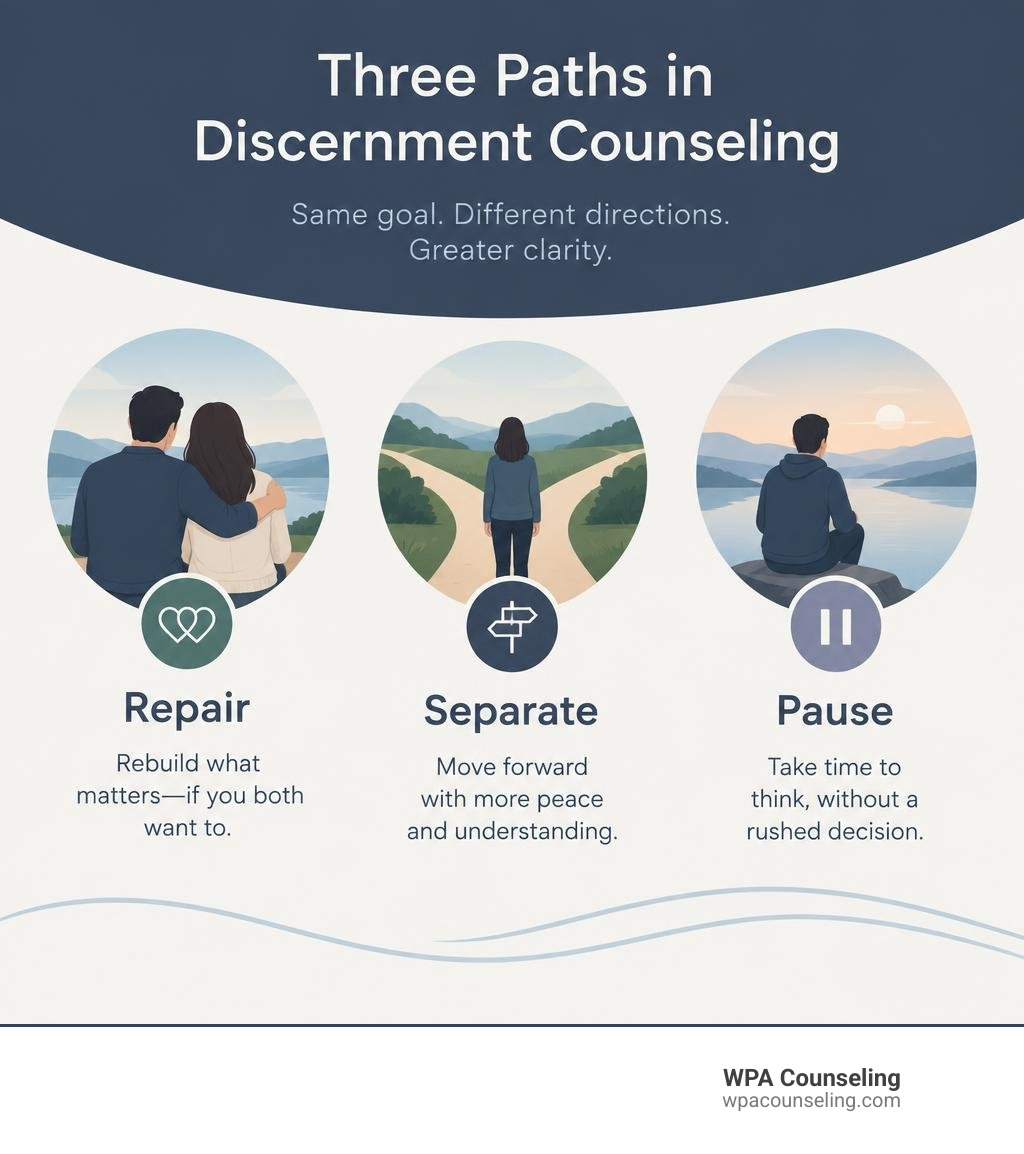
Discernment counseling creates space for both partners to be heard. The goal is clarity: commit to serious relationship work, move toward separation with greater peace, or decide to pause without making a rushed choice. According to the American Association for Marriage and Family Therapy, discernment counseling is a structured approach designed specifically for mixed-agenda couples facing this kind of relationship ambivalence.
What Is Discernment Counseling and How Does It Differ from Couples Therapy?
When a marriage enters a deep crisis, both spouses are rarely in the exact same emotional space. More often, you find what therapists call a “mixed-agenda” dynamic:
- The Leaning-Out Partner: Feels emotionally drained, ambivalent, or ready to end the relationship, doubting that real change is possible.
- The Leaning-In Partner: Wants to save the marriage, repair the connection, and do whatever it takes to stay together.
Traditional marriage and couples counseling presumes that both individuals enter the room with a shared commitment to fix the relationship. When one partner is already standing near the exit door, standard therapy often backfires. The leaning-out partner feels pressured, while the leaning-in partner grows increasingly anxious.
Discernment counseling replaces the pressure to fix things with a structured framework designed solely for decision-making.
| Feature | Traditional Couples Therapy | Discernment Counseling |
|---|---|---|
| Primary Goal | Repair, strengthen, and resolve relationship conflicts | Gain clarity and confidence on whether to stay or leave |
| Client Commitment | Both partners committed to working on the union | One or both partners ambivalent about staying together |
| Format | Mostly joint sessions focusing on communication | Brief joint check-ins with extensive one-on-one time |
| Duration | Open-ended (months to years) | Short-term (strictly 1 to 5 sessions) |
| Therapist Role | Neutral mediator facilitating connection | Objective guide helping partners choose a clear direction |
Who Should Consider Discernment Counseling (and When It Is Not the Right Fit)
Roughly 75% of divorce proceedings cite a lack of commitment as a primary factor, making ambivalence the single leading reason couples split. If you find yourself asking, “is it too late to fix my marriage?” discernment counseling provides an intentional pause before legal actions become irreversible.
Discernment counseling is an ideal fit when:
- One spouse is considering divorce while the other wants to preserve the marriage.
- You have tried traditional counseling in the past and felt it stalled because of unequal commitment.
- You want to understand your own contribution to the relationship’s breakdown before making a permanent life transition.
When discernment counseling is NOT appropriate:
- There is ongoing intimate partner violence, physical abuse, or danger of coercion.
- An active, unmanaged substance addiction makes clear decision-making impossible.
- One partner has already made an absolute, final decision to divorce and simply wants counseling to break the news gently.
- Both partners are already fully committed to repairing the marriage (in which case, standard couples therapy is the right choice).
- One partner will not attend at all. Discernment counseling needs both partners to take part, so if yours won’t come, read what you can do when your partner won’t go to couples counseling.
How to Access Discernment Therapy Near Me for Virtual or In-Person Sessions
Finding qualified care should not add stress to an already overwhelming season. Modern discernment counseling can be accessed through convenient in-person office visits or via secure telehealth platforms. Telehealth provides vital emotional privacy, allowing each spouse to join from comfortable spaces while maintaining full clinical focus under the guidance of a licensed Pennsylvania professional.
How the Discernment Process Works: Structure, Sessions, and the Three Paths
Discernment counseling is designed to be time-limited, running anywhere from 1 to a maximum of 5 sessions. Each meeting lasts between 80 and 120 minutes.

Unlike standard counseling where partners sit together the entire hour, discernment sessions follow a deliberate rhythm:
- Brief Joint Opening: The counselor meets with both partners together for 10–15 minutes to establish the focus of the day.
- Individual Conversations: The counselor spends dedicated one-on-one time (typically 30–40 minutes) with each spouse separately. This allows the leaning-out partner to share doubts without feeling judged, and the leaning-in partner to process grief without escalating conflict.
- Joint Wrap-Up: Both partners rejoin for the final 10 minutes to summarize key insights and decide together whether to schedule the next discernment session.

The Three Possible Outcomes of Discernment Counseling
At the end of the process (or at any point during the 1 to 5 sessions), couples choose one of three distinct paths:
- Path 1: The Status Quo. Keep the relationship as it is, making no immediate moves toward either separation or intensive repair.
- Path 2: Separation or Divorce. Move intentionally toward dissolving the relationship. While roughly 41% of couples choose separation after discernment counseling, they do so with significantly greater peace, reduced legal hostility, and clearer co-parenting alignment than couples who split impulsively. If this path is chosen, understanding what to expect from short-term divorce therapy can help both individuals transition with dignity.
- Path 3: A Six-Month Intensive Reconciliation Commitment. Set divorce completely off the table for six months and commit fully to rigorous couples therapy. Research shows that nearly half (47%) of couples completing discernment counseling choose this path, giving their marriage an authentic, wholehearted second chance.
Navigating Betrayal, High Conflict, or a Hesitant Partner
When an affair or emotional betrayal has occurred, the pain can trigger intense volatility. Discernment counseling helps unpack how the breakdown occurred without forcing the betrayed partner to immediately promise forgiveness or forcing the unfaithful partner into endless defensive postures.
If your partner is hesitant to attend, frame the invitation as a short, low-pressure exploration. Emphasize that discernment counseling is not a trap to force them to stay; it is a neutral arena to help both of you stop spinning your wheels and figure out what is truly best.
Finding Discernment Therapy Near Me: Cost, Insurance, and Professional Standards
Because discernment counseling is specialized, short-term decision-making work rather than treatment for a diagnosed mental health disorder, it is generally billed out-of-pocket rather than through insurance. Clinicians must hold active state licensure (such as LPC, LMFT, or LCSW) and possess advanced training in mixed-agenda dynamics, attachment theory, and crisis mediation.

Before beginning, review a practical guide to marriage counseling in Pennsylvania to understand how session fees, clinical boundaries, and informed consent work within the commonwealth.
Choosing the Right Provider for Discernment Therapy Near Me in Pennsylvania
At WPA Counseling, our clinical team brings deep experience and an established local practice history in walking couples through complex crossroads. As a dedicated group practice of licensed professional counselors rooted in Western Pennsylvania, we have extensive background serving individuals and couples facing pivotal relationship decisions. Our comprehensive clinical practice covers individual counseling, anxiety therapy, depression counseling, trauma therapy, couples counseling, family counseling, grief support, stress management, and faith-sensitive counseling.
We utilize evidence-based frameworks—including Cognitive Behavioral Therapy (CBT), Dialectical Behavior Therapy (DBT), trauma-informed care, and attachment-based approaches—to help clients identify and understand core relational dynamics.
Our work is deeply informed by our core Counseling Blueprint, which guides individuals and couples through four stages of restoration:
- Take Off the Mask: Building safe rapport where both partners can be completely honest about their ambivalence without fear of judgment.
- Heal the Wounds: Identifying deep emotional injuries, unresolved resentments, and attachment ruptures.
- Remove the Toxins: Uncovering unhelpful behavioral cycles, unmanaged anxiety, and destructive communication habits.
- Replace with Truth: Establishing clear, grounded perspectives about personal boundaries, self-worth, and healthy relational dynamics.
We offer comfortable, private in-person sessions at our offices in Irwin / North Huntingdon and Penn Hills, as well as secure, confidential telehealth across the entire state of Pennsylvania. To explore the clinical qualities that make a significant difference in your care, read our guide on finding the right marriage counseling in Pittsburgh.
Frequently Asked Questions About Discernment Counseling
What happens if my partner refuses to participate in discernment counseling?
If your spouse is completely unwilling to attend, you can still participate in solo discernment counseling. Individual clarity sessions with a licensed therapist allow you to step back, evaluate your personal boundaries, examine your contributions to the relationship dynamic, and decide how you wish to proceed with calm confidence.
How many sessions does discernment counseling take to reach clarity?
Discernment counseling is strictly limited to 1 to 5 sessions. Each meeting concludes with a simple question: “Do you want to come back for another session, or are you ready to choose Path 1, 2, or 3?” Most couples find the clarity they need within 2 to 4 sessions.
Is virtual discernment counseling as effective as in-person therapy?
Yes. Telehealth discernment counseling provides identical clinical outcomes to in-person meetings. Virtual sessions allow each partner to engage from a secure, familiar environment, which often reduces physiological tension and makes vulnerable, honest conversation easier.
Conclusion: Gaining Clarity and Peace for Your Next Step
Living in relationship limbo is exhausting. When you feel caught between the fear of leaving and the pain of staying, continuing the cycle of daily arguments and silent resentment will only drain your emotional reserves.
Discernment counseling gives you and your partner a structured, compassionate, and pressure-free roadmap. Whether your journey leads toward rebuilding your bond through dedicated couples counseling in Pittsburgh or transitioning apart with mutual respect, you deserve clarity and peace.
At WPA Counseling, we match you with a licensed Pennsylvania counselor who understands the nuances of relationship ambivalence. Reach out to our team today to get matched with a therapist and take your next step forward with confidence.
This article was researched with AI and heavily edited by Stephen Luther for accuracy and relevance.
Stephen Luther is the Executive Director and Founder of WPA Counseling. He holds a Master’s degree in Education from the University of Georgia and a Master’s degree in Marriage and Family Therapy from Duquesne University. He is a licensed professional counselor in Pennsylvania (LPC).
Since 1997, Steve has been helping children, adolescents, adults, couples, and families overcome emotional and relational challenges. He specializes in working with hurting families, including those with foster, adopted, or traumatized children. Steve uses Attachment-Based Therapy, client-centered therapy, and Therapeutic Parent Coaching to support healing and relationship restoration.
This guide is for educational and spiritual encouragement and is not a substitute for personalized professional counseling. If you are in crisis, please reach out for immediate help.