Understanding Divorce Trauma vs. PTSD
When we talk about the deep, lingering pain of a marriage ending, we often use the word “trauma.” But is it clinically accurate to call this experience Post-Traumatic Stress Disorder (PTSD)?
To understand this, we have to look at how mental health professionals diagnose trauma. Under the Diagnostic and Statistical Manual of Mental Disorders (DSM-5-TR), a formal diagnosis of PTSD requires exposure to a “Criterion A” event. This means an individual must have experienced or witnessed actual or threatened death, serious injury, or sexual violence.
Because most divorces—even highly stressful ones—do not involve these specific physical threats, a formal PTSD diagnosis typically does not apply to a standard marital split. However, if your marriage involved intimate partner violence or severe abuse, a formal PTSD diagnosis is absolutely possible and highly relevant. You can read more about navigating these challenges in our guide on navigating PTSD: strategies and support.
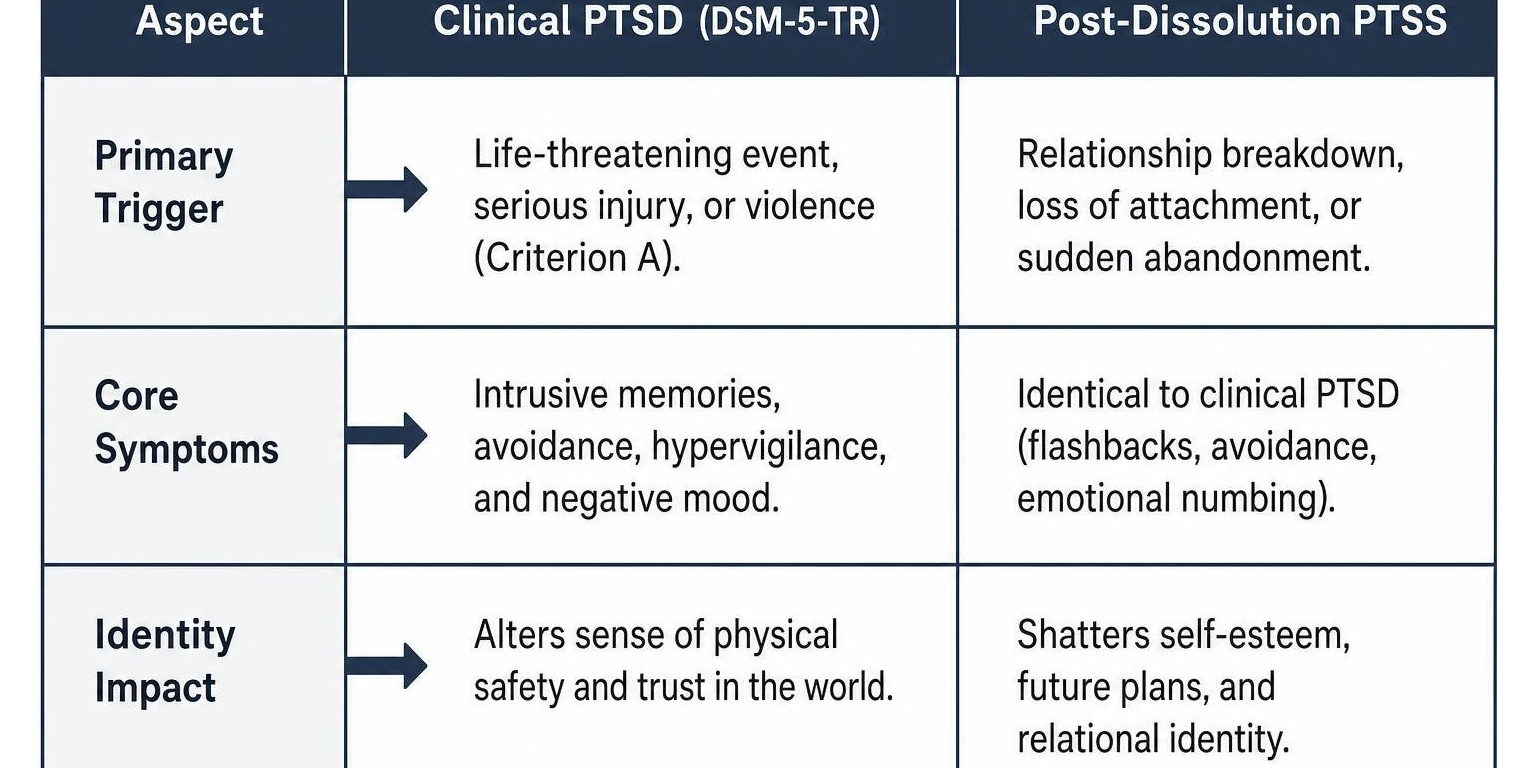
For those who do not meet the strict Criterion A definition but still experience identical psychological distress, researchers use the term post-dissolution PTSS (post-traumatic stress symptoms). The brain’s threat-response system does not know the difference between a physical threat, like a predator, and the emotional threat of having your primary attachment system shattered. Both trigger the exact same fight-or-flight response, flooding your body with cortisol and adrenaline.
| Aspect | Clinical PTSD (DSM-5-TR) | Post-Dissolution PTSS |
|---|---|---|
| Primary Trigger | Life-threatening event, serious injury, or violence (Criterion A). | Relationship breakdown, loss of attachment, or sudden abandonment. |
| Core Symptoms | Intrusive memories, avoidance, hypervigilance, and negative mood. | Identical to clinical PTSD (flashbacks, avoidance, emotional numbing). |
| Identity Impact | Alters sense of physical safety and trust in the world. | Shatters self-esteem, future plans, and relational identity. |
| Diagnostic Status | Officially recognized clinical mental health diagnosis. | Sub-clinical classification that recognizes identical trauma symptoms. |
Whether you meet the formal diagnostic criteria or are experiencing post-dissolution PTSS, your pain is real, valid, and highly disruptive. Recognizing that your nervous system is stuck in survival mode is the first step toward reclaiming your life.
Recognizing the Symptoms of Divorce Trauma
How do you know if you are experiencing normal grief or if you are dealing with deeper divorce trauma? When a split is particularly high-conflict, sudden, or abusive, the emotional fallout can crystallize into trauma symptoms that make it difficult to function in your daily life.
Common symptoms of divorce-related trauma include:
- Intrusive thoughts and memories: You might find yourself replaying the moments of the split, final arguments, or legal battles over and over in your mind. These can show up as daytime flashbacks or vivid nightmares that disrupt your sleep.
- Hypervigilance: Your nervous system remains on high alert. You might feel constantly anxious, jumpy, or waiting for the “other shoe to drop,” even when you are in a safe environment.
- Avoidance: You go to great lengths to avoid places, people, songs, or conversations that remind you of your ex-spouse or the marriage.
- Physical and sleep issues: Trauma lives in the body. You may experience chronic insomnia, digestive issues (like irritable bowel syndrome), muscle tension, or even jaw pain (TMJ) from clenching your teeth.
- Negative changes in mood and cognition: You might struggle with persistent feelings of shame, guilt, or anger. It is common to hold exaggerated negative beliefs about yourself, such as “I am unlovable” or “I will always be alone.”
If these symptoms persist for more than a month and interfere with your ability to work, parent, or care for yourself, it is a sign that your healing process has stalled. Understanding these signs is crucial, and you can learn more about how professional help can guide you through this in our article on understanding trauma therapy: a path to healing.
Coping with Divorce Trauma: The Emotional and Psychological Impact
Processing the emotional and psychological impact of a divorce requires a gentle, structured approach. When we are in the thick of a crisis, our minds often struggle to tell the difference between thoughts and feelings.
For example, saying “I feel like I will never be happy again” is actually a thought (a cognitive projection about the future), not a pure feeling. The underlying feeling might actually be sadness, fear, or loneliness. Learning to separate your thoughts from your raw emotions is a vital skill. When you label your feelings accurately—such as distinguishing frustration from deep grief—you can choose healthier coping mechanisms that actually match your emotional state.
Grief is not a straight line. It is a messy, circular process where you might feel completely fine one day and utterly devastated the next. This emotional volatility is a normal response to the death of your shared dreams and identity. To explore the depth of this emotional journey, you can read our comprehensive resource, the complete guide to divorce grief.
Navigating the Five Phases of Divorce Grief
While traditional grief models exist, divorce grief is unique because the person you are grieving is still alive, and you may still have to interact with them due to legal matters or co-parenting. We often view this journey through five specific phases:
- Heartbreak: This is the initial shock phase. Your world feels like a bomb has gone off in the living room. You may experience physical symptoms of shock, numbness, or deep denial.
- The Rollercoaster: This is typically the longest and most volatile phase. You will swing wildly between anger, bargaining, profound sadness, and sudden moments of relief.
- Mending: In this phase, the intense emotional swings begin to level out. You start to shift your focus away from what your ex-spouse is doing and turn your energy back toward yourself and your own healing.
- Letting Go: This phase involves accepting the reality of the end of the marriage. You stop wishing things were different and begin to take responsibility for your own part in both the relationship and your future happiness.
- Moving On: You begin to embrace your new identity as an individual. You start looking toward the future with hope, pursuing new interests, and building a life that feels genuinely fulfilling.
Understanding where you are on this spectrum can help normalize the daily challenges you face. For a deeper dive into these stages, check out our in-depth guide to divorce grief stages.
Rebuilding Self-Esteem and Fostering Posttraumatic Growth
Divorce has a sneaky way of eroding your self-esteem. When a marriage ends, we often internalize the split as a personal failure. We ask ourselves: “What is wrong with me? Why wasn’t I enough?”

However, the pain of divorce does not have to be the end of your story. In psychology, there is a concept known as Posttraumatic Growth (PTG). PTG refers to the positive psychological changes that can occur as a result of struggling with highly challenging life circumstances. It is not about pretending the trauma was a good thing; rather, it is about finding a way to rebuild your life in a way that makes you stronger, more resilient, and more self-aware than you were before.
Through cognitive reappraisal—shifting your perspective from “I am a victim of a failed marriage” to “I am a survivor who is learning to stand on my own”—you can foster true growth. You can explore this transformative process in our article on the definitive guide to emotional divorce recovery.
How Self-Esteem Mediates Coping with Divorce Trauma
Research shows that self-esteem is the primary psychological bridge that translates posttraumatic growth into actual, day-to-day happiness and subjective well-being. When you actively work to rebuild your self-perception, improve how you relate to others, and cultivate a deeper appreciation for life, your self-esteem naturally rises.
This rise in self-esteem is what ultimately leads to greater happiness. Interestingly, studies show that there are no significant differences between men and women in how self-esteem and posttraumatic growth interact. Everyone has the capacity to rebuild their self-worth.
For those who struggle with low self-esteem after a split, exploring spiritual, existential, or faith-sensitive pathways can also offer a powerful alternative route to finding peace and happiness. No matter where you are starting from, understanding these steps is key to moving through the stages of divorce recovery.
Practical Strategies for Healing and Moving Forward
Healing from divorce trauma requires active, daily participation in your own recovery. Here are practical strategies you can implement starting today:
- Establish Clear Boundaries: If communicating with your ex-spouse always turns into an argument, change how you interact. Move to a written, business-like communication style. If a phone call turns hostile, calmly say, “I am hanging up now, and we can discuss this via email later.”
- Practice Somatic Self-Soothing: When your nervous system is overwhelmed, engage in deep breathing, progressive muscle relaxation, or spending quiet time in nature.
- Build Your Social Support Network: Do not isolate yourself. Reach out to trusted friends, join a local support group, or find a new hobby—like an art class or an intramural sports team—to begin rebuilding your social circle.
- Delay Major Life Decisions: The immediate aftermath of a split is not the time to quit your job, move across the country, or make drastic financial changes. Give yourself time to stabilize first.
If you are looking for a structured way to navigate these steps, you can find actionable support in our guide on healing from trauma: proven steps for emotional recovery.
Supporting Children Through Divorce Trauma
If you are a parent, you are likely carrying the double burden of managing your own emotional recovery while trying to protect your children. Children are incredibly perceptive; they absorb the stress and conflict in their environment.
To help your children cope with the transition:
- Provide Constant Reassurance: Remind them regularly that the divorce is an adult issue and is absolutely not their fault.
- Maintain Stable Routines: Keep bedtimes, school schedules, and rules as consistent as possible across both households.
- Avoid Parental Conflict in Front of Them: Never argue in front of your children, use them as messengers, or speak negatively about the other parent.
- Consider Transitional Arrangements: Some families utilize temporary “birdnesting” (where the children stay in the family home and the parents rotate in and out) to minimize initial disruption.
Professional Support and Evidence-Based Therapy
Sometimes, the weight of coping with divorce trauma is too much to carry alone. Seeking professional help is not a sign of weakness; it is an evidence-based step toward reclaiming your mental health and well-being.
At WPA Counseling, we match clients with licensed Pennsylvania counselors who specialize in helping individuals process trauma, anxiety, and relationship transitions. We use proven, evidence-based approaches—such as Cognitive Behavioral Therapy (CBT), Dialectical Behavior Therapy (DBT), attachment-based therapy, and trauma-informed care—to help you safely process your experiences.
With a rich history of serving the Western Pennsylvania community, WPA Counseling has established a reputation for clinical excellence and dedicated local practice. Our licensed therapists bring years of specialized clinical experience in trauma recovery, family transitions, and emotional rehabilitation. Over our years of local practice, we have helped hundreds of individuals navigate the complex emotional landscape of divorce, providing a stable, compassionate anchor in the community. By combining deep local roots with rigorous, evidence-based counseling strategies, we ensure our clients receive highly credible, professional care tailored to their unique lives.
Whether you prefer in-person therapy at our comfortable offices in Western Pennsylvania or secure telehealth sessions from anywhere in the state, our team is here to support you. You can learn more about how we tailor this care in our guide to PA divorce trauma therapy.
Professional Counseling for Coping with Divorce Trauma
Our core clinical approach is the Counseling Blueprint, a thoughtful, four-stage healing journey designed to help you move from pain to posttraumatic growth:
- Take Off the Mask: We focus on building genuine rapport and trust. You can drop the brave face and express your rawest emotions in a safe, non-judgmental space.
- Heal the Wounds: We explore the deep emotional and relational hurts caused by the split, allowing you to process the grief and trauma safely.
- Remove the Toxins: Together, we identify and dismantle the unhelpful beliefs, self-blame, and lingering lies (such as “I am a failure” or “I will never be loved again”) that are keeping you stuck.
- Replace with Truth: We install empowering, accurate, and healthy perspectives about yourself, others, and your future, helping you step into a life of renewed self-esteem and happiness.
We provide convenient in-person options at our offices in Irwin/North Huntingdon and Penn Hills, as well as secure online therapy across the entire state of Pennsylvania. To learn more about how our trauma-informed care works, check out our resource on trauma therapy explained: what it is and how it helps.
Frequently Asked Questions about Divorce Trauma
Can divorce cause formal PTSD?
Generally, no. Under the DSM-5-TR, a formal PTSD diagnosis requires exposure to a “Criterion A” event involving actual or threatened death, serious injury, or sexual violence. However, if your marriage involved domestic violence, PTSD is a common and valid diagnosis. For non-physical splits, individuals frequently experience post-dissolution PTSS, which presents identical emotional, cognitive, and physical symptoms.
How long does it take to heal from divorce trauma?
There is no fixed timeline. Healing is non-linear. While the immediate crisis phase often stabilizes within a few months, fully processing the grief, rebuilding your self-esteem, and moving into posttraumatic growth can take one to three years. Working with a licensed professional can help you navigate this timeline safely.
How can I protect my children from high-conflict divorce stress?
The best way to protect your children is to keep them out of the middle of the conflict. Maintain consistent, predictable routines, communicate with your co-parent using business-like boundaries, and avoid speaking negatively about your ex-spouse in their presence.
Conclusion
Coping with divorce trauma is a deeply challenging journey, but you do not have to walk this path alone. The pain of a marital split can feel like an ending, but with the right support, it can also become the foundation for profound personal growth, restored self-esteem, and a happier, more resilient future.
At WPA Counseling, our compassionate team of licensed Pennsylvania counselors is ready to guide you through our four-stage Counseling Blueprint. Whether you visit us in person at our Irwin or Penn Hills offices, or connect with us via secure telehealth, we are committed to matching you with a therapist who truly understands your needs.
If you are ready to take the next step on your healing journey, explore our grief and loss counseling services today to get thoughtfully matched with a compatible professional counselor. Your path to posttraumatic growth starts here.
This article was researched with AI and heavily edited by Stephen Luther for accuracy and relevance.
Stephen Luther is the Executive Director and Founder of WPA Counseling. He holds a Master’s degree in Education from the University of Georgia and a Master’s degree in Marriage and Family Therapy from Duquesne University. He is a licensed professional counselor in Pennsylvania (LPC).
Since 1997, Steve has been helping children, adolescents, adults, couples, and families overcome emotional and relational challenges. He specializes in working with hurting families, including those with foster, adopted, or traumatized children. Steve uses Attachment-Based Therapy, client-centered therapy, and Therapeutic Parent Coaching to support healing and relationship restoration.
This guide is for educational and spiritual encouragement and is not a substitute for personalized professional counseling. If you are in crisis, please reach out for immediate help.