

Why Your Brain Treats Relationship Uncertainty Like a Threat
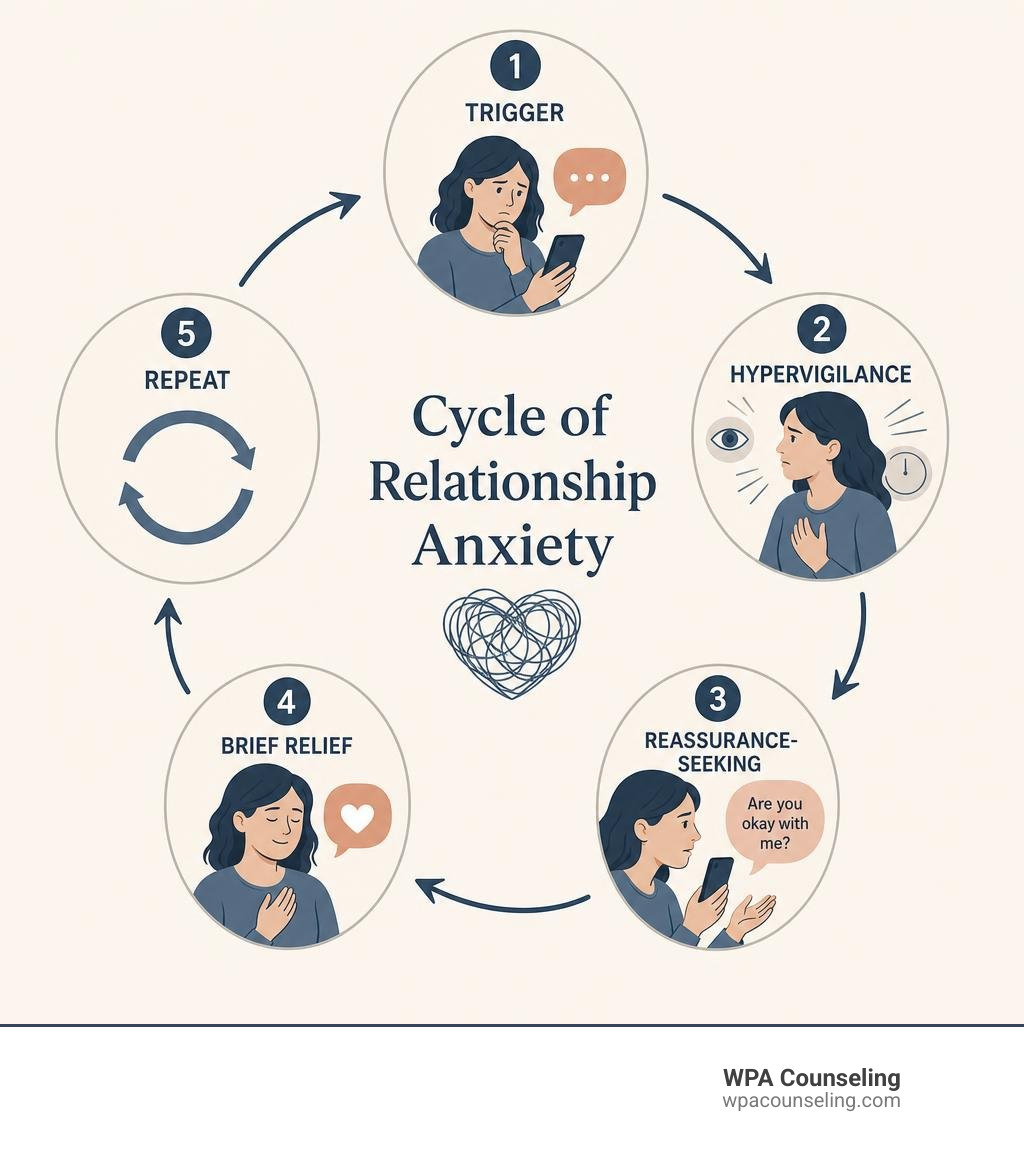
Attachment anxiety relationship patterns are cycles of fear, hypervigilance, and reassurance-seeking that repeat in close relationships — often without the person realizing why.
Here’s a quick overview of what these patterns look like and where they come from:
- What it is: A way of relating to partners shaped by early experiences with inconsistent caregivers
- Core fear: Being abandoned, rejected, or not loved enough
- Common behaviors: Checking your phone constantly, seeking reassurance, clinging, overanalyzing small signals
- Root cause: Childhood experiences where emotional needs were met sometimes — but not consistently
- Who it affects: Roughly 20% of adults carry anxious attachment patterns
- The good news: Attachment styles can change through therapy, self-awareness, and healthy relationships
You know the feeling. Your partner doesn’t text back for an hour and your brain starts running worst-case scenarios. They seem a little distant at dinner and suddenly you’re convinced something is wrong. You feel it in your chest — that tight, restless dread that won’t quiet down until you get some kind of reassurance.
And then the reassurance comes. And it helps. For about twenty minutes.
This isn’t a character flaw. It’s not neediness or immaturity. It’s your nervous system doing exactly what it learned to do — scanning for danger in the one place that feels most important to you: your relationship.
Anxious attachment doesn’t start in adulthood. It starts much earlier, when the most important people in your life were sometimes warm and present, and sometimes distant or unavailable. Your brain learned to stay on high alert, because love felt conditional — something that had to be constantly earned and monitored.
At WPA Counseling, we work with many Pennsylvania residents who are exhausted by this loop. They’re not “crazy” or “too much.” They’re people whose nervous systems learned a very understandable — but very costly — survival strategy. And with the right support, that strategy can change.
This guide explains how these patterns develop, how to recognize them, and what real healing looks like.
What is Anxious Attachment and How Does It Develop?
Attachment theory, originally formulated by British psychoanalyst John Bowlby and expanded by American developmental psychologist Mary Ainsworth, posits that the bonds we form with our primary caregivers in the first 18 months of life create a lifelong template for how we navigate intimacy, manage conflict, and handle emotional vulnerability.
When a caregiver is consistently attuned, responsive, and emotionally available, a child develops a secure attachment. However, when caregiving is inconsistent, unpredictable, or emotionally misattuned, the child’s nervous system is forced to adapt. This adaptation is what we recognize as an insecure attachment style.
Anxious attachment—often referred to in clinical literature as anxious-preoccupied attachment—develops primarily from this environment of inconsistency. In these settings, a parent or caregiver might be warm, loving, and highly attentive one day, but cold, distracted, or emotionally unavailable the next. Sometimes, a caregiver’s own chronic anxiety or “emotional hunger” leads them to use the child to meet their own emotional needs, rather than focusing on the child’s developmental needs.
This unpredictable environment teaches the developing child a confusing lesson: My needs will only be met some of the time, and I must work incredibly hard to keep my caregiver’s attention. Because they can never be sure when or if emotional support will be available, they learn to keep their attachment system chronically activated.
To explore the foundational concepts of attachment theory further, you can read A Quick Start Guide to Attachment Issues or learn more about clinical definitions in this guide on What Is Anxious Attachment Style?.
The Childhood Roots of Attachment Anxiety
In early childhood, caregiver attunement is the primary mechanism through which we learn to regulate our emotions. When an infant cries, a secure caregiver responds reliably, which helps soothe the child’s nervous system. Over time, this repetitive cycle of distress and comfort is internalized, forming what Bowlby called “internal working models.” These working models are cognitive and emotional blueprints containing deep-seated beliefs about our own self-worth and the reliability of other people.
For a child developing anxious attachment, the internal working model looks something like this:
- View of Self: I am fundamentally flawed, unworthy, or “too much.” If I were better, my caregiver would be consistently close to me.
- View of Others: Others are unpredictable, easily overwhelmed, and likely to leave me. I must monitor them constantly to keep them close.
When these working models are established early in life, they act as lenses through which all future interpersonal interactions are filtered. To understand how these early relational pathways continue to direct adult behavior, read our detailed article on How Childhood Attachment Shapes Adult Relationships.
Nature vs. Nurture in Attachment Development
While early childhood environments play a massive role in shaping how we love, the development of attachment anxiety relationship patterns is not a simple case of environmental determinism. Instead, it is a complex interaction between nature and nurture:
- Genetic Factors and Temperament: Every infant is born with a unique genetic makeup and baseline temperament. Some children are naturally more sensitive, highly reactive to sensory input, or prone to distress. A highly sensitive child may perceive minor gaps in caregiver attunement as highly distressing, making them more vulnerable to developing anxious patterns even in relatively stable environments.
- Environmental Triggers: Severe home conflict, parental divorce, chronic illness within the family, or sudden loss can disrupt otherwise stable parenting, acting as environmental catalysts that activate insecure attachment systems.
- Evolutionary Adaptation: From an evolutionary standpoint, anxious attachment is an intelligent survival mechanism. On the ancestral savanna, an infant who remained hypervigilant, kept physical proximity to caregivers, and cried loudly (protest behavior) was far less likely to be left behind or exposed to predators.
Attachment is not a fixed personality trait dictated purely by genes, nor is it a permanent scar from childhood neglect. It is a dynamic, biological survival strategy that exists on a spectrum.
Recognizing Attachment Anxiety Relationship Patterns in Adulthood
In adult romantic relationships, the underlying hypervigilance developed in childhood translates into highly specific behaviors. The anxious adult’s nervous system functions like an oversensitive smoke detector, constantly scanning their partner’s facial expressions, tone of voice, text response times, and body language for any sign of emotional withdrawal.
When this internal alarm is triggered, individuals often engage in “hyperactivating strategies.” These are subconscious, automatic behaviors designed to force a reassurance response from the partner and re-establish a sense of safety. These strategies include:
- Flooding a partner with text messages or phone calls
- Overanalyzing neutral comments or minor changes in behavior
- Using physical closeness or sexual intimacy as a tool to prove they are still loved
- Engaging in “protest behaviors,” such as threatening to leave, acting cold, or picking fights to see if the partner will chase them
A key component of these hyperactivating strategies is Excessive Reassurance Seeking (ERS). While seeking reassurance is normal in relationships, ERS is a persistent, compulsive pattern where no amount of reassurance is ever quite enough to permanently quiet the underlying anxiety.
Research highlights the relational cost of this dynamic. For example, a study on The Contribution of Attachment Styles and Reassurance Seeking to Trust in Romantic Couples – PMC found that for anxiously attached women, engaging in daily excessive reassurance seeking actually predicted lower levels of trust in the relationship the following day. Rather than building safety, the constant need for validation can paradoxically erode the seeker’s internal sense of trust and place immense strain on their partner.

Signs of Attachment Anxiety Relationship Patterns in Adults
While the internal experience of attachment anxiety is characterized by a relentless fear of abandonment, its outward manifestations in adult relationships are diverse and complex:
- Preoccupation with the Relationship: Expending massive amounts of mental energy thinking about the status of the relationship, analyzing past conversations, and worrying about future outcomes.
- People-Pleasing and Overgiving: Prioritizing a partner’s needs to the absolute exclusion of one’s own, driven by the subconscious belief that being indispensable is the only way to prevent abandonment.
- Difficulty with Boundaries: Struggling to set boundaries out of fear that saying “no” will cause the partner to leave, while simultaneously struggling to respect a partner’s boundaries, viewing their need for space as a form of rejection.
- Emotional Neediness and Low Self-Worth: Relying entirely on external validation from a partner to feel worthy or secure.
- Conflating Sex and Love: Using physical intimacy as a primary metric for relationship safety, sometimes accepting unhealthy dynamics just to maintain physical proximity.
- Physical Manifestations: Chronic relationship stress can even disrupt basic biological functions. For instance, research has explored the link between Attachment Anxiety, Relationship Context, and Sleep in Women With …, demonstrating that the physiological hyperarousal associated with attachment anxiety can lead to poor sleep quality and heightened daytime fatigue.
To read a compassionate breakdown of these signs and understand how they manifest daily, consult this resource on Anxious preoccupied attachment: signs, causes, and how to cope — Calm Blog.
How Childhood Attachment Shapes Adult Romantic Bonds
When we enter adult relationships, we do not leave our childhoods behind. Instead, we unconsciously select partners and recreate dynamics that match our early relational blueprints.
For those who experienced childhood emotional neglect or inconsistent parenting, adult intimacy can feel like a high-stakes survival game. When a partner acts distant or forgets an important date, the adult’s nervous system undergoes a “time machine” effect. The present-day trigger activates the old, pre-verbal wound of childhood abandonment, sending the limbic system into full fight-or-flight panic.
This dynamic is particularly intense for individuals who have experienced relational trauma, emotional abuse, or highly unstable early bonds. In these cases, it is vital to distinguish between a secure, albeit anxious, attachment style and a trauma bond. A trauma bond is a highly addictive, destructive tie formed through cycles of abuse and intermittent reinforcement, which can easily be mistaken for “passionate” love.
To understand the difference, explore our guides on Relationship Trauma and Emotional Abuse and Trauma Bonding vs Healthy Attachment: How to Tell the Difference. For a deeper look at how these historical blueprints operate, read about Anxious Attachment Style: What It Is and the Path Out – Annie Wright.
The Anxious-Avoidant Trap: Navigating the Pursue-Withdraw Cycle
One of the most common and painful phenomena in relationship psychology is the “anxious-avoidant trap”—sometimes called the pursue-withdraw cycle or the “Waltz of Pain.”
Although highly anxious and highly avoidant individuals have opposite ways of managing relationship stress, they are magnetically drawn to one another. The anxious partner is attracted to the avoidant partner’s apparent self-reliance and independence. The avoidant partner is drawn to the anxious partner’s warmth, emotional availability, and expressive nature.
However, once the initial honeymoon phase fades, their contrasting survival strategies begin to trigger one another’s core wounds. The moment the anxious partner seeks closer emotional proximity, the avoidant partner perceives it as a threat to their autonomy and pulls away (using a “deactivating strategy”). This withdrawal triggers the anxious partner’s fear of abandonment, causing them to pursue even harder (using a “hyperactivating strategy”). The harder the anxious partner pursues, the more suffocated the avoidant partner feels, prompting further retreat.
| Attachment Dimension | Anxious Attachment (The Pursuer) | Avoidant Attachment (The Withdrawer) |
|---|---|---|
| Core Wound | Abandonment and insignificance | Rejection, control, and loss of autonomy |
| Primary Strategy | Hyperactivating (escalating distress, seeking proximity) | Deactivating (suppressing emotion, seeking distance) |
| Underlying Belief | “If I don’t hold on tight, you will leave me.” | “If I depend on you, I will get hurt or controlled.” |
| Conflict Behavior | Pursuing, demanding, picking fights, over-explaining | Stonewalling, shutting down, changing the subject |
| View of Intimacy | Yearns for total closeness; fears losing the connection | Yearns for connection but fears being consumed by it |
Anxious vs. Avoidant Attachment Dynamics
To understand why this trap is so difficult to escape, we have to look at the neurobiology of both partners during a conflict.
When a relationship threat is perceived, the anxious partner’s amygdala fires rapidly, releasing cortisol and adrenaline. Their nervous system enters a state of sympathetic arousal (fight-or-flight), demanding immediate connection to regulate.
Conversely, the avoidant partner’s nervous system responds to the threat of emotional overwhelm by shutting down. They utilize deactivating strategies—such as mental distraction, physical withdrawal, or emotional flatlining—to defensively suppress negative thoughts and preserve their independence. This physiological divergence is highly measurable; research shows that different attachment pairings predict distinct neuroendocrine, behavioral, and biological stress responses during conflict, as detailed in Spouses’ Attachment Pairings Predict Neuroendocrine, Behavioral ….
When these two opposing systems collide, the resulting cycle can feel incredibly toxic, even when both partners care deeply for each other. To read more about how this dynamic plays out in real-time, see this analysis on What Is Anxious Attachment in Relationships – Empathi.com.
Breaking the Cycle of Attachment Anxiety Relationship Patterns
Breaking free from the pursue-withdraw cycle requires both partners to shift from a model of individual self-preservation to a model of relational co-regulation. Because humans are biologically wired for connection, we cannot heal insecure attachment in complete isolation. We need safe, predictable relational spaces to rewrite our nervous system’s response to vulnerability.
To de-escalate the cycle, couples must learn to:
- Name the Cycle: Instead of blaming each other, partners must recognize the pursue-withdraw dynamic as the common enemy. You might say, “Our cycle is starting. I am feeling anxious and wanting to push, and I know that makes you want to pull away. Let’s take a breath.”
- Implement Structured Time-Outs: When the avoidant partner needs space, they must communicate a specific return time (e.g., “I’m feeling overwhelmed and need 20 minutes to calm down, but I promise I will come back at 4:00 PM to finish this conversation”). This simple step prevents the anxious partner’s abandonment alarm from sounding.
- Practice Mini-Vulnerabilities: Both partners must practice sharing the raw, underlying emotion beneath their protective behaviors. The pursuer shares their fear of being unloved, while the withdrawer shares their fear of failure or inadequacy.
To begin implementing these changes, you can read our step-by-step guide: A Roadmap to Repairing Your Damaged Bond.
The Path to Earned Security: Healing Your Relational Blueprint
One of the most hopeful findings in modern attachment research is that your childhood attachment style is not a life sentence. Approximately 25% of people experience a shift in their attachment style over time, moving from insecurity to what researchers call “earned security.”
Earned security is the capacity to develop a stable, secure attachment style in adulthood through conscious effort, therapeutic intervention, and healthy relational experiences. It is built by creating a “gap” between your nervous system’s automatic trigger and your behavioral response.

To grow toward a secure relational blueprint, you can practice these daily self-regulation and interpersonal skills:
- Nervous System Tracking: Learn to identify where anxiety lives in your body (e.g., a tight chest, shallow breathing, a racing heart). Before you send that text or ask for reassurance, pause and focus on calming your physical body.
- Somatic Grounding: Use deep, diaphragmatic breathing, progressive muscle relaxation, or body scan meditation to soothe your sympathetic nervous system when triggered.
- Challenging Cognitive Distortions: When your brain screams, “They haven’t texted in an hour because they are planning to leave me,” gently challenge that thought with objective evidence. Reframe the thought: “They are likely busy at work, and I am safe even when we are temporarily disconnected.”
- Choosing Secure Partnerships: If you are dating, consciously look for partners who are reliable, consistent, and comfortable with emotional intimacy—even if their stability initially feels “boring” to a nervous system calibrated for high-drama cycles.
For a deeply localized perspective on navigating this journey, check out The Steel City Guide to Healing Anxiety Through Attachment.
Evidence-Based Therapy for Attachment Anxiety
While self-help strategies are incredibly valuable, the pre-verbal, somatic nature of attachment wounds means that professional therapy is often essential for deep, lasting change. Several evidence-based therapeutic modalities are highly effective for addressing attachment anxiety:
- Cognitive Behavioral Therapy (CBT): Helps identify and restructure the core negative beliefs (e.g., “I am unlovable”) that drive hyperactivating strategies.
- Emotionally Focused Therapy (EFT): A gold-standard couples therapy approach that maps the pursue-withdraw cycle, helping couples move from defensive postures to secure, emotionally vulnerable connections. Learn more about its restorative power in The Healing Power of Attachment-Based Couples Therapy in ….
- Attachment-Based Therapy: Focuses specifically on the therapeutic relationship itself as a safe, corrective emotional experience where rupture and repair can be safely practiced. For those seeking specialized care in Pennsylvania, you can explore options like Attachment-Based Therapy Therapists in Philadelphia, PA.
At WPA Counseling, we guide individuals and couples through this healing process using our proprietary clinical framework, the Counseling Blueprint. This four-stage journey is designed to systematically heal relational trauma and build earned security:
- Take Off the Mask: We build a foundation of absolute trust, safety, and non-judgmental rapport, allowing you to drop your protective defenses and speak honestly about your fears.
- Heal the Wounds: We explore the childhood origins of your attachment style, identifying the specific moments of emotional inconsistency or trauma that shaped your relational blueprint.
- Remove the Toxins: We identify and dismantle the lingering lies, unhelpful beliefs, and automatic coping strategies that keep you trapped in painful relationship loops.
- Replace with Truth: We install empowering, accurate perspectives about your inherent self-worth and build healthy, conscious patterns of communication and self-soothing.
Professional Support with WPA Counseling in Pennsylvania
If you are tired of navigating the exhausting highs and lows of relationship anxiety, you do not have to walk this path alone. WPA Counseling is a compassionate group practice of licensed professional counselors dedicated to helping individuals and couples across Pennsylvania heal their hearts and build secure, thriving relationships.
With years of clinical experience and a deep-rooted history of serving local Pennsylvania communities, our practice has helped hundreds of clients navigate complex relational trauma, anxiety, and attachment issues. Our clinicians bring decades of combined expertise in evidence-based psychotherapeutic modalities, ensuring that our local practice history is defined by clinical excellence, ethical care, and lasting recovery. We focus our trauma recovery and relationship healing entirely on counseling-based strategies, providing a safe, structured environment for emotional growth.
We provide highly personalized care tailored to your unique needs, combining evidence-based methods like CBT, trauma-informed care, and attachment-based therapy with our structured Counseling Blueprint framework.
We offer flexible options to fit your lifestyle:
- In-Person Counseling: Conveniently located at our welcoming offices in Western Pennsylvania, including Irwin/North Huntingdon and Penn Hills.
- Secure Telehealth: Available to any resident living anywhere in the state of Pennsylvania, allowing you to access high-quality therapy from the comfort and privacy of your own home.
Whether you are looking to heal individual anxiety or want to break a painful cycle with your partner, our team is here to support you. To learn more about our couples services, explore our dedicated page on Relationship Counseling.
Frequently Asked Questions about Attachment Anxiety
Can you have both anxious and avoidant attachment?
Yes. This combination is known clinically as disorganized attachment (or fearful-avoidant attachment). It typically develops in environments where a child’s primary caregiver was a source of fear rather than safety (e.g., in homes with abuse, severe addiction, or unresolved trauma).
An adult with disorganized attachment desperately craves love and intimacy (the anxious drive) but is simultaneously terrified of getting close to others because they associate closeness with pain and betrayal (the avoidant drive). They often experience a confusing “come close, go away” dynamic in their relationships.
How long does it take to change your attachment style?
There is no fixed timeline for healing attachment wounds, as it depends on the depth of your childhood trauma, the consistency of your therapeutic work, and the quality of your current relationships.
Because the brain possesses remarkable neuroplasticity, it is constantly rewriting its neural pathways based on new experiences. Many people begin to notice genuine shifts in their emotional reactivity and communication patterns within six months to a year of dedicated therapy and consistent self-regulation practice. Moving fully into earned security is a gradual, beautiful journey of self-discovery.
How can a partner support someone with anxious attachment?
If you are loving someone with an anxious attachment style, the most powerful gift you can offer is consistency.
- Provide Proactive Reassurance: Don’t wait for them to ask if you are mad at them. Offer spontaneous verbal appreciation, physical affection, and reminders that you love them.
- Keep Your Promises: Be reliable. If you say you will call at a certain time, do it. If you have to cancel plans, explain why immediately and reschedule.
- Set Loving, Firm Boundaries: You do not have to lose your own autonomy to make them feel safe. Set boundaries with warmth: “I love you and I want to hear all about your day, but I need 30 minutes of quiet time to unwind first. Let’s sit together at 6:30 PM.”
Conclusion: Hopeful Healing and Relational Growth
Living with attachment anxiety relationship patterns can feel like being caught in an endless storm, constantly searching for a safe harbor that always seems just out of reach. But as we have explored, this anxiety is not a permanent defect in who you are. It is simply a survival blueprint that your nervous system learned a long time ago to keep you safe.
Because these patterns were learned, they can be unlearned. Through the power of self-awareness, somatic regulation, consistent relational experiences, and professional therapeutic support, you can quiet your internal alarm system, heal your childhood wounds, and step into the peace of earned security.
You are not “too much,” and your desire for deep, safe connection is entirely valid.
If you are ready to stop the anxiety loop and start building a relationship grounded in trust and ease, we invite you to take the next step. Let us match you with a compassionate, licensed Pennsylvania counselor who understands your struggle and knows the way forward.
To begin your healing journey, explore our foundational resource on How Childhood Attachment Shapes Adult Relationships or contact WPA Counseling today to get thoughtfully matched with a therapist. Your path to secure, joyful love starts here.
This article was researched with AI and heavily edited by Stephen Luther for accuracy and relevance.
Stephen Luther is the Executive Director and Founder of WPA Counseling. He holds a Master’s degree in Education from the University of Georgia and a Master’s degree in Marriage and Family Therapy from Duquesne University. He is a licensed professional counselor in Pennsylvania (LPC).
Since 1997, Steve has been helping children, adolescents, adults, couples, and families overcome emotional and relational challenges. He specializes in working with hurting families, including those with foster, adopted, or traumatized children. Steve uses Attachment-Based Therapy, client-centered therapy, and Therapeutic Parent Coaching to support healing and relationship restoration.
This guide is for educational and spiritual encouragement and is not a substitute for personalized professional counseling. If you are in crisis, please reach out for immediate help.
Stop Ghosting Your Growth with Online Attachment Counseling