
You’re Not Alone: Finding Anxiety Support Groups in Pittsburgh PA
If you’re looking for anxiety support groups in Pittsburgh PA, here’s a quick overview of your top options:
| Group | Format | Cost | Schedule |
|---|---|---|---|
| NAMI Connection (Allegheny County) | In-person | Free | Monthly |
| NAMI Family Support | In-person | Free | Monthly |
| Pittsburgh Bridges OCD | In-person & virtual | Free / $1-2 suggested | Weekly / Bi-monthly |
| DBSA Mood Peers Pittsburgh | In-person & virtual | Free | Weekly |
Anxiety can make you feel completely alone — even in a city of nearly 300,000 people.
But here’s the truth: you are far from alone. Pittsburgh has a growing network of peer-led support groups, free community resources, and professional counseling options designed to help people just like you find relief, connection, and hope.
Whether you’re dealing with everyday stress that’s spiraled out of control, OCD, panic attacks, or the kind of anxiety that follows you everywhere — there is a place for you here.
This guide covers every major anxiety support group in Pittsburgh PA we know of, so you can find the right fit for where you are right now.
And if peer support isn’t quite enough on its own, we’ll also walk you through what professional anxiety therapy looks like — and how the two can work beautifully together.
Finding the Right Anxiety Support Groups in Pittsburgh PA
Anxiety isn’t just “feeling a little nervous.” It is a complex physical and emotional experience. According to Mayo Clinic’s resource on Anxiety disorders – Symptoms and causes, anxiety can manifest as a rapid heart rate, hyperventilation, persistent worry, and an overwhelming desire to avoid things that trigger your stress. When these symptoms begin to disrupt your daily life, finding a safe space to process what you are going through becomes essential.
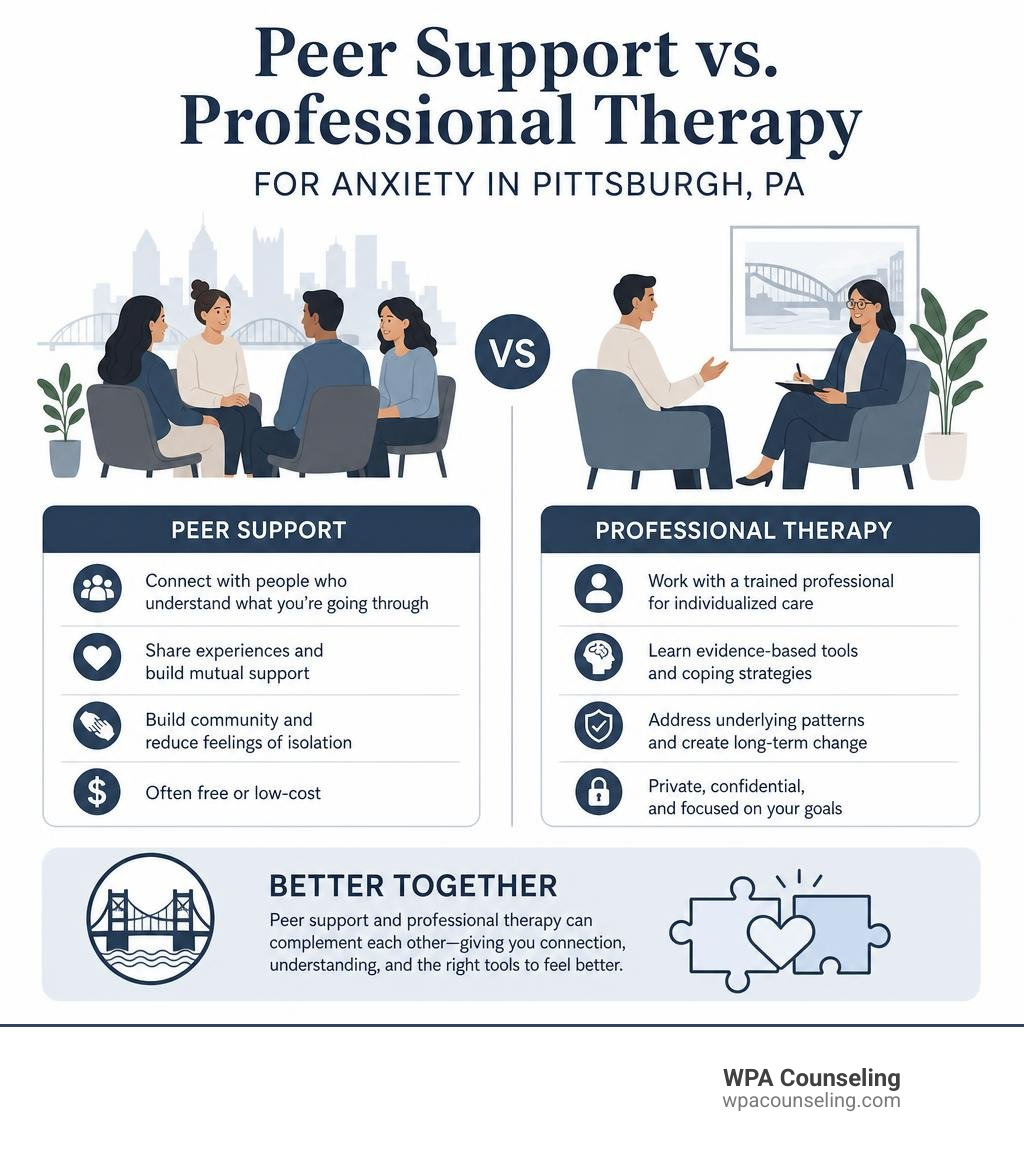
For many people in Western Pennsylvania, anxiety support groups in Pittsburgh PA serve as an incredibly helpful starting point. These groups are generally divided into two main categories:
- Peer-Led Groups: Facilitated by individuals who have lived experience with mental health conditions. They focus on shared experiences, mutual encouragement, and practical coping strategies.
- Clinical Therapy Groups: Directed by licensed professionals who use evidence-based modalities to treat underlying mental health conditions.
If you are just beginning to explore your options, peer-led networks like NAMI Connection and NAMI Family Support offer low-barrier, welcoming environments. However, understanding how to navigate these groups alongside your personal healing journey is key. For a deeper look at how to address anxiety holistically, you can read everything you need to know about anxiety therapy.
Top Free and Specialized Peer Support Groups in the Steel City

One of the greatest benefits of peer-run support groups is their accessibility. Because they are typically free or run on nominal donations, they offer a low-barrier entry point for anyone who needs to talk.
Furthermore, these spaces prioritize strict confidentiality. Many local groups utilize a simple, peer-run format where participants take turns sharing their experiences. If you struggle with social anxiety, you will be glad to know that sharing is entirely optional — you are always welcome to “pass” and simply listen to others.
Here are the top free and specialized peer support groups operating in the Pittsburgh area as of July 2026.
NAMI Keystone Pennsylvania and Local Affiliates
NAMI (National Alliance on Mental Illness) Keystone Pennsylvania and its local affiliates offer free, confidential support groups for individuals, families, and caregivers affected by mental health conditions. These groups meet weekly, every other week, or monthly across Allegheny County and surrounding areas.
NAMI divides its programs into two distinct branches:
- NAMI Connection Support Groups: Designed specifically for adults living with mental health challenges. For example, the Ross Township Connection group meets on the first Thursday of every month from 6:00 PM to 8:00 PM.
- NAMI Family Support Groups: Tailored for family members, partners, and friends of those living with mental health conditions. Local meetings occur in neighborhoods like McKeesport (at Penn State Greater Allegheny) and Churchill (which hosts a specialized spouse support group).
If you live outside the immediate city limits, you can find similar community-based programs through the Support Groups | Westmoreland County, PA – Official Website. Additionally, if your anxiety is tied to past difficult experiences, exploring pittsburgh support groups for navigating trauma can provide a more focused path toward healing.
DBSA Mood Peers Pittsburgh for Hybrid Support
For those looking for a highly flexible, hybrid model, DBSA Mood Peers Pittsburgh hosts weekly, peer-run support groups for individuals living with depression, bipolar disorder, and anxiety.
- Online Meetings: Held every Wednesday evening from 7:00 PM to 8:30 PM via Zoom.
- In-Person Meetings: Held on the second and fourth Tuesday of each month from 7:00 PM to 8:30 PM at Bellefield Towers in the Oakland neighborhood of Pittsburgh.
These meetings are open to individuals experiencing these conditions, as well as friends, family members, and students looking to learn more. Because anxiety and depression so frequently occur together, this group is an excellent resource for navigating what can feel like a double battle. You can read more about managing these overlapping challenges in our guide on anxiety depression the battle of the fight to stay present.
Pittsburgh Bridges OCD Support Groups
If your anxiety manifests primarily as Obsessive-Compulsive Disorder (OCD) or panic, specialized peer support can make a massive difference. Bridges Support is a dedicated local organization run directly by individuals affected by OCD.
- Virtual Meetings: Held on Tuesdays from 7:00 PM to 9:00 PM EST via Zoom.
- In-Person Meetings: Held on the first and third Wednesdays of each month from 7:00 PM to 9:00 PM at the Sixth Presbyterian Church (1688 Murray Ave, Pittsburgh, PA 15217 in Squirrel Hill).
Bridges focuses on peer sponsorship, community advocacy, and education surrounding Exposure and Response Prevention (ERP) — the gold standard behavioral therapy for OCD. If you are also dealing with sudden, intense physical symptoms of anxiety, pairing peer support with effective panic disorder therapy in pennsylvania can help you regain control over your body’s alarm system.
When Peer Support Isn’t Enough: Professional Anxiety Therapy in Pennsylvania
While peer-led anxiety support groups in Pittsburgh PA provide wonderful community and validation, they are not a substitute for clinical treatment. Peer facilitators cannot diagnose conditions, build personalized treatment plans, or help you process deep-seated emotional wounds.

Transitioning from Peer-Led Anxiety Support Groups in Pittsburgh PA to Clinical Therapy
If you find that your anxiety remains high despite attending weekly support groups, it may be time to transition to professional clinical care.
At WPA Counseling, we guide our clients through a structured, compassionate journey called the Counseling Blueprint. This four-stage healing process is designed to go far deeper than peer support can:
- Take Off the Mask: We focus on building genuine rapport and trust, creating a safe space where you don’t have to pretend you have it all together.
- Heal the Wounds: We gently explore the emotional, situational, and relational hurts that lie at the root of your chronic worry.
- Remove the Toxins: We help you identify and dismantle the unhelpful beliefs, cognitive distortions, and lingering lies that keep your nervous system in a constant state of fight-or-flight.
- Replace with Truth: We work together to install empowering, accurate, and peaceful perspectives about yourself and the world around you.
If you are ready to explore a structured path to relief, our team offers dedicated anxiety counseling in pittsburgh.
How Professional Anxiety Support Groups in Pittsburgh PA Compare to Individual Counseling
Some individuals thrive in a group clinical setting, while others prefer the focused attention of individual therapy.
- Clinical Group Therapy: Led by a licensed therapist, clinical groups use structured modalities like Cognitive Behavioral Therapy (CBT), Dialectical Behavior Therapy (DBT), or attachment-based therapy to help members practice real-time relational skills.
- Individual Counseling: Offers highly personalized care tailored entirely to your unique history, pacing, and goals.
For many people, a combination of both is the ultimate key to recovery. To learn more about how individual therapy targets these concerns, check out our resources on individual counseling anxiety depression.
Professional Clinical Support with WPA Counseling
At WPA Counseling, we are a compassionate group practice of licensed professional counselors based in Irwin/North Huntingdon, Pennsylvania, with an additional physical office in Penn Hills. We provide comfortable, in-person clinical counseling at our Western Pennsylvania locations, as well as secure telehealth therapy across the entire state of Pennsylvania.
With years of dedicated clinical experience serving the Western Pennsylvania community, WPA Counseling has established a trusted local practice history. Our team of licensed professional counselors has helped hundreds of Pittsburgh-area residents navigate complex anxiety, trauma, and mood disorders. By combining deep clinical expertise with a compassionate, community-focused approach, we have become a cornerstone of mental health support in Westmoreland and Allegheny counties, ensuring every client receives evidence-based, highly personalized care.
Our team utilizes evidence-based methods — including CBT, DBT, attachment-based therapy, and trauma-informed care — to help you find lasting relief from anxiety. Whether you prefer meeting face-to-face in Westmoreland County or utilizing our secure online anxiety therapy in pennsylvania, we make sure your treatment fits your life.
If you are wondering about the practical details of starting therapy, read our guide on anxiety therapist near me logistics fit and finances.
Frequently Asked Questions About Pittsburgh Anxiety Support
Are NAMI support groups in Allegheny County free to attend?
Yes. All NAMI Keystone Pennsylvania support groups are completely free, confidential, and led by trained peer facilitators who have lived experience with mental health conditions. Similarly, groups like those detailed on the Support Group Meetings | DBSA Mood Peers Pittsburgh page do not charge fees to attend.
Do I need a referral or registration to join a local support group?
It depends on the group. Many peer-run groups, like DBSA Mood Peers, operate on a drop-in basis where no prior registration is required. However, some NAMI groups and specialized virtual meetings require you to register online or via email by 4:00 PM on the day of the meeting to receive the secure Zoom credentials.
If you are looking for support resources specifically as a parent helping a child navigate these struggles, you can explore our advice on parenting a teen with anxiety.
What is the difference between peer support and professional therapy?
Peer support is built on shared lived experience and mutual encouragement without professional clinical oversight. Professional therapy is led by a licensed clinician trained in evidence-based modalities (like CBT, DBT, and attachment theory). While peer support is an excellent way to build community, professional therapy — like our four-stage Counseling Blueprint — is designed to treat, heal, and resolve clinical anxiety disorders. You can learn more about these structural differences by reading about understanding anxiety counseling pennsylvania.
Conclusion: Take Your Next Step Toward Healing
Whether you choose to start with a weekly peer-led support group in Oakland, an OCD group in Squirrel Hill, or professional individual therapy, the most important step is simply taking action. You do not have to carry the weight of chronic worry by yourself.
If you are ready to move beyond peer support and want to experience deep, structured emotional healing, we are here to walk with you. At WPA Counseling, we make it simple to find a therapist who truly understands your needs.
Take a deep breath, visit our get matched page, and let us help you find the right licensed counselor so you can finally breathe easier. If you want to learn more about our local services first, explore our page on anxiety counseling in pittsburgh.
Stephen Luther is the Executive Director and Founder of WPA Counseling. He holds a Master’s degree in Education from the University of Georgia and a Master’s degree in Marriage and Family Therapy from Duquesne University. He is a licensed professional counselor in Pennsylvania (LPC).
Since 1997, Steve has been helping children, adolescents, adults, couples, and families overcome emotional and relational challenges. He specializes in working with hurting families, including those with foster, adopted, or traumatized children. Steve uses Attachment-Based Therapy, client-centered therapy, and Therapeutic Parent Coaching to support healing and relationship restoration.
This guide is for educational and spiritual encouragement and is not a substitute for personalized professional counseling. If you are in crisis, please reach out for immediate help.