

Trauma Bonding vs Healthy Attachment: How to Tell the Difference
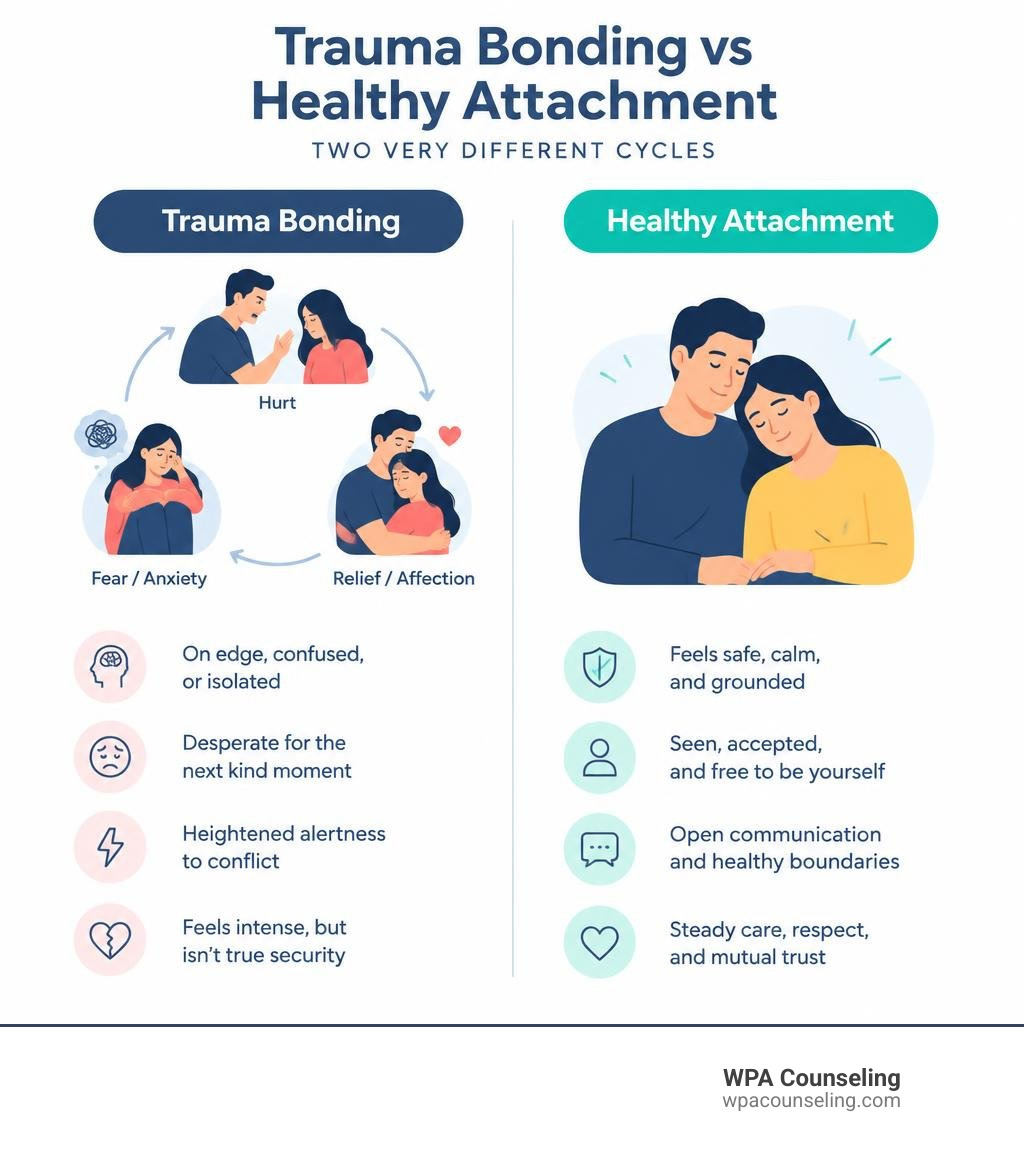
Trauma bonding vs healthy attachment comes down to one key difference: safety. A trauma bond grows through repeated cycles of hurt, fear, and then relief or affection from the same person. Healthy attachment grows through steady care, respect, honesty, and emotional safety.
A quick way to assess the pattern:
| If the relationship leaves you feeling… | It may point to… |
|---|---|
| On edge, confused, isolated, or desperate for the next kind moment | Trauma bonding |
| Seen, free to be yourself, able to set boundaries, and generally calm | Healthy attachment |
Strong feelings alone do not prove love. In a trauma bond, your nervous system may become highly alert to conflict and then experience intense relief when tension ends. That relief can feel powerful, but it is not the same as a secure connection.
At WPA Counseling, we know that recognizing this pattern can bring up fear, grief, and self-doubt. You do not have to figure it out alone. With support, it is possible to rebuild self-trust, restore healthy boundaries, and choose relationships that feel safe rather than unstable.
Understanding Trauma Bonding vs Healthy Attachment: Core Differences
When we evaluate any significant relationship, we often look at the magnitude of our feelings. We assume that fiery passion, racing pulses, and an inability to stop thinking about someone must indicate a profound soul connection. However, psychological research paints a very different picture. In adult attachment terms, true security is characterized by a stable base rather than a state of heightened arousal (Hazan & Shaver, 1987).
At its core, a healthy attachment is built on consistent emotional safety, predictable care, and mutual psychological autonomy. In a secure bond, both individuals express their thoughts, voice disagreements, and maintain their personal identities without fear of retaliation, abandonment, or emotional punishment. The relationship acts as a peaceful refuge from the stresses of the outside world.
In contrast, exploring the mechanics of a trauma bond reveals an attachment forged through chronic unpredictability, power imbalances, and alternating patterns of devaluation and affection. Rather than providing a secure base, the relationship itself becomes the primary source of threat—and paradoxically, the sole source of comfort. When the person causing the emotional distress is also the one offering occasional validation, the brain becomes locked in a survival loop, mistaking relief for deep devotion.
The Dynamics of Trauma Bonding vs Healthy Attachment in Daily Life
In everyday life, the distinction between these two relationship styles becomes evident in how daily interactions, disagreements, and quiet moments unfold:
- Conflict and Resolution: In healthy relationships, conflict is an opportunity for attunement and problem-solving. Disagreements are handled with mutual respect, without personal attacks or silent treatments. In a trauma-bonded dynamic, conflict threatens survival. It involves explosive arguments, blame-shifting, stonewalling, and dramatic reconciliations that fail to address the underlying issues.
- Consistency vs. Chaos: Healthy love is reliably consistent. You do not have to wonder which version of your partner will walk through the door. A trauma bond thrives on walking on eggshells, where kindness is earned through compliance and tension is always simmering beneath the surface.
- The Role of Calm: When life is calm, a securely attached couple experiences restful connection. In a traumatic bond, quiet periods trigger anxiety; individuals often find themselves waiting for the other shoe to drop, mistaking genuine peace for boredom or hidden danger.
Understanding these patterns also helps clarify other intense emotional states. As explored in clinical research on attachment and limerence, people often mistake obsessive preoccupation for love. While limerence is sustained by uncertainty about whether romantic feelings are reciprocated, a trauma bond is sustained by alternating harm and relief delivered by an abusive or manipulative partner. In both cases, intensity tracks uncertainty rather than authentic compatibility.
Neurochemical Drivers: Cortisol, Oxytocin, and Intermittent Reinforcement
Why does a toxic, painful relationship feel so impossible to walk away from? The answer lies within human neurobiology. A trauma bond is not a sign of emotional weakness or a lack of intelligence; it is a profound physiological conditioning process.
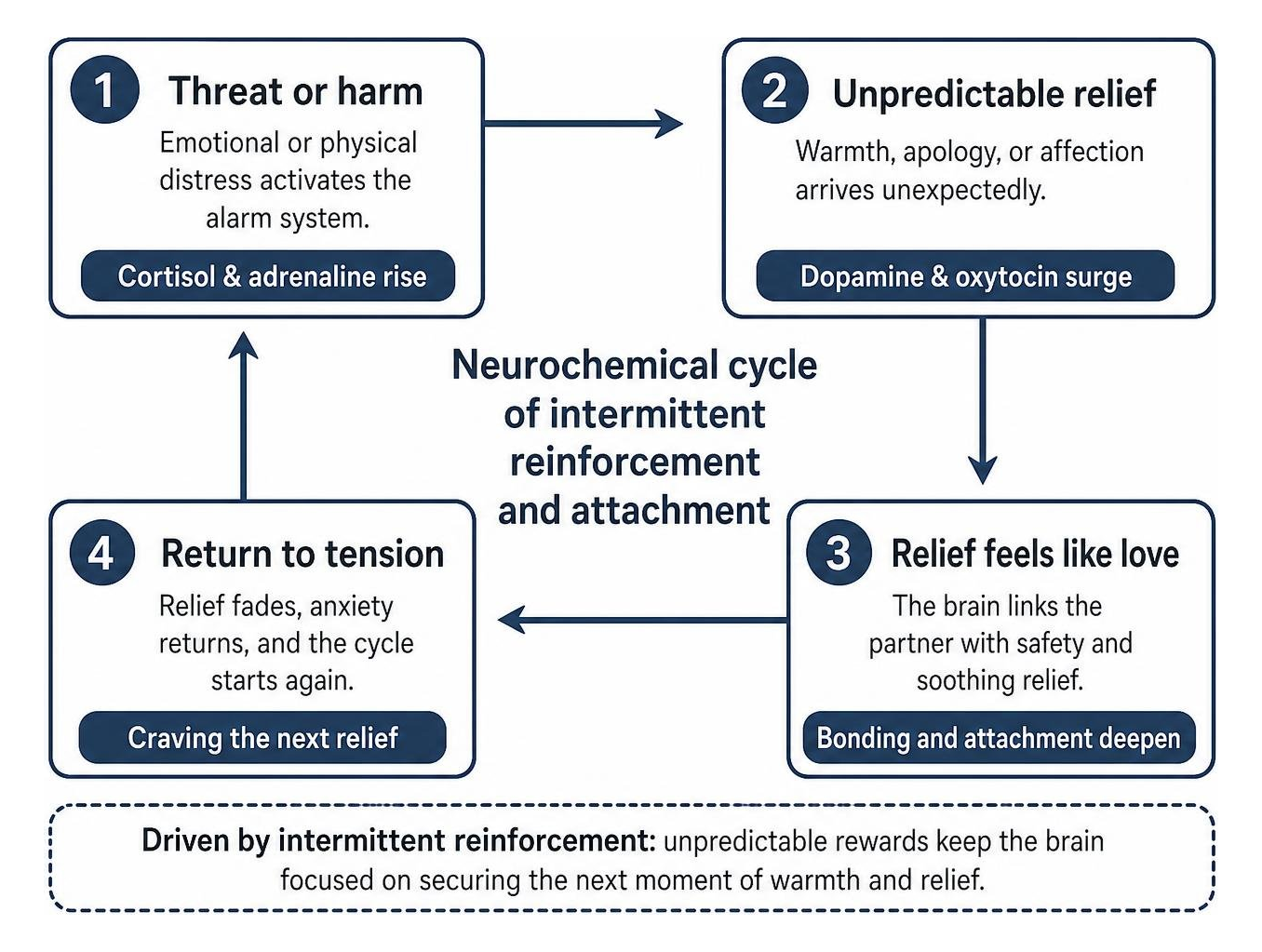
When a partner threatens your emotional or physical safety, your brain’s alarm system activates, flooding your bloodstream with cortisol and adrenaline (the stress and fear hormones). You enter a state of high alert. But when that same partner suddenly turns warm, offers an apology, or pulls you into a comforting embrace, your brain experiences a massive surge of dopamine (the reward and pleasure chemical) alongside oxytocin (the bonding and trust hormone).
This extreme physiological swing from terror to soothing creates an intoxicating neurochemical cocktail. The brain begins to associate the abusive partner with ultimate safety, because their return to kindness is the only thing that relieves the agony they caused in the first place.
This process is driven by intermittent reinforcement—the psychological principle where rewards are delivered on an unpredictable schedule. Pioneering research on abusive relationships demonstrates that an unpredictable alternation of punishment and reward produces an attachment that intensifies rather than weakens as mistreatment worsens (Dutton & Painter, 1993). Just like a gambler at a slot machine who keeps pulling the lever because a payout might happen on the next spin, a trauma-bonded individual stays hyper-focused on securing the next moment of warmth. Over time, repeated cycles of harm and rescue build learned helplessness, a state where the brain stops searching for an exit and focuses entirely on appeasing the person causing the pain.
Somatic and Emotional Warning Signs: Is It Love or a Trauma Bond?
The mind can rationalize mistreatment, make excuses, and cling to nostalgic memories, but the physical body rarely lies. Recognizing what our physical symptoms are communicating is essential when healing from relationship trauma and emotional abuse.
When your nervous system is trapped in a trauma bond, it spends most of its time stuck in sympathetic arousal (fight-or-flight) or dorsal vagal shutdown (freeze). You may notice chronic physical tension, digestive upset, a persistent knot in your stomach, shallow breathing, sleep disturbances, or a sudden tightening in your chest whenever your phone rings. These somatic markers indicate that your system perceives threat, even if you are consciously telling yourself that everything is fine.
By contrast, genuine love engages the parasympathetic branch of the autonomic nervous system—specifically the ventral vagal state, often called the “rest-and-digest” or “social engagement” system. In a healthy connection, your body physically softens. Your shoulders drop, your breathing deepens, and your heart rate stabilizes. Love feels like an exhale; a trauma bond feels like holding your breath underwater.
Key Signs of a Trauma Bond and Gaslighting Loops
Recognizing the warning signs of a traumatic bond requires looking honestly at the behavioral cycles within the relationship:
- Love Bombing and Idealization: The relationship begins with overwhelming affection, excessive gift-giving, rapid commitments, and declarations of being “soulmates,” creating an unrealistic and unsustainable baseline.
- Rationalizing the Unacceptable: You find yourself making excuses for behavior you would fiercely warn a friend against tolerating.
- Self-Doubt and Gaslighting Loops: You constantly second-guess your memory, perceptions, and sanity because your partner denies events, twists conversations, or blames you for their outbursts.
- Erosion of Identity: You gradually sacrifice your hobbies, career goals, personal values, and friendships to keep the peace and avoid triggering your partner’s anger.
- Hypervigilance as Devotion: You spend immense cognitive energy tracking your partner’s micro-expressions, tone of voice, and body language to predict their mood swings, mistaking this anxious scanning for deep intimacy.
- Addiction-Like Cravings: When separated after a fight, you experience acute physical panic, obsessive rumination, and an overpowering urge to reach out just to relieve the distress.
Characteristics of Secure Love and Nervous System Regulation
Healthy attachment operates on entirely different principles. Understanding healthy dynamics can help those navigating complex adult attachment issues distinguish between anxiety-driven enmeshment and genuine emotional safety:
- Pacing and Differentiation: Healthy love develops gradually. There is no rush to merge lives, and both partners encourage each other to maintain independent friendships, interests, and boundaries.
- Emotional Predictability: You do not have to worry about sudden, unprovoked withdrawals of affection or silent treatments as punishment.
- Safe Vulnerability: Sharing your fears, mistakes, or insecurities does not result in them being weaponized against you during future disagreements.
- Shared Responsibility: When ruptures happen, both individuals participate in repair without defensiveness, projection, or demands for groveling.
- Nervous System Grounding: Being around your partner brings a sense of calm ease rather than an agitated, adrenaline-fueled high.
Distinguishing Trauma Bonding vs Healthy Attachment: Side-by-Side Comparison
To help evaluate your relational dynamics clearly, consider this direct comparison:
| Metric | Trauma Bonding | Healthy Attachment |
|---|---|---|
| Foundation | Intermittent fear, unpredictability, and relief | Consistent safety, mutual trust, and respect |
| Emotional Tone | Dramatic highs and devastating lows | Grounded, calm, fulfilling, and steady |
| Conflict Dynamic | Volatile, weaponized, silent treatment, no true resolution | Constructive, solution-focused, emotionally safe |
| Power Balance | Unequal; control maintained via manipulation or threat | Equal; collaborative decision-making and mutual autonomy |
| Nervous System State | Chronic hypervigilance (sympathetic/freeze) | Regulated calm (ventral vagal social engagement) |
| Sense of Identity | Lost; enmeshed; shaped entirely around partner’s needs | Preserved; each person grows independently together |
| Primary Motivation | Fear of abandonment, conflict avoidance, seeking relief | Genuine companionship, mutual care, shared values |
| Response to Calm | Triggers anxiety, paranoia, or perceived boredom | Fosters relaxation, contentment, and deep rest |
Breaking the Cycle: A Practical Roadmap to Healing and Recovery
Detangling yourself from a trauma bond is one of the most challenging psychological hurdles a person can face. Because the bond mimics physical addiction in the brain, walking away requires deliberate emotional strategies, somatic support, and compassionate guidance through dedicated trauma bonding therapy.

- Break the Secrecy and Ground in Reality: Trauma bonds thrive in isolation. Begin writing down events, conversations, and boundary violations in a private journal exactly as they occur. When gaslighting makes you doubt your sanity, your written record serves as an objective anchor to reality.
- Establish Clear, Uncompromising Boundaries: When safety allows, establish firm boundaries around contact. If complete non-contact is not possible (such as in co-parenting situations), transition to strict “low contact” or the “gray rock” method—interacting only with neutral, unemotional, and strictly factual language.
- Reclaim Micro-Identities: Start rebuilding your sense of self outside the relationship. Take a walk alone, reconnect with a supportive friend, return to an old hobby, or make independent choices about your daily schedule without asking for permission.
- Practice Somatic Grounding: When intense cravings to break contact arise, address the physiological distress rather than arguing with your thoughts. Use nervous system regulation tools to soothe the bodily panic.
Navigating the Withdrawal Process and Regulating Your Nervous System
When you step away from a trauma bond, your brain experiences a sudden drop in dopamine and oxytocin alongside an acute spike in stress hormones. This phase feels almost identical to chemical withdrawal. In clinical terms, acute distress peaks during the initial days of separation, followed by rolling waves of grief and anger before the nervous system gradually recalibrates.
To support your body through this neurochemical reset, practice these evidence-based somatic grounding tools:
- Physiological Sighs: Take two quick breaths in through your nose (one deep, followed immediately by a sharp top-off inhale), then slowly release a long, audible exhale through your mouth. Repeat this three to five times to manually trigger parasympathetic calming.
- The 5-4-3-2-1 Sensory Reset: Bring your awareness to your immediate physical environment by naming 5 things you can see, 4 things you can physically feel, 3 things you can hear, 2 things you can smell, and 1 positive truth about your current safety.
- Temperature Modulation: Splash cold water on your face or hold an ice cube in your palm for 30 seconds. The sudden temperature shift stimulates the vagus nerve, helping break emotional flashbacks and obsessive thought spirals.
- Bilateral Tapping: Cross your arms over your chest and tap your shoulders alternately in a slow, steady rhythm (the butterfly hug). This rhythmic stimulation helps integrate distress and down-regulate panic responses.
Professional Relational Support Across Pennsylvania

Recovering from relational trauma is not something you have to navigate in isolation. WPA Counseling is an established group practice of licensed professional counselors with extensive clinical experience serving communities across Western Pennsylvania. Our clinicians bring deep professional expertise in treating complex attachment wounds, relational trauma, and chronic emotional manipulation, offering grounded guidance rooted in clinical excellence and compassionate care.
Throughout our practice history in Western Pennsylvania, our experienced team has supported individuals and couples through evidence-based, counseling-focused paths to healing. Our clinical work is guided by our structured, four-stage counseling framework designed to walk you out of confusion and into emotional liberation:
- Take Off the Mask: We cultivate a compassionate, non-judgmental therapeutic environment where you can safely take off the protective armor, express your authentic pain, and establish genuine trust.
- Heal the Wounds: Utilizing evidence-based approaches—such as Cognitive Behavioral Therapy (CBT), Dialectical Behavior Therapy (DBT), trauma-informed care, and attachment-focused therapies—we gently explore past relational injuries and process unresolved trauma.
- Remove the Toxins: Together, we identify and dismantle the lingering lies, cognitive distortions, and toxic self-blame patterns installed by gaslighting and emotional manipulation.
- Replace with Truth: We help you install empowering, accurate perspectives about your worth, develop robust boundary-setting skills, and step into self-trust and relational autonomy.
We provide comprehensive counseling services tailored to your unique needs, including Individual counseling, Anxiety therapy, Depression counseling, Trauma therapy, Family counseling, Grief support, Stress management, and faith-sensitive counseling.
Whether you prefer meeting in person at our Western Pennsylvania offices—conveniently located in Irwin/North Huntingdon and Penn Hills—or connecting through secure, HIPAA-compliant telehealth available statewide across Pennsylvania, our experienced team of licensed Pennsylvania counselors is here to support your journey. We also offer specialized couples and relationship counseling for partners committed to dismantling insecure habits and cultivating mutual emotional safety.
Frequently Asked Questions About Relational Bonding
Can trauma bonding and healthy attachment coexist in the same relationship?
No, genuine healthy attachment and trauma bonding cannot truly coexist within the same relational dynamic. While an abusive or unstable relationship will frequently have periods of tenderness, romance, and mutual laughter, these calm windows are components of the trauma cycle itself (the reconciliation and calm phases), not evidence of secure attachment.
Healthy attachment requires a foundation of unwavering psychological safety and predictable respect. When safety is conditional, unpredictable, or periodically stripped away, the structural integrity of the bond remains traumatic rather than secure.
How does the withdrawal from a trauma bond feel similar to substance withdrawal?
The neurochemical mechanisms driving a trauma bond mirror those of chemical dependency. Brain imaging research reveals that intense romantic attachment and the pursuit of intermittent rewards activate the same mesolimbic dopamine pathways involved in substance addiction (Aron et al., 2005).
When you leave a trauma-bonded relationship, your brain is abruptly deprived of the dopamine surges that accompanied reconciliation. This sudden deficit triggers intense physical and psychological withdrawal symptoms: acute anxiety, obsessive rumination, sleep disturbances, appetite changes, profound depressive dips, and overwhelming cravings to contact your ex-partner simply to make the physiological agony stop. Understanding that this pain is neurochemical withdrawal—not proof of a magical soulmate connection—is crucial for maintaining your resolve.
How do childhood experiences influence vulnerability to traumatic bonds?
Our earliest relational experiences lay the groundwork for what our nervous systems perceive as “normal” love. Children who grow up with emotionally unpredictable, frightening, or neglectful caregivers learn to associate intimacy with anxiety, vigilance, and striving for approval. As detailed in our guide on how childhood attachment shapes adult relationships, individuals with anxious or disorganized attachment histories often unconsciously gravitate toward chaotic adult partners. A calm, secure partner may initially feel unfamiliar or “boring,” whereas a turbulent partner feels familiar—triggering the old, ingrained compulsion to win over an inconsistent caregiver.
Conclusion: Reclaiming Peace and Secure Connection
Walking away from the intoxicating highs and crushing lows of an unhealthy relationship is rarely easy, but staying trapped in a cycle of fear and relief exacts a devastating toll on your health, self-esteem, and future. Recognizing the reality of your dynamic is the first, most courageous step toward freedom.
True love does not demand that you abandon yourself to maintain peace. It does not require you to walk on eggshells, decipher mixed signals, or endure emotional harm in exchange for affection. Authentic, healthy connection is steady, respectful, and safe—it expands your world rather than shrinking it.
If you are ready to untangle yourself from relational trauma, rebuild your self-trust, and discover what genuinely secure love feels like, the compassionate clinical team at WPA Counseling is ready to walk beside you. We invite you to take the next step in your healing journey by exploring our thoughtful counselor matching process. Contact our practice today to get matched with a licensed Pennsylvania counselor who can help you replace chaos with lasting peace.
This article was researched with AI and heavily edited by Stephen Luther for accuracy and relevance.
Stephen Luther is the Executive Director and Founder of WPA Counseling. He holds a Master’s degree in Education from the University of Georgia and a Master’s degree in Marriage and Family Therapy from Duquesne University. He is a licensed professional counselor in Pennsylvania (LPC).
Since 1997, Steve has been helping children, adolescents, adults, couples, and families overcome emotional and relational challenges. He specializes in working with hurting families, including those with foster, adopted, or traumatized children. Steve uses Attachment-Based Therapy, client-centered therapy, and Therapeutic Parent Coaching to support healing and relationship restoration.
This guide is for educational and spiritual encouragement and is not a substitute for personalized professional counseling. If you are in crisis, please reach out for immediate help.