

When Your Body Won’t Let Go: Understanding Somatic Therapy for Body Tension
Somatic therapy for body tension is a body-centered approach to healing that helps release stress, trauma, and emotional pain stored as physical tightness in your muscles, jaw, neck, and shoulders.
Here’s what you need to know at a glance:
- What it is: A form of therapy that works with the body — not just the mind — to release stored stress and trauma
- How it helps: Techniques like breathwork, body scanning, and gentle movement release chronic muscle tension linked to anxiety and trauma
- Who it’s for: Anyone experiencing persistent physical tightness, PTSD, anxiety, or stress — especially when talk therapy alone hasn’t been enough
- What the research says: 90% of participants in one study reported significant improvement in trauma symptoms after somatic experiencing therapy
- Where to start: With a licensed, trauma-informed counselor trained in somatic approaches
There’s a reason The Body Keeps the Score has sat on the New York Times bestseller list for more than four years. People are recognizing something that researchers and therapists have known for decades: trauma doesn’t just live in your memories — it lives in your body.
Think about the last time you felt anxious or overwhelmed. Did your shoulders creep up toward your ears? Did your jaw clench? Did your chest feel tight? Those aren’t random physical quirks. They’re your nervous system doing exactly what it’s designed to do — protect you.
The problem is that for many people, especially those carrying unresolved trauma or chronic stress, that protective tension never fully switches off. The body stays braced. Muscles stay guarded. And no amount of thinking your way through it seems to bring lasting relief.
That’s where somatic therapy comes in.
At WPA Counseling, we see this pattern often with Pennsylvania clients who come to us feeling stuck — intellectually they understand their stress, but their body hasn’t gotten the message that it’s safe to let go. This guide walks you through exactly how somatic therapy works, what techniques are used, and what to expect when your body finally begins to release what it’s been holding.
Understanding the Mind-Body Connection: How Trauma and Stress Store in the Muscles
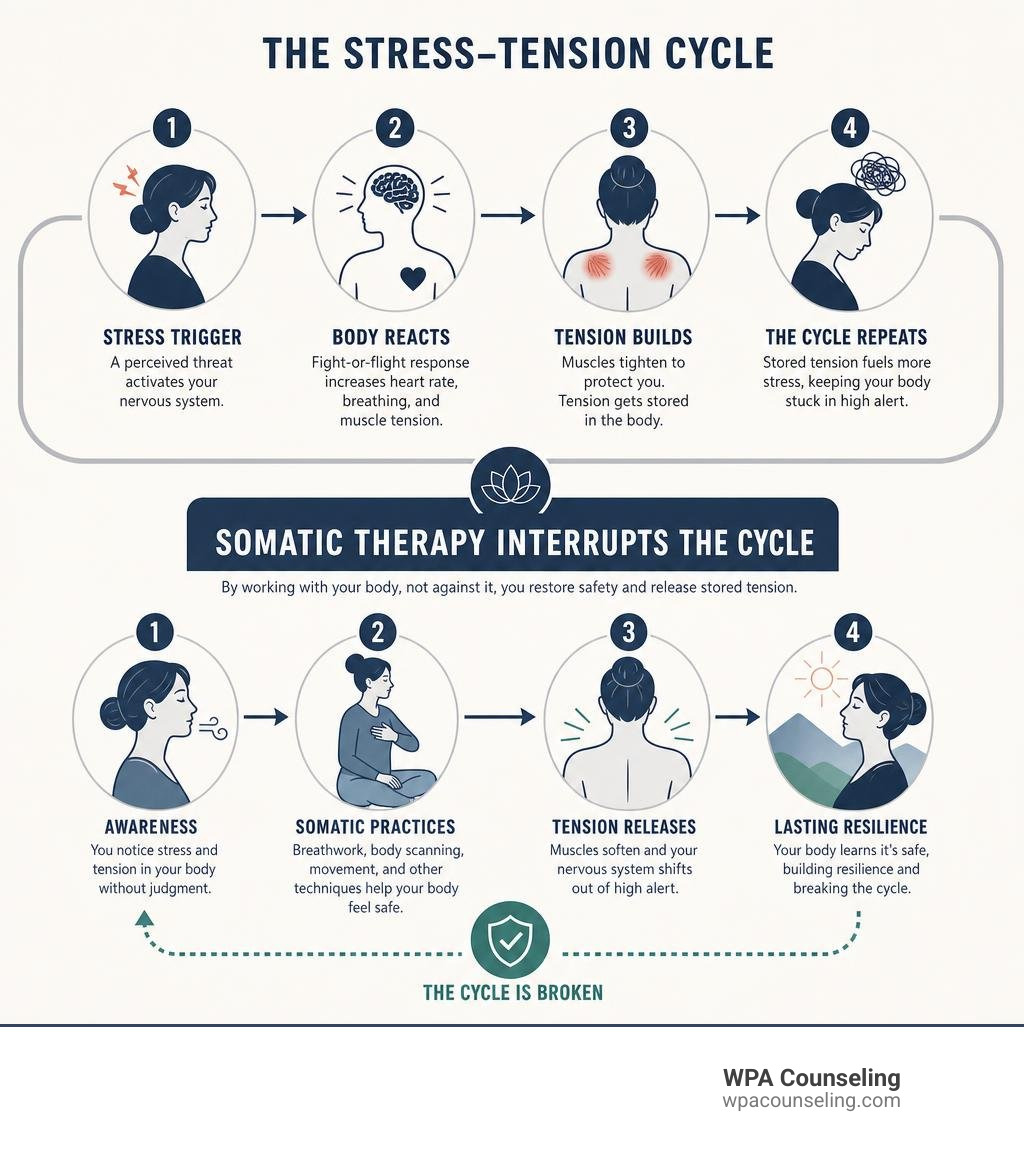
To understand how stress gets trapped in our muscles, we have to look at the autonomic nervous system. When you encounter a threat—whether it is a literal physical danger or a stressful email from your boss—your brain triggers the fight-or-flight response. Your heart rate increases, your breathing becomes shallow, and your muscles contract to prepare you to run or fight.
Ideally, once the threat passes, your nervous system returns to its baseline of safety. However, when we experience chronic anxiety, it is like keeping a foot constantly pressed down on the gas pedal. This creates continuous wear and tear on the body without reprieve.
According to A Complete Guide to Somatic Therapy, trauma can register within our bodies on a cellular level. When the nervous system cannot complete its natural stress cycle, it resorts to “muscle guarding”—a state where muscles remain semi-contracted to protect against anticipated pain or threat. The vagus nerve, which acts as the primary highway for the parasympathetic nervous system, becomes underactive, keeping us locked in a state of physical hyperarousal. Over time, this unresolved stress manifests as chronic neck pain, shoulder stiffness, tension headaches, and jaw clenching.

Somatic Therapy for Body Tension vs. Traditional Talk Therapy
When people seek support for mental health, they often think of traditional “talk therapy,” such as Cognitive Behavioral Therapy (CBT). CBT is an excellent tool that focuses on cognitive patterns—helping you identify and reframe unhelpful thoughts to change your emotional responses. This is known as a “top-down” approach because it starts in the mind and works its way down to the body.
Somatic therapy reverses this direction. It is a “bottom-up” approach, meaning it starts with the physical sensations in the body to access and heal the mind.
To understand the practical differences, we can look at how each modality approaches stress and trauma:
- Traditional Talk Therapy (CBT): Focuses on conscious thoughts, behavioral modifications, and desensitizing people to uncomfortable physical sensations. Learn more in The Complete Guide to Cognitive Behavioral Therapy.
- Somatic Therapy: Focuses directly on tracking internal sensations, releasing physical tension, and completing unfinished biological stress responses. Explore the nuances in our comparison of Somatic Therapy vs Talk Therapy.
How Somatic Therapy for Body Tension Bridges the Gap
While talk therapy is highly effective, it has limitations when it comes to somatic memory. Sometimes, the brain protects us by rationalizing a painful experience, but the physical body continues to carry the raw, survival-based stress. If you only focus on cognitive desensitization, you might understand why you feel anxious, but your shoulders will still feel like granite.
By incorporating somatic therapy for body tension, we can bridge this gap. Modalities like somatic experiencing help us tap into the physiological root of emotional blockages. Rather than just talking about a stressful event, a somatic approach helps you notice where that stress resides in your body and guides you to physically release it. This integrated pathway is central to What Is Somatic Therapy? and represents one of many Holistic Approaches in Depression Counseling.
Core Techniques Used in Somatic Therapy to Release Physical Tightness
Somatic therapy is not a one-size-fits-all practice. It uses a variety of gentle, body-centered techniques designed to restore balance to your nervous system.
| Somatic Technique | Core Focus | Primary Benefit |
|---|---|---|
| Body Awareness | Scanning the body to locate areas of comfort or tension | Increases interoception (internal body awareness) |
| Breathwork | Conscious manipulation of the breath | Activates the parasympathetic nervous system |
| Titration | Experiencing small amounts of stress at a time | Prevents the nervous system from becoming overwhelmed |
| Pendulation | Shifting focus between areas of tension and areas of calm | Teaches the body that stress is temporary |
| Resourcing | Accessing positive memories or physical sensations | Establishes an internal sense of safety |
Breathwork, in particular, is a foundational element. By slowing down our exhales, we send a direct message to the brain that we are safe, allowing tight muscles to finally let go of their protective grip.
Titration and Pendulation
Developed by trauma pioneer Peter Levine, titration and pendulation are specialized somatic techniques designed to prevent retraumatization.
- Titration: This involves introducing traumatic memories or physical sensations in tiny, slow, and highly manageable doses. Instead of diving headfirst into a painful memory, you touch the edges of the feeling while actively tracking and calming your physical sensations in real time.
- Pendulation: This is the practice of gently guiding your awareness between states of physical distress (like a tight chest) and states of calm or safety (like the warmth of your hands). This moving back and forth trains your nervous system to expand its tolerance for uncomfortable sensations without entering a panic loop.
These techniques ensure that healing occurs at a pace your nervous system can handle. For a deeper look at this process, read Trauma Therapy Explained: What It Is, How It Works, and Why It Helps.
Resourcing and Grounding
Before we can safely explore difficult somatic memories, we must build a foundation of safety. This is achieved through resourcing and grounding.
- Resourcing: This involves identifying internal or external anchors that make you feel safe, calm, and strong. An external resource might be a supportive relationship, a pet, or a peaceful spot in nature. An internal resource could be a comforting memory, a personal strength, or a physical sensation of stability in your feet.
- Grounding: Grounding exercises bring your awareness back to the present moment. This can be as simple as feeling the physical sensation of your feet flat on the floor, observing the colors in the room, or feeling the texture of the chair beneath you.
By prioritizing safety first, we can gently approach stored emotional pain without triggering a survival response. Learn more about these stabilizing methods in Understanding Trauma Therapy: A Path to Healing.
Practical Somatic Exercises for Jaw, Neck, and Shoulder Tension
Many somatic techniques are simple enough to practice at home. Some of the most effective exercises draw inspiration from the Feldenkrais Method—a system of somatic education developed to reset posture and release tension—and the work of Thomas Hanna, who coined the term “Somatics” in 1976.
These exercises are designed to be performed consciously, with your complete internal focus and attention. They are not about pushing through pain; they are about moving slowly and noticing how your muscles feel. For a wider range of nervous system soothing techniques, check out Stop the Panic with These Somatic Exercises for Anxiety.
Simple Exercises for TMJ and Jaw Release
Jaw clenching is one of the most common physical manifestations of stress. The masseter muscle—the primary muscle used for chewing—can hold an immense amount of tension. Try this simple somatic release:
- The Jaw Drop: Sit comfortably. Slowly and mindfully let your mouth drop open as wide as is comfortable. Do not force it. Pay attention to the sensation in your jaw joints. Slowly, over a count of five, bring your teeth back together, stopping just before they touch. Repeat this three times, focusing on making the movement as smooth and fluid as possible.
- Masseter Release: Place the heels of your hands gently on your cheeks, right below your cheekbones. Apply very light, supportive pressure. Slowly open your mouth while sliding your hands gently downward along the jawline. Breathe deeply and visualize the muscle softening under your hands.
Integrating Somatic Therapy for Body Tension into Your Daily Routine
You do not need hours of free time to benefit from somatic practices. In fact, integrating “somatic shorts”—quick, 5-minute micro-sessions—into your workday is incredibly effective for managing energy and resetting your posture.
Try setting a timer every few hours to perform a quick body scan. Notice if you are clenching your jaw, holding your breath, or raising your shoulders. Spend two minutes practicing three-dimensional breathing (breathing into your belly, ribs, and back) or doing a gentle seated pelvic tilt to mobilize your spine. Consistency is key; these brief moments of daily self-care help retrain your nervous system to choose ease over tension. For more tips on managing daily stress, explore our resources on Anxiety Therapy.
What to Expect: Signs Your Body is Releasing Stored Tension
As your nervous system begins to recalibrate and step down from a state of constant survival, you will experience both physical and emotional shifts. These “signs of release” are positive indicators that your body is completing its natural stress cycles. Understanding these signs can help you feel safe and supported during the healing process, which is detailed in Healing from Trauma: Proven Steps for Emotional Recovery.
Physical Signs of Release
During or after a somatic session, you might notice involuntary physical responses. These can include:
- Muscle twitching or shaking: This is the nervous system’s natural way of discharging excess survival energy.
- Temperature changes: Feeling sudden waves of warmth or cool tingling sensations as circulation improves.
- Deep, spontaneous sighs: An automatic sign that your diaphragm is relaxing and your breathing is shifting back to a parasympathetic state.
- Post-therapy fatigue: Feeling deeply tired as your body finally steps out of “high alert” and enters a state of deep rest and recovery.
Emotional and Mental Shifts
Because physical tension and emotional processing are deeply intertwined, physical releases often trigger emotional shifts:
- Sudden crying or laughter: Experiencing a sudden wave of tears or laughter without an obvious cognitive trigger. This is a normal emotional discharge.
- Feeling “lighter”: A sense of physical and mental spaciousness, as if a literal weight has been lifted from your chest or shoulders.
- Vivid dreams: As your brain and body process stored experiences, you may experience more active dreaming.
- Improved mood: An increased capacity for joy, presence, and connection. You can read more about balancing intense emotions in Mindfulness Meets Emotion: A Complete Guide to DBT for Depression.
Professional Support: How WPA Counseling Integrates Somatic Approaches
While self-guided exercises are fantastic for daily maintenance, processing deep-seated trauma and chronic somatic tension is safest and most effective under the guidance of a trained professional.
At WPA Counseling, we provide compassionate, evidence-based mental health care tailored to your unique story. Our team of licensed professional counselors specializes in helping clients bridge the gap between mind and body, utilizing proven approaches like CBT, DBT, and trauma-informed somatic techniques.
With years of clinical experience serving the Western Pennsylvania community, WPA Counseling has established a trusted local practice history of helping individuals navigate complex trauma, anxiety, and chronic stress. Our licensed therapists bring deep clinical expertise and specialized training in somatic and cognitive modalities, ensuring that our clients receive the highest standard of evidence-based, trauma-informed care. By combining our deep roots in the local community with rigorous clinical standards, we provide a safe, professional environment where true healing can take place.
We utilize a structured, four-stage healing journey known as the Counseling Blueprint:
- Take Off the Mask: We focus on building genuine, non-judgmental rapport and trust, ensuring you feel completely safe in our space.
- Heal the Wounds: Together, we gently explore the emotional and physical hurts, identifying where your body is storing past stress.
- Remove the Toxins: We help you identify unhelpful beliefs, lingering lies, and chronic tension patterns that keep you feeling stuck.
- Replace with Truth: We install empowering, accurate perspectives about yourself and your world, helping you step into a life of physical and emotional freedom.
We are proud to offer convenient in-person therapy at our welcoming offices in Western Pennsylvania (located in Irwin/North Huntingdon and Penn Hills), as well as secure, high-quality telehealth counseling for clients living anywhere across Pennsylvania. Whether you are looking for anxiety support, trauma therapy, or faith-sensitive counseling, we are here to support your journey toward wholeness.
Frequently Asked Questions about Somatic Therapy
Is somatic therapy effective for chronic pain and PTSD?
Yes, scientific research strongly supports the use of body-centered therapies. A notable study involving natural disaster survivors showed that 90% of participants reported significant improvement or were completely free of trauma symptoms (such as intrusion and hyperarousal) after receiving somatic experiencing therapy.
Furthermore, a 2021 review confirmed that somatic experiencing effectively reduces trauma symptoms, with improvements lasting long after the treatment ends. For those dealing with anxiety and depression, a 2025 pilot study combining mindfulness with body awareness demonstrated significant symptom reduction after just eight weeks. Additionally, somatic therapy has been proven highly effective for physical ailments like cervical myofascial pain, offering a powerful, evidence-based approach to physical and emotional relief.
How many sessions of somatic therapy do I need to see results?
Somatic therapy is highly individualized, and there is no single timeline for healing. However, clinical studies and reviews (such as the 2021 trauma review) show that many clients experience meaningful, lasting improvements in as few as 1 to 15 sessions. Your specific timeline will depend on your history, the nature of your physical tension, and how comfortable you feel processing somatic sensations.
Does insurance cover somatic therapy?
Because somatic therapy is sometimes classified as an alternative or integrative approach, many specialized somatic practitioners do not contract directly with health insurance companies. However, when somatic techniques are integrated into standard psychotherapy by a licensed counselor, it is often covered under standard mental health benefits. At WPA Counseling, we can provide you with a detailed receipt (often called a superbill) that you can submit to your insurance provider for potential out-of-network reimbursement.
Conclusion
Healing is not just about changing how you think—it is about changing how you live inside your own skin. When you cultivate an awareness of your bodily sensations and learn to release chronic muscle tightness, you give your nervous system the ultimate gift: a return to safety, ease, and balance.
If you are tired of carrying stress in your jaw, neck, and shoulders, you do not have to navigate this path alone. Let us help you find relief. Take the first step toward mind-body harmony today by visiting Stop the Panic with These Somatic Exercises for Anxiety to learn more, or reach out to us at WPA Counseling to get thoughtfully matched with a compatible licensed Pennsylvania counselor.
This article was researched with AI and heavily edited by Stephen Luther for accuracy and relevance.
Stephen Luther is the Executive Director and Founder of WPA Counseling. He holds a Master’s degree in Education from the University of Georgia and a Master’s degree in Marriage and Family Therapy from Duquesne University. He is a licensed professional counselor in Pennsylvania (LPC).
Since 1997, Steve has been helping children, adolescents, adults, couples, and families overcome emotional and relational challenges. He specializes in working with hurting families, including those with foster, adopted, or traumatized children. Steve uses Attachment-Based Therapy, client-centered therapy, and Therapeutic Parent Coaching to support healing and relationship restoration.
This guide is for educational and spiritual encouragement and is not a substitute for personalized professional counseling. If you are in crisis, please reach out for immediate help.