

When Faith and Mental Health Come Together
Faith and mental health are often treated as separate worlds — one belonging to the sanctuary, the other to the therapist’s office. For too long, mental illness was quietly viewed as a spiritual failing, and spirituality was dismissed as unscientific. That divide has left many people caught in the middle, unsure where to turn when they’re struggling.
But that separation is not just unnecessary — the evidence suggests it may be actively harmful.
Here is a quick overview of what the research tells us:
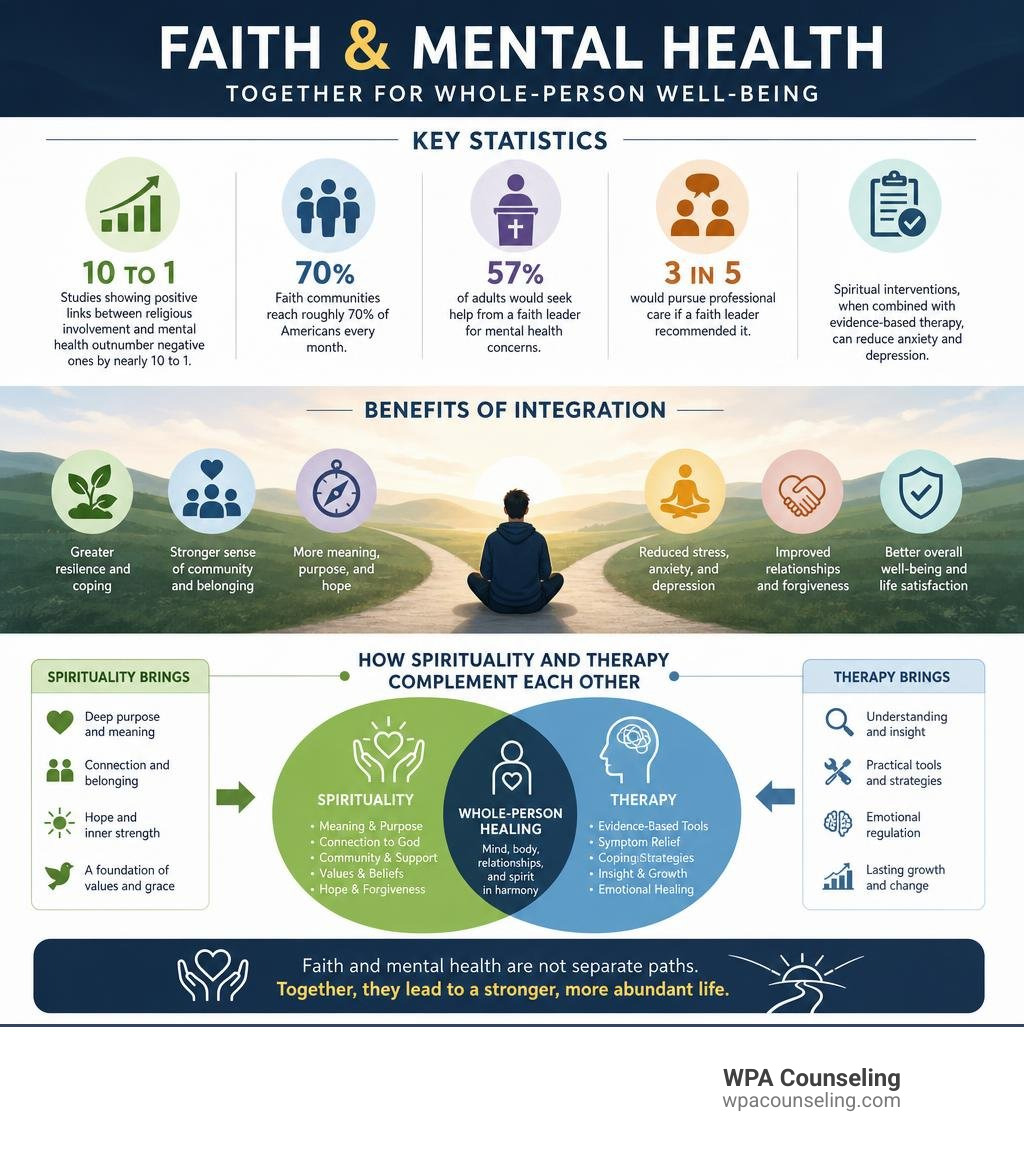
- Faith and mental health are complementary, not competing. Spiritual practices like prayer, community, and meaning-making support emotional resilience alongside clinical care.
- The evidence is strong. Studies showing positive links between religious involvement and mental health outnumber negative ones by nearly 10 to 1.
- Faith communities are a massive, underused resource. Churches, mosques, temples, and other faith communities reach roughly 70% of Americans every month.
- Faith leaders are often the first call. 57% of adults say they would seek help from a faith leader for mental health concerns — and 3 in 5 say they would pursue professional care if a faith leader recommended it.
- Integration works. Clinical research shows that spiritual interventions, when combined with evidence-based therapy, can meaningfully reduce anxiety and depression.
The goal of this guide is simple: to show how faith and professional mental health care can work together — and to help you understand what that integration looks like in real, practical terms.
Whether you lean heavily on your faith, hold it quietly, or are still figuring out what you believe, your whole self — emotional, relational, and spiritual — deserves care.
The Scientific Connection Between Faith and Mental Health
To understand how faith and mental health interact, we have to look at what modern clinical and sociological research reveals. For decades, a false narrative persisted that religious belief was either irrelevant to psychological health or, worse, a source of neurosis. However, looking at the academic landscape in July 2026, the scientific consensus has shifted dramatically.
A massive, decades-long meta-analysis of over 1,000 medical and social science studies has brought clear data to this discussion. According to a landmark report, studies showing a positive association between religious involvement and mental health outnumber those showing negative associations by a staggering 10-to-1 margin (961 positive studies compared to only 101 negative studies). You can read more about this extensive data in the New Decades-Long Research Analysis Finds Religion Improves Mental Health By a 10-to-1 Margin.
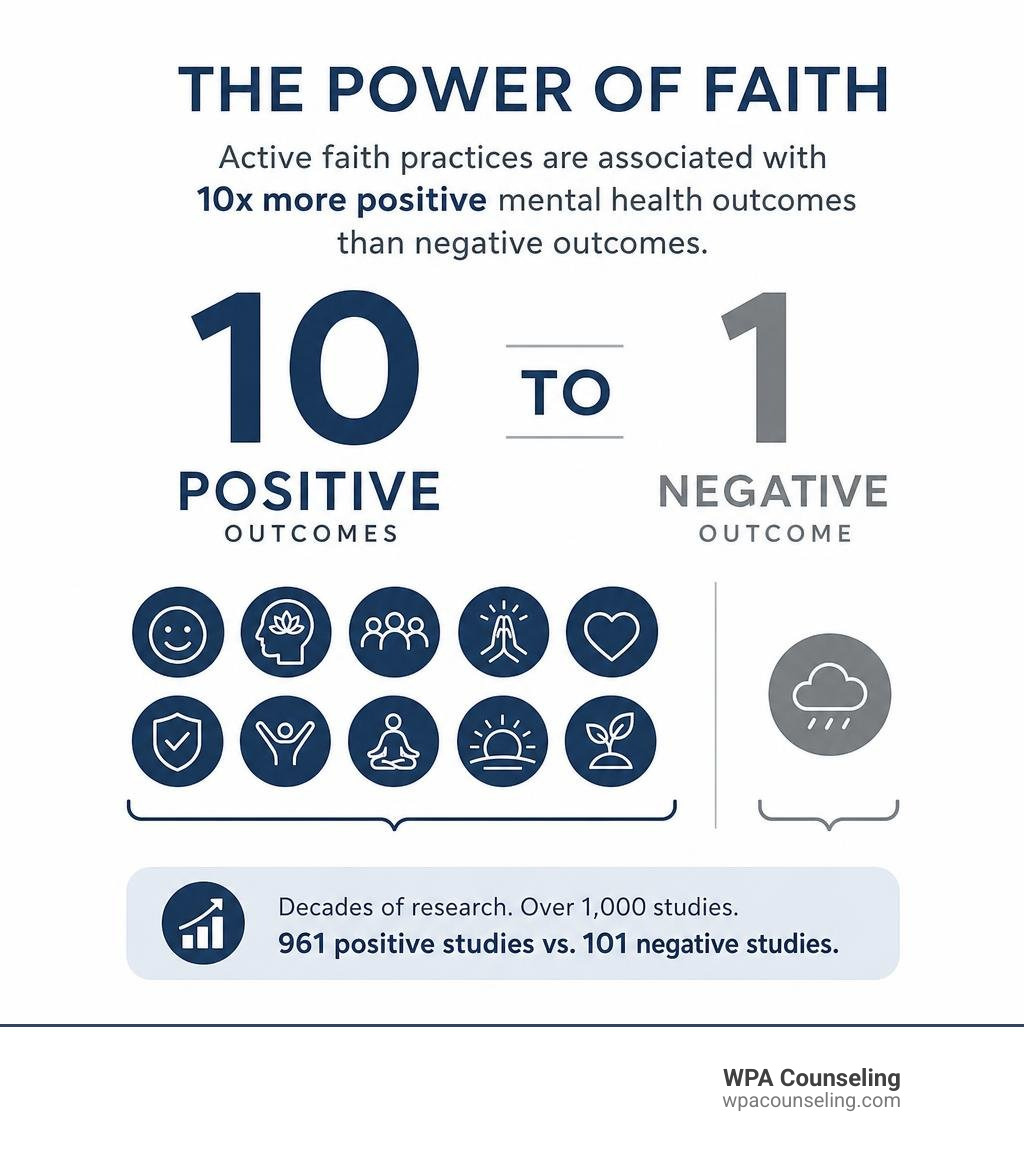
This research reveals that active religious participation acts as a powerful shield against some of our most pressing mental health crises:
- Depression: 74% of 247 high-quality studies found significantly better depression outcomes among those with active spiritual lives.
- Anxiety: 69% of 85 studies reported lower anxiety levels among highly religious individuals.
- Suicide Prevention: 89% of 76 high-quality studies demonstrated lower rates of suicide among those with active religious involvement. In fact, researchers estimate that the decline in weekly religious attendance in the United States may account for up to 40% of the rise in the national suicide rate.
- Stress Coping: 86% of 103 studies found a direct connection between active faith and positive coping mechanisms during times of high stress.
To build a complete picture, we must also look at how these dynamics play out over time. In a rigorous longitudinal study published by PLOS One, researchers examined the bidirectional relationship between religion and mental health over a 20-year period. The study, Exploring bidirectional causality between religion and mental health: A longitudinal study using data from the parent generation of a UK birth cohort | PLOS One, noted that while cross-sectional studies often show massive, immediate protective effects, long-term causality is highly individualized. It also highlighted that a sudden drop in religious participation is often a symptom of depressive withdrawal rather than a loss of belief.
This underscores why we cannot look at spiritual health and mental health in isolation. When we treat them as disconnected pieces, we miss the bigger picture of human wellness. By adopting a unified perspective, we can leverage the protective elements of faith while utilizing the clinical tools of modern psychology. To explore this concept further, read our guide on Embracing Wholeness: The Power of Holistic Counseling.
Bridging the Gap: Clergy and Therapists as Partners in Care
For too long, professional therapists and faith leaders operated in separate silos. A pastor might have worried that a secular psychologist would dismantle a congregant’s faith, while a therapist might have feared that a spiritual leader would tell a clinically depressed individual to simply “pray harder.”
Today, we know that the most effective path to healing involves building collaborative care networks. When clergy and mental health professionals work together, they form a comprehensive support system that addresses the emotional, physical, and spiritual dimensions of a person’s life. To understand how professional clinical therapy operates within this partnership, see our resource on Understanding Clinical Mental Health Counseling: A Comprehensive Guide.
How Faith and Mental Health Practices Work Together
Rather than acting as opposing forces, spiritual coping and clinical psychology are deeply complementary. Clinical therapy provides the practical, evidence-based tools to process trauma, manage biochemical imbalances, and restructure unhelpful cognitive patterns. Faith, on the other hand, provides the overarching framework of meaning, purpose, and hope that sustains a person through the hard work of therapy.
This synergistic relationship is backed by clinical data. A comprehensive systematic review and meta-analysis published in Psychological Medicine analyzed randomized controlled trials to evaluate the clinical efficacy of spiritually-integrated treatments. The study, Religious and spiritual interventions in mental health care: a systematic review and meta-analysis of randomized controlled clinical trials | Psychological Medicine | Cambridge Core, found that spiritually-integrated psychotherapy and spiritual meditation produced statistically significant reductions in general anxiety and depressive symptoms compared to standard secular treatments alone.
By integrating a client’s spiritual values into clinical treatment, we respect their core identity, which dramatically strengthens the therapeutic alliance and improves long-term recovery outcomes.
The Role of Faith Leaders as First Responders
In many communities, faith leaders are the actual first responders to a mental health crisis. This is especially true in medically underserved areas or communities of color, where systemic barriers and historical mistrust keep people from visiting traditional medical clinics.
The sheer scale of the faith network makes clergy an indispensable part of our public health infrastructure:
- Accessibility: Clergy outnumber psychiatrists in the United States by nearly 10 to 1, and they are much more equitably distributed across rural and urban neighborhoods.
- Reach: Local churches, temples, mosques, and synagogues reach approximately 70% of the American population every single month.
- Trust: 57% of adults experiencing a mental health struggle would seek help from a faith leader first.
Because of this trust, faith leaders hold the keys to professional care. Since 3 in 5 adults report they would actively seek professional mental health treatment if their faith leader recommended it, training clergy to recognize clinical symptoms and build trusted referral pipelines to licensed therapists is one of the most effective ways to close the mental health care gap.
Understanding Help-Seeking Behaviors and Demographics
Where a person turns for help during a psychological crisis is rarely random. It is shaped by their culture, demographic background, and the specific nature of their struggle. Understanding these help-seeking behaviors allows us to meet people exactly where they are. If you are wondering whether it is time to seek support, you can read more about self-reflection in our article, Is Therapy Right for You?.
Why Congregants Turn to Spiritual Leaders First
When life becomes overwhelming, the local church or place of worship feels safe. Congregants turn to spiritual leaders because of an established trust and a shared worldview. When you are processing deep grief, marital conflict, or existential anxiety, you want to talk to someone who understands your values and believes in the same ultimate truth.
Longitudinal data highlights how baseline beliefs shape these choices:
- Baseline Religious Identification: Individuals with high levels of baseline religious identification are slightly less likely to visit secular therapists (reduced by a factor of 0.94 over 20 years). They often rely heavily on their faith community for initial support.
- Baseline Spirituality: Conversely, individuals with high baseline spirituality are more likely to visit spiritual leaders (increased by a factor of 1.89) and are actually more open to visiting secular therapists (increased by a factor of 1.13).
This demonstrates that spirituality and professional therapy are not mutually exclusive; for many, they are deeply intertwined pathways to the same goal of healing.
How Age, Marriage, and Diagnosis Shape Care Choices
Demographics play a significant role in how people navigate their mental health care:
- Age and Marital Status: Studies show that older adults and married individuals are statistically less likely to seek help from both secular therapists and religious leaders, often relying instead on private coping mechanisms or immediate family networks.
- The Severity of Illness: The type of mental health challenge also dictates the help-seeking pathway. When facing mild to moderate stress, individuals may rely solely on pastoral counsel or personal prayer. However, when severe mental illness strikes, help-seeking behavior changes. The presence of a clinical mental illness increases visits to secular therapists by a factor of 6.89 and to religious leaders by a factor of 3.43.
This “dual-use” of care shows that when struggles become severe, individuals instinctively realize they need both spiritual guidance and clinical expertise. Recognizing when your struggles have crossed the line from a temporary spiritual dry spell to a clinical condition is vital. For guidance on identifying these signs, read our article on When to See a Therapist: 10 Signs You Should Not Ignore.
Practical Spiritual Disciplines That Support Well-Being
Faith is not just a set of abstract ideas; it is lived out through daily and weekly practices. These spiritual disciplines act as natural buffers against psychological distress, offering structure, quiet, and perspective in a chaotic world. When paired with professional Anxiety Therapy, these practices can significantly accelerate emotional recovery.

The Power of Communal Worship vs. Solitary Prayer
While both communal and private spiritual practices are valuable, research reveals they impact our mental health in fundamentally different ways.
A cross-sectional study published in BMC Psychology examined how different dimensions of faith affect coping styles. The study, Exploring the relationship between religiosity and coping strategies among individuals with mental illness in Uganda: a cross-sectional study | BMC Psychology | Springer Nature Link, made an important distinction between Organizational Religious Activity (communal worship and church attendance) and Non-Organizational Religious Activity (private, solitary prayer).
The researchers found that:
- Communal Worship (Organizational): Active participation in communal religious services was associated with a 32% increase in the odds of utilizing positive, adaptive coping strategies. Gathering with others provides structured social support, breaks the isolation of mental illness, and fosters collective problem-solving.
- Solitary Prayer (Non-Organizational): Conversely, a high reliance on solitary, private religious activity was associated with a 31% reduction in the odds of positive coping when it was used as a passive, avoidant, or guilt-driven mechanism (e.g., hiding from others to pray in isolation rather than seeking help).
| Dimension of Faith | Practice Examples | Mental Health & Coping Outcomes |
|---|---|---|
| Organizational (Communal) | Weekly services, small groups, community outreach | Fosters adaptive coping, reduces social isolation, builds robust peer support networks |
| Non-Organizational (Private) | Solitary prayer, private meditation, independent reading | Provides personal comfort; however, if isolated, it can sometimes lead to avoidant or passive coping |
This table highlights why a healthy spiritual life requires balance. Private reflection is restorative, but we are wired for connection. Gathering with a community of faith keeps us grounded and supported.
The Role of Faith Communities in Reducing Faith and Mental Health Stigma
Unfortunately, stigma still exists. Among adults who belong to a religious community, only 52% report that their community discusses mental health openly and without stigma. When a community treats mental illness as a secret shame or a lack of faith, it silences those who are hurting.
However, faith communities have an incredible opportunity to lead the way in stigma reduction. By speaking openly about mental health from the pulpit, hosting support groups, and teaching that seeking therapy is a sign of strength and wisdom, faith communities can create a safe harbor for those struggling with anxiety, trauma, or depression. This open dialogue is a vital companion to professional Depression Therapy, helping individuals step out of isolation and into a supportive, healing community.
Professional Care and the WPA Counseling Approach
At WPA Counseling, we believe that you shouldn’t have to leave your faith at the door to receive high-quality, professional therapy. We are a compassionate group practice of licensed professional counselors based in Irwin/North Huntingdon, Pennsylvania, with an additional office in Penn Hills. We provide convenient in-person counseling at our offices in Western Pennsylvania and secure telehealth therapy across all of Pennsylvania.
With years of dedicated clinical experience serving the Western Pennsylvania community, WPA Counseling has established a rich local practice history. Our team of licensed therapists brings decades of combined expertise in treating complex mental health conditions, helping individuals navigate life’s transitions with evidence-based, compassionate care. Over the years, we have built deep roots in Irwin, North Huntingdon, Penn Hills, and the broader Pittsburgh region, collaborating closely with local healthcare providers, community organizations, and faith leaders to deliver trusted, high-quality mental health support.
Our team of licensed Pennsylvania counselors utilizes evidence-based methods—such as Cognitive Behavioral Therapy (CBT), Dialectical Behavior Therapy (DBT), and trauma-informed care—while providing specialized, faith-sensitive counseling.
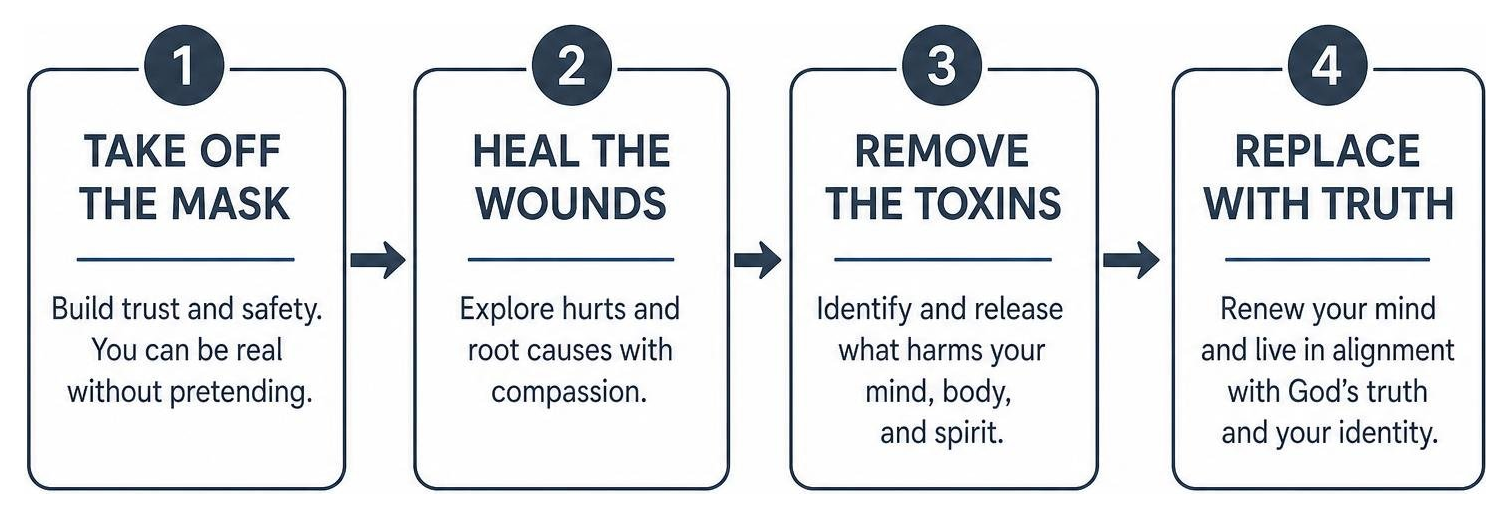
We guide our clients through our core approach, the Counseling Blueprint, which is a structured, four-stage healing journey:
- Take Off the Mask: We begin by building genuine rapport and trust. You can drop the pressure to look “perfect” and share what is truly happening in your life.
- Heal the Wounds: We gently explore emotional and relational hurts, looking at the root causes of your current struggles.
- Remove the Toxins: Together, we identify unhelpful beliefs, negative coping patterns, or lingering lies you may have believed about yourself or your worth.
- Replace with Truth: Finally, we install empowering, accurate, and life-giving perspectives about yourself, others, and the world, allowing you to walk forward in freedom.
Whether you are looking for Licensed Mental Health Support in Pennsylvania to navigate a difficult season, seeking Individual Counseling for personal growth, or looking for the convenience of Online Counseling, we are here to support your whole self—mind, body, and spirit.
Frequently Asked Questions about Faith and Mental Health
When should I see a professional therapist instead of only talking to my pastor?
While pastoral counsel is incredibly valuable for spiritual guidance, crisis comfort, and moral support, pastors are generally not trained to treat clinical psychological conditions. You should seek a professional, licensed therapist if you experience persistent clinical symptoms that disrupt your daily life, such as:
- Intrusive thoughts or flashbacks of trauma
- Prolonged, debilitating sadness or loss of interest in life
- Panic attacks or chronic, uncontrollable worry
- Relational patterns or deep grief that feel impossible to navigate alone
A pastor can walk beside you spiritually, but a therapist provides the clinical tools needed to treat the underlying mental health condition. For support during seasons of deep loss, you can read more about our specialized Grief Counseling.
Can I use both spiritual practices and clinical therapy at the same time?
Absolutely. In fact, this dual-use of care is often the most effective path to healing. Practicing spiritual disciplines like prayer, attending services, and engaging with your faith community can run parallel to your clinical therapy sessions. Your therapist can help you integrate these life-giving spiritual routines directly into your treatment plan, creating a holistic approach to your wellness. To see how this integration looks in practice, read our insights on Holistic Approaches in Depression Counseling.
How does negative religious coping affect my mental health?
Faith is a powerful asset, but how we relate to our beliefs under stress matters. Researchers categorize religious coping into positive and negative styles:
- Positive Religious Coping: Trusting in a loving higher power, seeking spiritual support, and viewing trials as opportunities for growth. This style acts as an active buffer, protecting mental health during stressful times.
- Negative Religious Coping (Spiritual Struggles): Feeling abandoned or punished by God, experiencing intense religious guilt, or facing unresolved spiritual doubt.
According to a pooled analysis published in the Journal of Religion and Health, negative religious coping actively worsens the impact of stress on mental health, leading to higher rates of depression and anxiety. You can read the detailed study here: Religious Coping, Stress, and Mental and Physical Health: A Pooled Analysis Across Diverse US Cohorts in Studies on Stress, Spirituality, and Health (SSSH) | Journal of Religion and Health | Springer Nature Link.
If you are carrying spiritual wounds, religious guilt, or trauma, our counselors can help you gently unpack these struggles. Learn more about healing from deep emotional wounds through our Trauma Therapy in Pittsburgh: Start Your Healing Today page.
Conclusion
At the intersection of faith and mental health lies a path to true, holistic wellness. You do not have to choose between your spiritual beliefs and clinical science—they are designed to work together to support your healing journey. By honoring both your faith and your emotional health, you can build a life of deep resilience, peace, and purpose.
If you are ready to take the next step in your healing journey, we would love to walk with you. Through our thoughtful matching process, we will connect you with a compatible licensed Pennsylvania counselor who respects your values and understands your goals.
To learn more about our services or to start your journey with the Counseling Blueprint, visit our Faith and Mental Health resource page or contact us today to get matched.
This article was researched with AI and heavily edited by Stephen Luther for accuracy and relevance.
Stephen Luther is the Executive Director and Founder of WPA Counseling. He holds a Master’s degree in Education from the University of Georgia and a Master’s degree in Marriage and Family Therapy from Duquesne University. He is a licensed professional counselor in Pennsylvania (LPC).
Since 1997, Steve has been helping children, adolescents, adults, couples, and families overcome emotional and relational challenges. He specializes in working with hurting families, including those with foster, adopted, or traumatized children. Steve uses Attachment-Based Therapy, client-centered therapy, and Therapeutic Parent Coaching to support healing and relationship restoration.
This guide is for educational and spiritual encouragement and is not a substitute for personalized professional counseling. If you are in crisis, please reach out for immediate help.