
When Relationships Hurt: What Relationship Counseling Can Do for You
Relationship counseling is professional support that helps couples — and individuals — work through emotional distance, communication breakdowns, conflict, and pain in their relationships.
Quick answer: What is relationship counseling?
- A licensed therapist works with you (and often your partner) to identify patterns causing harm
- Sessions create a safe, structured space to talk, listen, and rebuild connection
- It addresses issues like conflict, trust, intimacy, life transitions, and communication
- It differs from individual therapy in that the relationship itself is the focus
- It works for dating couples, married couples, and individuals navigating relationship challenges
- It can be done in person or via secure telehealth — including from two separate locations
Relationships are one of the most meaningful parts of life. They can also be one of the most painful.
Maybe you and your partner keep having the same argument. Maybe you feel more like roommates than partners. Maybe something happened — a betrayal, a loss, a major life change — and you’re not sure how to come back from it.
You’re not alone. Research published in Family Process found that the average person who completes couples therapy is better off than 70 to 80 percent of people who don’t seek help at all. That’s a meaningful difference — and it starts with a single step.
At WPA Counseling, we work with Pennsylvania residents every day who are carrying the weight of relationship struggles. We know how hard it is to reach out. We also know what becomes possible when you do.
What is Relationship Counseling and How Does It Work?
Many people wonder how relationship counseling differs from individual therapy. In individual therapy, the client is you—your personal history, your internal struggles, and your individual growth. In relationship counseling, the “client” is the relationship itself. The therapist acts as an objective, compassionate third party whose goal is to help the relational system function better for everyone involved.
In a typical couples counseling setting, both partners must attend the sessions. We focus on how you interact, how you respond to conflicts, and the unspoken rules that govern your partnership.
Session Formats, Duration, and What to Expect
When you begin, the first few sessions involve standard interview questions to explore the history of your relationship, individual priorities, and shared goals.
- Session Formats: Sessions are highly collaborative. The counselor will help you slow down your communication so you can see where things are breaking down, rather than letting you fall into the same unproductive bickering loops.
- Duration: While some couples benefit from short-term, structured programs that last one to two months, others prefer ongoing therapy to navigate complex, deeply rooted patterns.
- Typical Cost: Out-of-pocket rates for professional therapy in Pennsylvania typically range between $180 and $250 per session, depending on the counselor’s specialized training and the length of the session.

To learn more about how these sessions are structured and how they can benefit your partnership, you can read about our Marriage Couples Counseling services.
Common Reasons Couples Seek Professional Support
It is incredibly common for couples to face seasons of distance or distress. In fact, industry data shows that most couples wait six to seven years after the onset of relationship difficulties before finally seeking professional help. By waiting so long, small misunderstandings can solidify into deep-seated resentments.
Some of the most frequent reasons couples seek out relationship counseling include:
- Unproductive Communication Patterns: Falling into repetitive, circular arguments where both partners feel unseen, unheard, and defensive.
- Infidelity and Betrayal: Rebuilding trust after an affair is one of the most challenging relational hurdles. Healing requires creating an entirely new relationship dynamic rather than simply trying to return to how things were before.
- Waning Intimacy: Physical and emotional intimacy can decline due to stress, health challenges, or unaddressed emotional blocks. Counseling provides a safe, sex-positive environment to discuss desires and boundaries without shame.
- Major Life Transitions: Becoming empty nesters, adjusting to retirement, managing changing financial dynamics, or stepping into caretaking roles can severely strain a partnership.
- Anger Management and Conflict Resolution: When disagreements turn explosive or end in icy silence, couples need practical tools to de-escalate tension.
If you are currently struggling to communicate without escalating into anger, our guides on how to Stop Throwing Plates And Start Talking A Guide To Couples Counseling and The Couples Guide To Navigating Anger Management And Marriage Therapy offer highly practical, immediate steps you can take to cool down heated moments.
Types of Relationship Counseling Available
Not every relationship dynamic requires the exact same therapeutic approach. Depending on your specific challenges, different evidence-based frameworks can be utilized to guide your healing.
| Therapy Format | Primary Focus | Best Suited For |
|---|---|---|
| Gottman Method | Research-backed strategies to disarm conflicting verbal communication, increase intimacy, and respect. | Couples looking for highly practical, structured communication tools. |
| Emotionally Focused Therapy (EFT) | Attachment-based approach focusing on identifying and reshaping emotional responses and bonding patterns. | Partners experiencing deep emotional disconnection or attachment anxiety. |
| Discernment Counseling | A short-term format designed for couples where one partner wants to rebuild the relationship and the other is leaning toward ending it. | Couples at a critical decision-making crossroads who need clarity on their next steps. |
| Family Systems Theory | Views the relationship as an interconnected system where individual behaviors are influenced by family history. | Couples dealing with complex family dynamics, in-law issues, or generational patterns. |
Choosing the right modality can feel overwhelming, but a skilled therapist will tailor their approach to your unique needs. For those living in the local metro area, you can explore specialized options like Couples Counseling In Pittsburgh to find a local therapist trained in these evidence-based modalities.
Premarital and Marriage Therapy
Premarital counseling is a proactive way for engaged couples to build a strong foundation before tying the knot. It focuses on identifying shared values, aligning expectations regarding finances and family dynamics, and establishing healthy conflict-resolution skills early on. For long-term marriages, counseling acts as essential relationship maintenance, helping partners stay connected as they grow and change over decades together.
Specialized Relationship Counseling for Diverse Needs
Every partnership carries its own unique cultural, geographical, and spiritual context. For couples navigating specialized dynamics, tailored therapy is highly beneficial:
- Interracial and Intercultural Partnerships: Navigating differing cultural expectations, societal biases, and family traditions requires deep empathy and mutual understanding. You can read more in our guide on Relationship Counseling For Interracial And Intercultural Couples.
- Long-Distance Relationships: Managing emotional connection across zip codes or time zones presents distinct communication challenges. Learn how to bridge the gap with our article on Relationship Counseling For Long Distance Couples In Pennsylvania Wpa Counseling.
- Faith-Sensitive Counseling: Many couples prefer working with a counselor who understands and respects their spiritual beliefs, integrating faith-sensitive values directly into the therapeutic healing process.
The Benefits and Success Rates of Therapy
Seeking support for your partnership is an investment that yields measurable, long-term rewards. According to data from the American Association for Marriage and Family Therapy (AAMFT), over 97% of surveyed individuals reported receiving the help they desperately needed from couples therapy. Furthermore, 90% of couples report a significant increase in their overall emotional well-being after completing a course of relationship therapy with a highly trained professional.
When you commit to the therapeutic process, the benefits extend far beyond simply “fighting less.” You can expect to:
- Rebuild Emotional Safety: Learn how to express vulnerability without the fear of rejection, judgment, or defensiveness.
- Master Rupture and Repair: Accept that miscommunications and ruptures are a natural part of any relationship; the key to lasting connection is learning how to swiftly and lovingly repair those ruptures.
- Break Generational Trauma Cycles: By modeling healthy, respectful conflict resolution in your home, you break unhealthy family cycles and pass down constructive relationship habits to your children.
- Expand Your Emotional Vocabulary: Move away from constant feelings of loneliness, anger, and resentment, and replace them with emotional states of fulfillment, connection, and pride.
The WPA Counseling Approach to Healing Relationships
At WPA Counseling, we believe that with the right professional support, every person is capable of cultivating the relationship they truly desire and deserve. We are a compassionate group practice of licensed professional counselors based in Irwin/North Huntingdon, Pennsylvania, with an additional office in Penn Hills. We provide high-quality, in-person counseling at our Western Pennsylvania offices, as well as secure, HIPAA-compliant telehealth therapy across the entire state of Pennsylvania.
Our team consists of highly experienced, licensed Pennsylvania counselors who specialize in evidence-based methods tailored to your needs, including:
- Cognitive Behavioral Therapy (CBT): To identify and restructure unhelpful thought patterns that fuel conflict.
- Dialectical Behavior Therapy (DBT): To build emotional regulation and distress tolerance skills during tense discussions.
- Attachment-Based Therapy: To explore how childhood experiences shape how you seek safety and reassurance in your adult partnership.
- Trauma-Informed Care: To heal relational wounds and past trauma with gentleness, focusing on counseling-based strategies and moving at a pace that feels safe and comfortable for both partners.
With years of clinical experience and a deep local practice history serving the Western Pennsylvania community, WPA Counseling has established itself as a trusted resource for couples and individuals seeking lasting relational change. Our therapists bring decades of combined clinical expertise to every session, ensuring that our clients receive evidence-based, compassionate care rooted in proven therapeutic frameworks.
If you are looking for local support in the region, you can read our comprehensive guide on How To Find A Couples Counselor In The Steel City.
Navigating the Four-Stage Relationship Counseling Blueprint
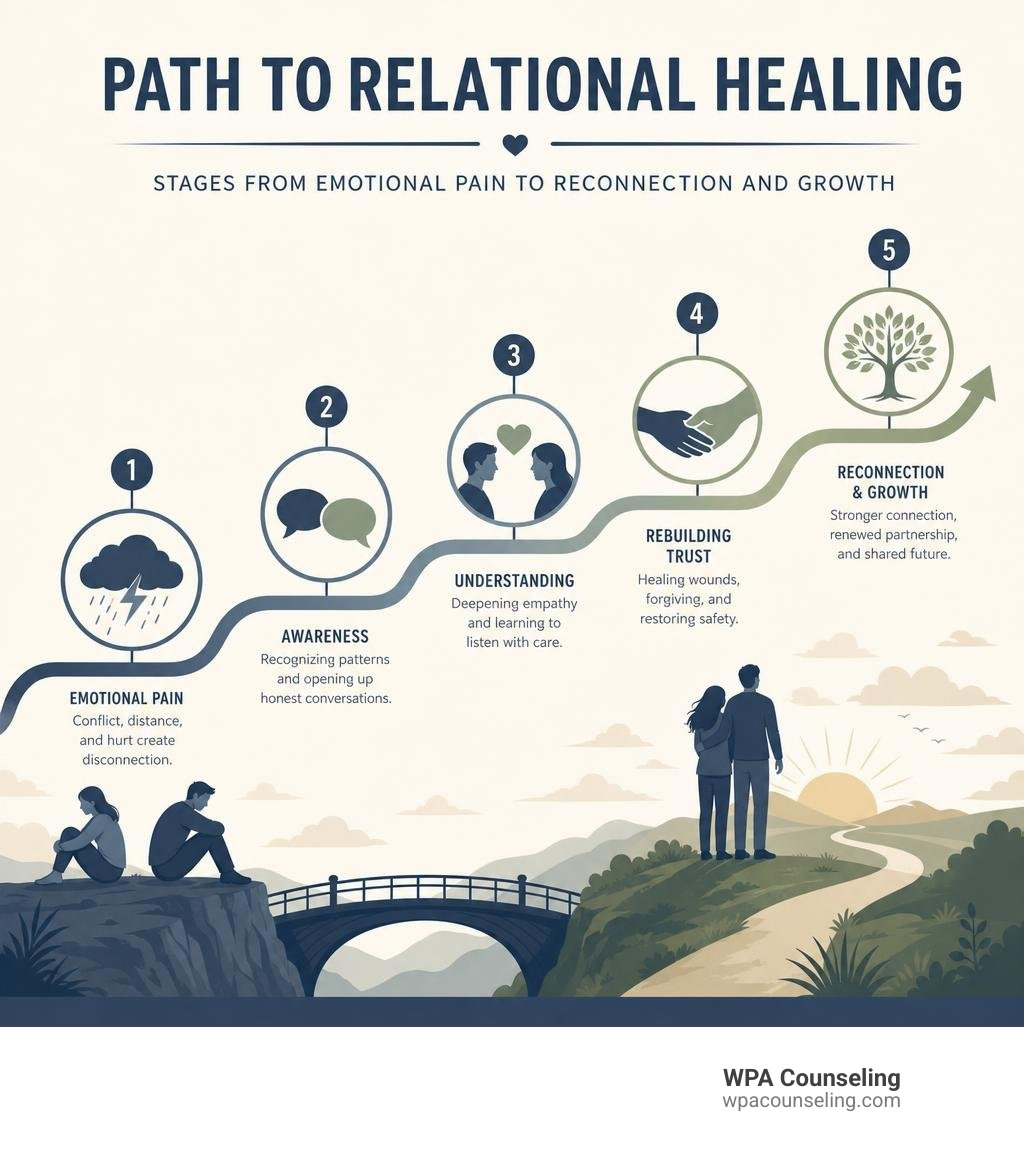
Relational healing is a journey, not a quick fix. To guide you through this process, WPA Counseling utilizes our signature Counseling Blueprint, a thoughtful, four-stage healing process designed to restore deep connection:
- Take Off the Mask: We focus on building genuine rapport and trust between you, your partner, and your counselor. This stage establishes a safe, non-judgmental space where you can drop your guard and speak honestly.
- Heal the Wounds: We gently explore the emotional and relational hurts that have built up over time, allowing both partners to express their pain and feel truly heard.
- Remove the Toxins: We identify and dismantle unhelpful beliefs, lingering lies, defensive patterns, and past resentments that are actively poisoning your daily interactions.
- Replace with Truth: We install empowering, accurate perspectives about yourself, your partner, and your shared future, equipping you with the tools to maintain a healthy, loving bond for years to come.
Frequently Asked Questions
Is online therapy as effective as in-person sessions?
Yes, online therapy is highly effective. In fact, studies show a 94% satisfaction rate among couples who utilize online relationship programs, with 91% of couples reporting noticeably improved relationships.
Using secure, HIPAA-compliant video platforms, virtual therapy allows you and your partner to join your counselor from the comfort of your home. It is also an excellent option for busy schedules, as couples can even join a single telehealth session from two separate physical locations if one partner is traveling or working.
Does insurance cover couples therapy?
Insurance coverage for couples therapy varies. Most standard health insurance plans do not cover couples counseling under a general mental health benefit unless one partner meets the diagnostic criteria for a specific mental health condition (such as depression or anxiety) and the couples therapy is deemed medically necessary to treat that condition.
However, many clients successfully use their Health Savings Account (HSA) or Flexible Spending Account (FSA) cards to pay for relationship therapy, as therapists are licensed healthcare providers. Additionally, out-of-network benefits may allow you to submit “superbills” (detailed receipts containing clinical billing codes) to your insurance company for partial reimbursement. Under the No Surprises Act, you are always entitled to a clear Good Faith Estimate outlining your projected therapy costs before your treatment begins.
What should we do if our counselor doesn’t feel like a good fit?
A strong therapeutic alliance is the single most important predictor of successful therapy. If you or your partner do not feel a genuine connection with your therapist, you are entirely entitled to keep looking.
At WPA Counseling, our dedicated Intake Coordinator is trained to match you with the counselor best suited to your personality, goals, and scheduling needs. If the first match doesn’t feel right, simply let us know, and we will happily help you transition to another licensed professional on our team.
Conclusion
Relational struggles can make you feel incredibly isolated, but you do not have to navigate this path alone. Whether you are looking to heal from a major betrayal, transition into a new phase of life, or simply stop having the same circular arguments, professional support can help you find your way back to love and mutual respect.
Through WPA Counseling’s thoughtful matching process, we will pair you with a compatible, licensed counselor who understands your unique struggles and respects your values. Take the first step toward emotional healing, empowerment, and a healthier relationship today.
Explore our dedicated Relationship Counseling services to learn more about our practice, or reach out to us today to get thoughtfully matched with a therapist who can guide you and your partner back to connection.
This article was researched with AI and heavily edited by Stephen Luther for accuracy and relevance.
Stephen Luther is the Executive Director and Founder of WPA Counseling. He holds a Master’s degree in Education from the University of Georgia and a Master’s degree in Marriage and Family Therapy from Duquesne University. He is a licensed professional counselor in Pennsylvania (LPC).
Since 1997, Steve has been helping children, adolescents, adults, couples, and families overcome emotional and relational challenges. He specializes in working with hurting families, including those with foster, adopted, or traumatized children. Steve uses Attachment-Based Therapy, client-centered therapy, and Therapeutic Parent Coaching to support healing and relationship restoration.
This guide is for educational and spiritual encouragement and is not a substitute for personalized professional counseling. If you are in crisis, please reach out for immediate help.