What Is Cognitive Behavioral Therapy?
Developed by Dr. Aaron Beck in the 1960s, cognitive behavioral therapy (CBT) revolutionized psychotherapy. Beck observed that depressed patients frequently experienced streams of spontaneous, negative thoughts about themselves, the world, and their future. By helping patients examine and modify these thoughts, Beck found that their emotional state and daily functioning improved significantly.
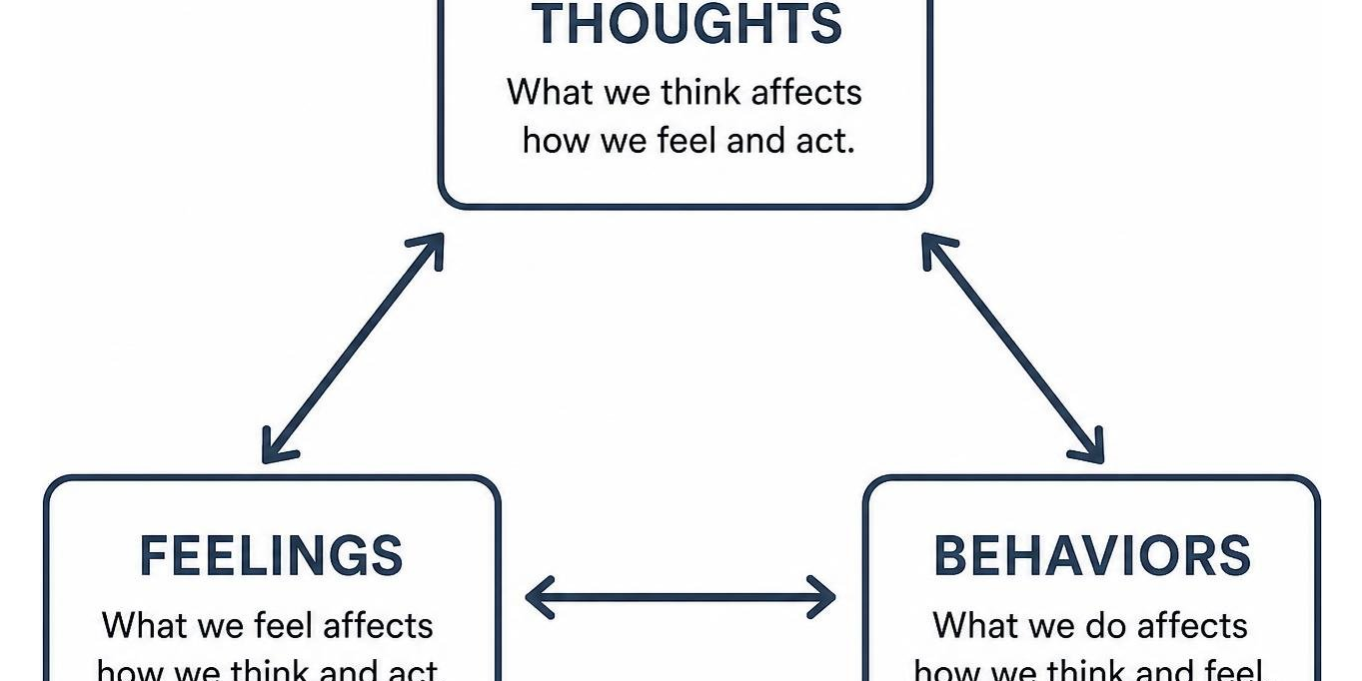
At its core, CBT is an evidence-based psychotherapy built on a straightforward concept known as the cognitive triangle. This model demonstrates that your thoughts, feelings, and actions are constantly influencing one another:
Unlike therapies that spend years dissecting early childhood experiences, CBT is a present-focused approach. While your therapist will gather necessary background history to understand where you’re coming from, the primary work centers on what is happening in your life right now. As noted in the StatPearls clinical review on CBT, this goal-oriented modality provides structured, didactic tools that allow individuals to actively reshape their daily mental and emotional health.
Core Principles of Cognitive Behavioral Therapy
The foundational premise of CBT rests on three core assumptions:
- Psychological problems stem partly from unhelpful or inaccurate ways of thinking.
- Psychological problems stem partly from learned patterns of unhelpful behavior.
- People suffering from these issues can learn better coping strategies, leading to symptom relief and improved quality of life.
Every day, our minds process thousands of automatic thoughts — immediate, unpremeditated interpretations of events. When these interpretations are distorted by logical errors (known as cognitive distortions), negative emotions and unhelpful behaviors naturally follow.
Common cognitive distortions include:
- Catastrophizing: Assuming the worst possible outcome will happen (e.g., “If I make a mistake on this report, I’ll definitely be fired”).
- Black-and-White Thinking: Viewing situations in absolute terms (e.g., “If I’m not perfectly successful, I’m a complete failure”).
- Mind Reading: Deciding you know what someone else is thinking without evidence (e.g., “She didn’t say hello because she hates me”).
By grounded principles of psychological learning, CBT treats these unhelpful thinking patterns as habits that can be unlearned. The approach focuses heavily on active problem-solving, teaching you to catch these thoughts in real-time. According to the InformedHealth overview of CBT, combining cognitive reframing with behavioral modification equips individuals with practical, self-directed tools for long-term health.
How Cognitive Behavioral Therapy Differs from Other Psychotherapies
If you’ve ever wondered how CBT stacks up against other forms of talk therapy, it helps to compare their fundamental goals, session structures, and timeframes:
| Therapy Modality | Core Focus | Session Structure | Typical Duration | Primary Goal |
|---|---|---|---|---|
| Cognitive Behavioral Therapy (CBT) | Present thought patterns, beliefs, and behaviors | Highly structured, agenda-driven with homework | Short-term (5–20 sessions) | Unlearn harmful habits and develop present-day coping skills |
| Psychodynamic Therapy | Unconscious drives, early childhood, and past trauma | Unstructured, open-ended discussion | Medium to long-term (months to years) | Gain deep self-insight into root historical causes |
| Humanistic / Person-Centered Therapy | Self-actualization, present emotional acceptance | Non-directive, guided by client’s immediate lead | Variable / Open-ended | Build self-acceptance through unconditional positive regard |
While traditional psychoanalysis dives deep into past historical causes, CBT maintains a sharp present-moment focus. Sessions are collaborative and structured rather than open-ended. You and your therapist work as a team: the therapist acts as an expert guide in psychological techniques, while you remain the expert on your own lived experience.
Mental Health Conditions and Life Challenges Treated by CBT
CBT is widely considered the gold standard of evidence-based psychotherapy because it has been rigorously studied across hundreds of clinical trials. It provides robust tools for managing psychiatric conditions as well as everyday life stress.
Psychiatric Conditions
- Depression: CBT helps break the cycle of lethargy and negative self-talk. Learning about depression therapy options can help you discover how cognitive restructuring restores hope and motivation.
- Anxiety Disorders: Whether managing generalized worry, social anxiety, or panic disorder, understanding anxiety psychotherapy and CBT reveals how reframing physical sensations and fears reduces anxiety.
- Post-Traumatic Stress Disorder (PTSD): CBT helps process traumatic memories safely, shifting lingering beliefs of self-blame toward safety and recovery.
- Eating Disorders & Obsessive-Compulsive Disorder (OCD): Structured CBT techniques dismantle rigid rules around food, body image, and obsessive compulsions.
Life Transitions and Stressors
CBT isn’t just for diagnosed mental health disorders; it’s equally powerful for navigating acute life stress. If you are struggling with a major life transition, such as career shifts or relationship breakdowns, specialized care like divorce anxiety counseling can help you re-establish stability and conquer fears of the unknown.
Non-Psychiatric Physical Conditions
Fascinatingly, research highlighted in the Mayo Clinic guide to cognitive behavioral therapy shows that CBT is highly effective for managing physical health issues. Because physical sensations and cognitive stress exist in a continuous feedback loop, CBT offers measurable relief for:
- Chronic pain conditions (fibromyalgia, lower back pain, migraines)
- Insomnia and sleep disruptions
- Irritable Bowel Syndrome (IBS) and chronic fatigue syndrome
Key Cognitive and Behavioral Techniques

CBT utilizes a diverse toolkit designed to help you analyze and adjust your responses to stress. For a closer look at these tools, consider this overview based on the Healthline breakdown of CBT techniques:
- Cognitive Restructuring & Thought Records: You’ll learn to track emotional triggers in a written journal. When distress arises, you log the situation, the automatic thoughts that popped up, and the evidence supporting or contradicting those thoughts. This allows you to evaluate your thinking objectively.
- Socratic Questioning: Your therapist won’t simply tell you that your thoughts are wrong. Instead, they ask targeted, curious questions (e.g., “What is the realistic probability of that happening?” or “What would you tell a dear friend in this exact situation?”) to help you uncover healthier perspectives yourself.
- Behavioral Activation: When depression or stress sets in, people often isolate themselves and stop doing activities they enjoy. Behavioral activation involves scheduling positive, manageable steps back into your week to rebuild energy and mood.
- Exposure Therapy & Gradual Desensitization: Avoiding feared situations actually strengthens anxiety over time because immediate avoidance brings temporary relief (a process called negative reinforcement). Exposure therapy involves facing feared scenarios step-by-step in a safe, controlled environment, teaching your nervous system that you can handle the discomfort.
- Mindfulness & Relaxation Skills: Deep abdominal breathing, progressive muscle relaxation, and present-moment grounding exercises help calm physical fight-or-flight responses.
What to Expect During a Typical CBT Session
If you’ve never been to therapy before, stepping into a counselor’s office can feel intimidating. Knowing the standard flow of a CBT session can help ease those initial jitters.
The Structure of a 50-Minute Session
Unlike unstructured sessions where you talk about whatever comes to mind, a typical 50-minute CBT session follows a clear agenda:
- Mood Check & Update (5 minutes): Briefly reviewing how you’ve been feeling physically and emotionally since the last meeting.
- Bridge from Previous Session (5 minutes): Reconnecting with main takeaways or insights from your prior session.
- Homework Review (10 minutes): Discussing exercises you practiced during the week, celebrating wins, and addressing any hurdles.
- Setting & Working the Agenda (25 minutes): Collaboratively selecting one or two specific present-day challenges to focus on using cognitive or behavioral tools.
- Summary & New Homework (5 minutes): Wrapping up core insights and agreeing on practical exercises to try before the next appointment.
Timeline and Homework
A standard course of cognitive behavioral therapy is short-term, generally lasting between 5 to 20 weekly sessions.
Homework is a crucial component of this timeline. Practice outside the clinic — whether that’s logging thoughts, practicing breathing techniques, or testing out new behaviors — is where real life change happens. Reading about cognitive behavior therapy for depression reveals how taking small, actionable steps between appointments builds momentum, ultimately teaching you to become your own therapist.
Benefits, Potential Risks, and Neuroscience Insights
CBT is one of the most thoroughly validated psychological treatments in modern healthcare, backed by decades of neuroscience research.
Long-Term Benefits and Medication Efficacy
Clinical studies consistently demonstrate that CBT is as effective as, or more effective than, psychiatric medications for treating mild-to-moderate depression and anxiety disorders. While medications adjust brain chemistry externally, CBT equips you with lifelong coping mechanisms. Even after treatment concludes, individuals who complete CBT show significantly lower relapse rates compared to those treated with medication alone.
What Science Says: Neuroscience Insights
Modern neuroimaging studies provide empirical evidence of CBT’s impact on the brain. As detailed in the Harvard Health research on CBT mechanics, brain scans reveal that successful CBT actually alters activity in key neural networks:
- Prefrontal Cortex: Enhances executive functioning, logic, and emotional regulation.
- Amygdala: Reduces hyperactive fight-or-flight fear responses.
- Neural Pathways: Builds resilient new neural pathways through neuroplasticity.
Potential Risks and Challenges
CBT is safe and non-invasive, but it is not always easy. Facing difficult thoughts, processing painful memories, or engaging in gradual exposure therapy can cause temporary emotional discomfort or physical fatigue. Feeling slightly worse before feeling better is a normal part of working through difficult feelings. A skilled, compassionate therapist will always pace these exercises safely to keep you supported.
Finding a Qualified Therapist and Getting Started in Pennsylvania
When seeking care, verifying a clinician’s credentials is step one. Look for licensed professionals — such as Licensed Professional Counselors (LPC), Licensed Clinical Social Workers (LCSW), or Licensed Psychologists — who hold specialized training in evidence-based care. Exploring resources on anxiety counseling in Pennsylvania can help clarify what credentials and clinical approaches best serve your needs.
Decades of Local Practice History and Clinical Experience
With years of dedicated service across Western Pennsylvania, WPA Counseling brings deep clinical experience and established local practice history to our community. Our practice was founded with a commitment to providing high-quality, compassionate mental health care to individuals, couples, and families throughout the region. Over the years, our seasoned team of licensed therapists has guided thousands of Pennsylvanians through depression, anxiety, trauma recovery, and complex life transitions using evidence-based cognitive behavioral techniques and counseling-focused care.
The WPA Counseling Difference: Our Counseling Blueprint
At WPA Counseling, we believe clinical expertise must be matched with deep empathy and personalized care. Our compassionate team of licensed Pennsylvania counselors integrates evidence-based CBT with our structured framework, The Counseling Blueprint. This four-stage healing journey helps guide your growth:
- Take Off the Mask: Building genuine trust and rapport so you feel safe being authentic.
- Heal the Wounds: Sensitively exploring underlying emotional hurts and past strain.
- Remove the Toxins: Identifying unhelpful automatic thoughts, distorted core beliefs, or lingering internal lies using proven CBT tools.
- Replace with Truth: Establishing empowering, accurate perspectives about yourself, your relationships, and your future.
Convenient Care Across Pennsylvania
We make high-quality therapy accessible wherever you are in the Commonwealth:
- In-Person Counseling: Comfortable, welcoming physical office locations in Western Pennsylvania, including our primary offices in Irwin/North Huntingdon and Penn Hills.
- Secure Statewide Telehealth: Convenient, HIPAA-compliant virtual therapy available to individuals, couples, and families anywhere in Pennsylvania.
Whether you prefer meeting face-to-face in Western PA or connecting online, our thoughtful matching process connects you with a licensed counselor tailored to your personality, goals, and values.
Frequently Asked Questions About CBT
How long does a standard course of CBT last?
A typical course of standard CBT generally ranges between 5 to 20 weekly sessions, with each session lasting about 50 minutes. The exact timeline depends on individual factors, including symptom severity, specific goals, and how consistently you practice homework exercises outside of therapy.
Is CBT as effective as medication for anxiety and depression?
Yes! Extensive research shows CBT is just as effective as medication for treating mild-to-moderate anxiety and depression. While medication can relieve acute symptoms quickly, CBT teaches lasting self-regulation skills. For severe conditions, research highlighted in our guide to anxiety disorder treatments shows that combining CBT with prescribing medical providers yields optimal long-term results.
Can CBT be conducted online through telehealth?
Absolutely. Numerous clinical studies confirm that online CBT delivered via secure video is just as effective as in-person therapy. At WPA Counseling, our virtual sessions offer flexible access to top-tier care across all of Pennsylvania, allowing you to engage in structured therapy from the privacy of home.
Conclusion
Understanding the basics of cognitive behavioral therapy empowers you to take charge of your mental health. By learning to examine your thought patterns, challenge internal assumptions, and adopt healthier behaviors, you acquire practical tools that last a lifetime. Emotional healing isn’t about ignoring life’s real hardships; it’s about building the resilience and clarity needed to navigate them.
If you’re ready to take the next step, our team at WPA Counseling is here to walk alongside you. We invite you to explore our complete guide to cognitive behavioral therapy or reach out today to get thoughtfully matched with a compassionate, licensed Pennsylvania therapist who fits your unique journey.
This article was researched with AI and heavily edited by Stephen Luther for accuracy and relevance.
Stephen Luther is the Executive Director and Founder of WPA Counseling. He holds a Master’s degree in Education from the University of Georgia and a Master’s degree in Marriage and Family Therapy from Duquesne University. He is a licensed professional counselor in Pennsylvania (LPC).
Since 1997, Steve has been helping children, adolescents, adults, couples, and families overcome emotional and relational challenges. He specializes in working with hurting families, including those with foster, adopted, or traumatized children. Steve uses Attachment-Based Therapy, client-centered therapy, and Therapeutic Parent Coaching to support healing and relationship restoration.
This guide is for educational and spiritual encouragement and is not a substitute for personalized professional counseling. If you are in crisis, please reach out for immediate help.