

When Trust Is Broken: What You’re Really Facing After Betrayal
Learning how to trust again after betrayal is one of the hardest things a person can do — but it is possible, and you are not alone in asking this question.
Here is a quick overview of the core steps:
- Acknowledge the pain — name what happened and let yourself feel it
- Allow time — research shows meaningful trust restoration takes 2–5 years of consistent change
- Set new terms of safety — decide what you need to feel safe going forward
- Rebuild through actions, not words — consistent, transparent behavior matters more than apologies
- Consider professional support — a licensed counselor can guide both partners through the process
- Separate forgiveness from trust — you can forgive someone and still choose to leave
- Decide intentionally — stay or go based on genuine commitment, not fear or inertia
Maybe your partner lied to you. Maybe they hid finances, cheated, or broke a promise so fundamental that the ground beneath you shifted. Whatever happened, you are likely feeling something that goes beyond ordinary heartbreak.
That is because betrayal is not just an emotional wound. Neuroscience shows it activates the same brain regions tied to physical pain. Your nervous system is not overreacting — it is doing exactly what it was designed to do: protect you.
The hard truth is that there is no quick fix here. But the encouraging truth is that couples who do the work of rebuilding trust often report deeper connection and satisfaction than they had before the betrayal occurred.
This guide walks you through what actually helps — step by step.
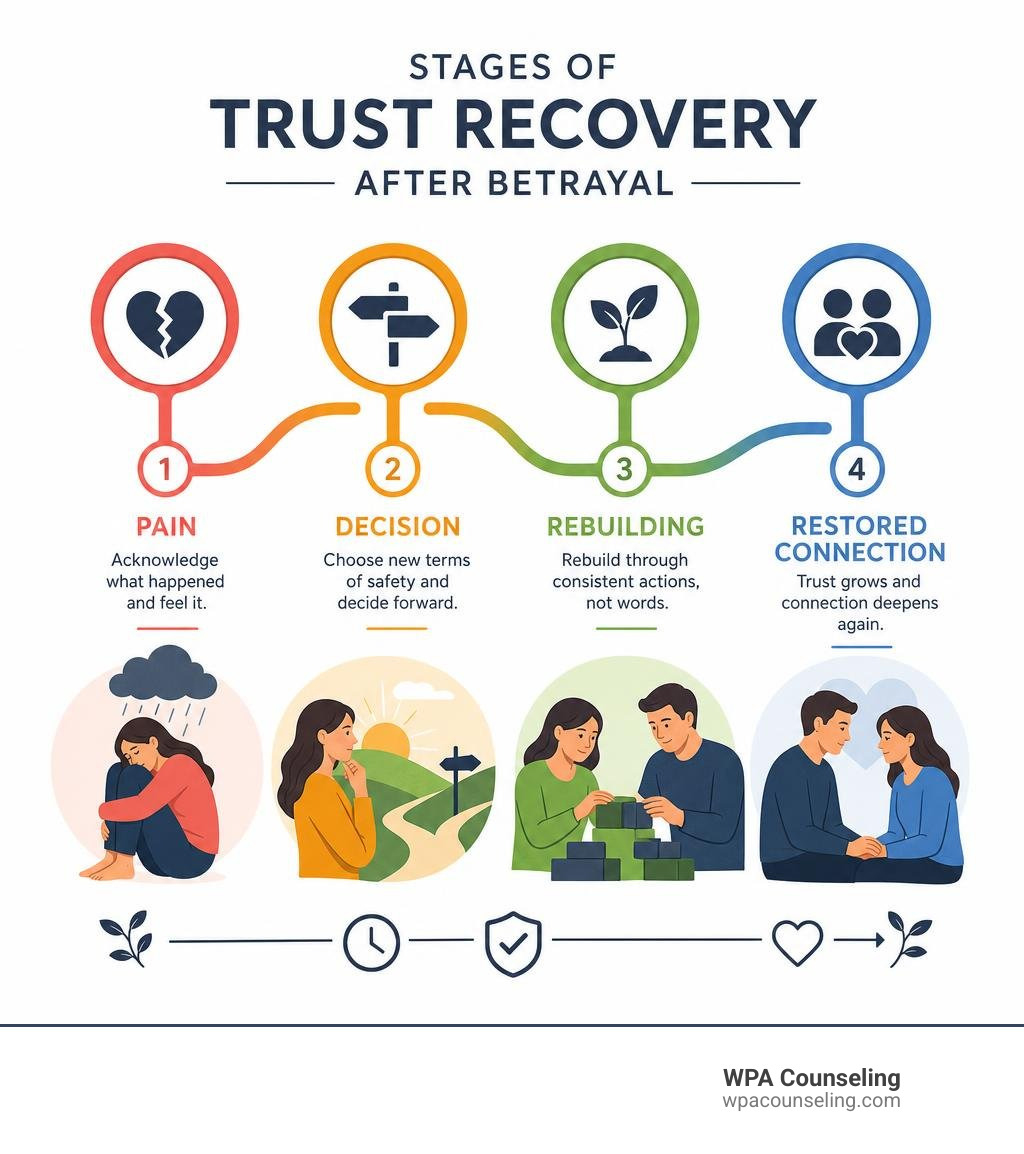
Simple how to trust again after betrayal word guide:
The Neurobiology of Broken Trust: What Betrayal Does to the Brain and Body
To understand how to trust again after betrayal, we first have to understand why broken trust feels like a physical blow. It is not just “all in your head.”
Neuroscientific research confirms that social betrayal activates the anterior cingulate cortex and the amygdala—the exact same regions of the brain associated with physical pain and survival-based fear. When someone you love and depend on violates your trust, your brain registers it as a literal threat to your survival.

This shock triggers a cascade of physical and emotional reactions:
- The Cortisol Spike: A lack of trust keeps your nervous system in a state of constant hypervigilance. This chronic state of alert elevates cortisol, the primary stress hormone. Over time, high cortisol levels are clinically linked to physical symptoms like fatigue, weight gain, brain fog, and a weakened immune system.
- Hypervigilance as Protection: If you find yourself checking their phone, overanalyzing their tone of voice, or panicking when a text message is delayed, your nervous system is trying to keep you safe. It is scanning the environment to make sure you are not blindsided again.
- The Anxiety Loop: Your brain goes into overdrive trying to reconcile two conflicting realities: “This is the person who is supposed to keep me safe, and this is the person who hurt me.”
We often see clients struggling to calm this internal storm. Understanding that your body is reacting to a legitimate trauma is the first step toward calming your nervous system. For a deeper look at why this happens, you can read about Why Your Brain Goes Wild in Relationships and How to Stop the Anxiety Loop.
How to Trust Again After Betrayal: Is Rebuilding Truly Possible?
The short answer is yes. But it is important to debunk a common myth: rebuilding trust does not mean returning to the relationship you had before. That old relationship is gone. Rebuilding trust means co-creating a new relationship—one built on active transparency rather than assumed safety.
Research brings us some incredibly encouraging news: married couples who actively work to restore trust after a major breach often achieve deeper levels of intimacy and relationship satisfaction than they had before the trust was lost. Why? Because the process forces both partners to communicate with a level of raw honesty they likely avoided in the past.
However, we must be realistic about the timeline. For major betrayals (such as long-term infidelity, deep financial deception, or hidden addictions), research suggests it takes 2 to 5 years of consistent behavior change before trust is meaningfully restored.
This is not a journey that can be rushed. It requires patience, a willingness to tolerate discomfort, and a structured approach. If you are wondering how to navigate the day-to-day survival of this process, our Trust Restoration Survival Guide offers practical tools to keep you grounded.
The Roadmap for Repair: Essential Steps for Both Partners
Rebuilding a damaged bond is a two-way street. While the partner who broke the trust must carry the heavy lifting of proving safety, the hurt partner must eventually decide if they are willing to allow safety to be proven.

To establish a clear path forward, both partners can follow our structured A Roadmap to Repairing Your Damaged Bond. Let’s break down what this roadmap requires from each of you.
Actionable Steps for the Partner Who Lied
If you are the one who broke the trust, you cannot rely on passive avoidance of bad behavior. Simply “not messing up” or staying silent does not rebuild safety. In fact, your silence might actually trigger your partner’s anxiety, because they remember that you were hiding things the last time everything seemed “fine.”
To rebuild safety, you must replace a system of secrecy with a proactive system of communication:
- Practice Radical Transparency: For a season, this means offering unprompted access to your phone, calendar, and finances. Do not make your partner ask; offer the information willingly to show you have nothing to hide.
- Share Vulnerabilities Before They Become Slips: If you feel a moment of weakness, temptation, or emotional discomfort, tell your partner before you act on it. Sharing an urge is a counterintuitive but highly effective way to prove that you are choosing honesty over secrecy.
- Use the Feelings Wheel: High-functioning adults often struggle to identify their internal emotional states. Use a Feelings Wheel to practice naming specific emotions (such as shame, anxiety, or loneliness) during a daily 5-minute check-in.
- Manage Shame: Shame will tempt you to defend yourself, minimize your actions, or shut down. Remember to separate your identity from your behavior: you did a bad thing, but you are not inherently a bad person. Taking accountability without defensiveness is crucial.
How to Trust Again After Betrayal When You Are the Hurt Partner
When you have been betrayed, your “assumptive world”—the fundamental beliefs you held about your partner, your safety, and your own judgment—shatters. Healing is a non-linear process of moving From Shock to Acceptance in Betrayal Recovery.
To navigate this transition, focus on these steps:
- Honor Your Hypervigilance: Do not shame yourself for feeling anxious or suspicious. Acknowledge that your body is trying to protect you, but gently remind yourself to slow down and look for objective evidence of safety.
- Set Clear Boundaries: You have the right to ask for what you need to feel safe. This might include asking for regular updates, pausing certain social interactions, or scheduling specific times to talk about the betrayal so it does not consume your entire day.
- Prioritize Self-Care: Restore your self-esteem by engaging in activities outside the relationship. Spend time with supportive friends, practice mindfulness, journal your thoughts, and focus on physical wellness to help lower those elevated cortisol levels.
Rebuilding the Bond: Constructive Communication and Vulnerability
When discussing the betrayal, couples often fall into a destructive cycle of attacking and defending. To break this loop, we often use the glass-bottom boat metaphor.
Imagine your relationship is a glass-bottom boat. The betrayal shattered the glass, plunging the hurt partner into cold, deep water while the other partner remained relatively dry. If the partner on deck gets frustrated that the partner in the water is panicking over a “minor splash,” the gap between them widens.
To rebuild the boat, you must practice constructive communication:
- Validate the Fear: The partner who broke trust must validate the hurt partner’s fear, even if the trigger seems minor. Saying “I understand why that delayed text made you worry, and I am here” is infinitely more healing than saying “You’re overreacting.”
- Ask Clarifying Questions to Understand, Not to Shame: The hurt partner has a right to ask questions to piece their reality back together. However, try to ask questions aimed at understanding the “why” and the “how,” rather than asking questions designed to punish or shame.
For a comprehensive look at navigating these complex dynamics, explore The Ultimate Guide to Healing from Trauma in a Relationship.

Navigating the Vulnerability Loop: How to Trust Again After Betrayal Without Fear
Vulnerability is the only pathway back to true connection, but it feels incredibly risky when you have been hurt. To overcome the fear of being hurt again, couples must slowly step into the “Vulnerability Loop.”
This loop begins when one partner takes a small emotional risk—such as admitting a fear or expressing a soft emotion—and the other partner responds with warmth, validation, and care. Each successful cycle of this loop strengthens attachment security.
Understanding how your early life experiences influence your adult relationships can also make this process easier. You can learn more about this by reading How Childhood Attachment Shapes Adult Relationships WPA Counseling.
Forgiveness vs. Trust: Understanding the Key Differences
One of the greatest obstacles to healing is confusing forgiveness with trust. They are entirely different psychological concepts, and understanding the distinction is liberating.
| Feature | Forgiveness | Trust |
|---|---|---|
| Focus | The past and the present | The future |
| Nature | A personal choice to release resentment | An earned expectation of safety |
| Requirement | Can be done unilaterally (by one person) | Requires consistent behavior from both |
| Purpose | To free yourself from the weight of pain | To build a safe, shared future |
You can forgive someone to free yourself from bitterness while still choosing to keep your boundaries firm or even end the relationship. Forgiveness is about releasing the debt; trust is about evaluating if they are safe enough to borrow from again.
When to Walk Away: Signs a Relationship Cannot Be Saved
While we believe in the power of restoration, we also recognize that some relationships cannot—and should not—be saved. It is not worth trying to rebuild trust if your partner displays the following patterns:
- A Pattern of Repeated Betrayal: If the betrayal is a chronic lifestyle rather than an isolated failure, the likelihood of genuine change is low.
- A Complete Lack of Remorse: If your partner minimizes your pain, blames you for their choices, or refuses to take full accountability, the foundation for rebuilding does not exist.
- Continued Secrecy and Lying: If you catch them in new lies or find they are still hiding things after promising total transparency, they are not ready to do the work.
- Active Emotional Abuse: It is vital to distinguish between a relationship going through a difficult recovery and one that is fundamentally abusive. To help you evaluate your situation, read our guide on Emotional Abuse vs a Difficult Relationship How to Tell the Difference.
Professional Support: How Therapy Guides Trust Restoration
Navigating betrayal trauma on your own can feel like walking through a minefield in the dark. Professional support provides the structure, safety, and clinical expertise needed to guide you through the healing process.
With over a decade of dedicated service in Western Pennsylvania, WPA Counseling has established a rich history of helping individuals and couples navigate the complex terrain of relationship trauma and betrayal recovery. Our clinical team brings decades of combined experience, having guided hundreds of local clients through the process of rebuilding trust and restoring emotional safety. Our deep roots in the community and extensive clinical background ensure that you receive highly specialized, evidence-based care tailored to your unique situation.
At WPA Counseling, our team of licensed Pennsylvania counselors utilizes evidence-based methods—including Cognitive Behavioral Therapy (CBT), Emotionally Focused Therapy (EFT), and Gottman Method couples therapy—to help couples de-escalate conflict and rebuild attachment security.
We guide our clients using our proprietary Counseling Blueprint, a compassionate four-stage healing journey:
- Take Off the Mask: We build a safe, non-judgmental environment of genuine rapport where you can drop your defenses and speak your raw truth.
- Heal the Wounds: We explore and validate the deep emotional hurts and relational traumas caused by the betrayal.
- Remove the Toxins: We help you identify and dismantle unhelpful beliefs, lingering lies, and toxic cycles of defensiveness or shame.
- Replace with Truth: We install empowering, accurate perspectives about yourself, your partner, and your future, helping you move forward with clarity.
Whether you are looking for in-person support at our convenient Western Pennsylvania offices in Irwin/North Huntingdon and Penn Hills, or prefer secure telehealth therapy available statewide across Pennsylvania, we are here to walk alongside you. You can take the first step toward healing by exploring our Couples Counseling in Pittsburgh page.
Frequently Asked Questions About Rebuilding Trust
Can a relationship be better after betrayal?
Yes. While the pain of betrayal is devastating, the process of recovery forces couples to dismantle superficial communication and address long-standing, hidden issues. Many couples who successfully complete this journey report a much deeper level of emotional intimacy, honesty, and mutual satisfaction than they experienced before the breach.
How long does it realistically take to trust again?
For major betrayals, clinical research and experience show that it realistically takes 2 to 5 years of consistent, transparent behavior change to restore a deep sense of safety. Healing cannot be rushed, and trying to force a faster timeline often leads to premature forgiveness that does not hold.
Is it possible to forgive someone but not trust them again?
Absolutely. Forgiveness is a personal choice to release anger and bitterness so that the betrayal no longer controls your life. Trust, however, is a cooperative assessment of future safety that must be earned through consistent action over time. You can fully forgive someone and still decide that it is healthier to end the relationship.
Conclusion
The journey of learning how to trust again after betrayal is undeniably challenging, but it is also a path toward profound personal and relational growth. Whether you choose to rebuild your relationship or find the strength to walk away, your healing is entirely possible. You do not have to carry this heavy burden alone.
At WPA Counseling, we are dedicated to helping individuals and couples find their way back to emotional safety and peace of mind. Let us support you in taking the next step. Contact us today to get thoughtfully matched with a compatible licensed counselor who understands your unique needs and can walk with you through our Counseling Blueprint. Learn more about our services and begin your recovery by visiting our Couples Counseling in Pittsburgh page.
This article was researched with AI and heavily edited by Stephen Luther for accuracy and relevance.
Stephen Luther is the Executive Director and Founder of WPA Counseling. He holds a Master’s degree in Education from the University of Georgia and a Master’s degree in Marriage and Family Therapy from Duquesne University. He is a licensed professional counselor in Pennsylvania (LPC).
Since 1997, Steve has been helping children, adolescents, adults, couples, and families overcome emotional and relational challenges. He specializes in working with hurting families, including those with foster, adopted, or traumatized children. Steve uses Attachment-Based Therapy, client-centered therapy, and Therapeutic Parent Coaching to support healing and relationship restoration.
This guide is for educational and spiritual encouragement and is not a substitute for personalized professional counseling. If you are in crisis, please reach out for immediate help.