

When Trust Breaks: What It Really Takes to Repair It
Trust restoration is the process of rebuilding safety, honesty, and emotional connection in a relationship after a betrayal or significant breach of trust.
Here is a quick overview of what it involves:
- Stop the harmful behavior — immediately and completely
- Practice radical transparency — voluntarily share information instead of waiting to be asked
- Validate the hurt partner’s pain — take full accountability without defensiveness
- Show up consistently — small, reliable actions every day matter more than grand gestures
- Give it time — research shows meaningful rebuilding typically takes 1 to 2 years
- Get professional support — couples who engage in structured therapy have a significantly higher success rate
If you have ever been betrayed by someone you loved and trusted, you already know the feeling. One moment everything seems fine. The next, the ground shifts beneath you and nothing feels safe anymore.
That experience is not just emotional. It is physical. Your nervous system registers the person you once felt safe with as a source of danger. And no amount of willpower — from either of you — can simply think your way past that.
The painful truth is that most couples who try to rebuild trust on their own get stuck. They cycle through the same arguments. One partner feels like they are never doing enough. The other feels like they will never feel safe again. Both feel exhausted.
But healing is possible. It just requires more than good intentions.
This guide walks you through exactly what trust restoration looks like — the psychology behind it, the steps that actually work, and how professional support can make the difference between spinning in place and genuinely moving forward.
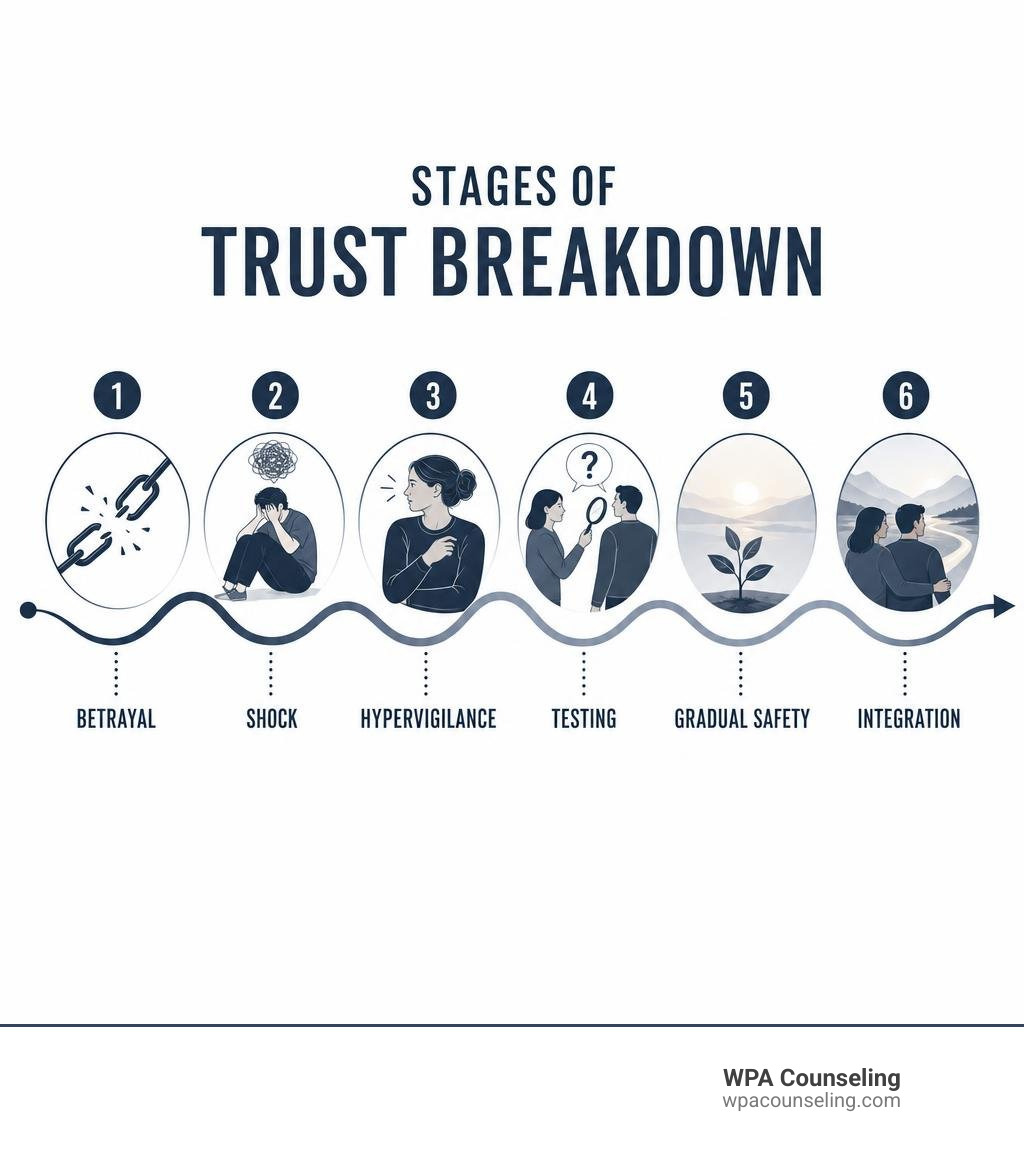
The Psychology of Trust and the Impact of Betrayal
To understand how to repair a broken bond, we first have to look at what trust actually is. In psychological terms, trust is not just a warm, fuzzy feeling. It functions as a sophisticated predictive model in the brain.
Our brains are constantly processing information to keep us safe. When you trust a partner, your brain builds a predictive model that says: “This person is safe, predictable, and has my best interests at heart.” Because of this model, your nervous system can rest. It does not need to waste energy scanning your partner for threats.

When betrayal occurs — whether through infidelity, financial deception, or a pattern of broken promises — it causes a massive prediction error in the brain. Suddenly, the person who was supposed to be your primary source of safety becomes the source of danger.
This prediction error triggers intense amygdala activation. The amygdala is the brain’s alarm system, and when it goes off, it floods your body with stress hormones. This is why betrayal feels like a physical blow. It is also why the injured partner enters a state of hypervigilance, constantly scanning for signs of further deception.
Many offending partners make the mistake of thinking, “If I just stop doing the bad thing, everything will go back to normal.” Unfortunately, it does not work that way. Simply stopping the harmful behavior does not rebuild safety; it only stops the active bleeding.
The silence that follows a stopped behavior can actually feel terrifying to a betrayed partner. Because they were blindsided before, quiet moments can trigger intense anxiety. To truly heal, the couple must dismantle the entire “secrecy system” that allowed the betrayal to happen in the first place, replacing it with a new, highly visible system of safety. This is a crucial phase of healing from trauma in a relationship and addressing the deep wounds of relationship trauma and emotional abuse.
The Blueprint for Trust Restoration: A Step-by-Step Protocol
Rebuilding trust requires moving from abstract apologies to structured, concrete actions.

A helpful way to conceptualize this is through the Trust Equation, which looks like this:
$$\text{Trust} = \frac{\text{Credibility} + \text{Reliability} + \text{Intimacy}}{\text{Self-Orientation}}$$
- Credibility: The truthfulness of your words.
- Reliability: The consistency of your actions.
- Intimacy: The emotional safety and vulnerability you share.
- Self-Orientation: How much you focus on yourself versus your partner. (If self-orientation is high — meaning you are defensive, protective of your ego, or impatient — the overall trust score plummets).
Scientific research on trust repair confirms that restoring this balance requires a structured approach. Let’s break down the Psychologist’s protocol for repairing relationships into three actionable phases. Following this protocol acts as a reliable roadmap to repairing your damaged bond.
Phase 1: Radical Transparency and Voluntary Disclosure
The first phase of trust restoration is often called the “Glass House” phase. During this time, the partner who broke trust must trade privacy for radical, voluntary transparency.
Secrecy is keeping information that, if known, would change your partner’s decisions or emotional state. Privacy is healthy, but in the wake of a betrayal, the boundary must temporarily shift toward total openness to calm the injured partner’s hyperactive alarm system.
- Voluntary Disclosure: Do not wait to be asked. If you ran late at work, text your partner with an update before they have to ask where you are.
- Open Access: Share passwords, calendar schedules, and financial statements willingly.
- Daily Emotional Check-ins: Spend 5 minutes sharing your internal state. Use a simple body, mind, and emotion check-in to practice expressing vulnerability before a crisis occurs.
Phase 2: Accountability and Validating the Hurt Partner’s Pain
When a relationship is recovering from a major transgression, standard mutual compromise does not work right away. Instead, the couple must enter a temporary phase of One-Way Repair. In this phase, the partner who caused the harm carries the heavy lifting of holding the other’s pain.
This requires practicing three core elements of reconciliation:
- Remorse: Expressing genuine, deep sorrow for the pain you caused, rather than just feeling bad that you got caught.
- Repentance: Openly admitting the wrongness of the action without shifting blame, making excuses, or offering explanations disguised as defenses.
- Recompense: A willingness to do whatever it takes to make things right, even if it feels uncomfortable or inconvenient.
When your partner expresses anger or grief, the goal is not to defend your intentions. The goal is to validate their impact. Saying, “I hear how much my actions hurt you, and it makes complete sense that you feel angry and unsafe right now,” does more to restore safety than a thousand defensive explanations.
Phase 3: Consistency in Small Actions Over Grand Gestures
It is a common relationship myth that a massive, romantic gesture can wipe away a betrayal. In reality, the brain’s predictive model is not rewritten by a weekend getaway or an expensive gift. It is rewritten by “sliding door moments” — the tiny, everyday opportunities to choose connection and reliability over self-interest.
According to relationship data, consistent small acts of reliability are 3 to 5 times more effective at rebuilding trust than grand gestures. The injured partner’s nervous system needs to see that you are predictable over time.
For more context on this long-term behavioral shift, you can explore the Cleveland Clinic’s guide on rebuilding trust.
| Grand Gestures (Ineffective for Repair) | Consistent Small Actions (Effective for Repair) |
|---|---|
| Buying expensive gifts or jewelry | Following through on daily promises and household chores |
| Planning an elaborate, surprise vacation | Texting when your plans change, even by 10 minutes |
| Making dramatic, sweeping promises of change | Answering the same questions patiently, without frustration |
| Staging a public, emotional apology | Showing up on time and being emotionally present daily |
The Betrayed Partner’s Journey: Moving from Suspicion to Safety
While the partner who broke trust must do the heavy lifting of proving safety, the injured partner has their own difficult path to walk. Healing is not passive. It is an active, exhausting process of retraining a traumatized nervous system.
When you have been betrayed, hypervigilance is not a sign of weakness; it is a protective survival strategy. Your brain is trying to make sure you never get blindsided again. However, living in a constant state of high alert is unsustainable.
Moving forward requires a gradual transition from shock to acceptance in betrayal recovery. This involves:
- Nervous System Regulation: Utilizing somatic practices, deep breathing, and self-soothing techniques to calm physical panic when triggers occur.
- Cognitive Reappraisal: Gently challenging intrusive thoughts. This means moving from “blind trust” (which is no longer safe) to “prudent, evidence-based trust.” You begin to look at the objective data points of your partner’s current, consistent behavior rather than relying solely on past fear.
Establishing Boundaries and Communication Patterns for Long-Term Trust Restoration
As safety returns, the couple can begin co-creating new boundaries. These are not rules designed to control the other person; rather, they are clear standards of what is required to keep the relationship safe and healthy.
- Active Listening: Practice repeating back what your partner says to ensure they feel heard before you respond.
- Clear Deal-Breakers: Clearly define what behaviors are unacceptable moving forward.
- Mutual Respect: Shift from accusatory “you” statements to vulnerable “I” statements (e.g., “I feel anxious when I don’t hear from you” instead of “You are hiding things from me again”).
Professional Support: How Evidence-Based Therapy Facilitates Healing
Trying to navigate trust restoration alone can feel like walking through a minefield in the dark. It is incredibly easy to step on triggers that set back progress by weeks or months. This is where professional, evidence-based therapy becomes invaluable.
In our clinical experience, standard couples therapy that focuses on mutual compromise too early can actually be counterproductive. After a betrayal, the relationship needs a trauma-informed approach.
We utilize proven, evidence-based frameworks to guide couples through this delicate process:
- Cognitive Behavioral Therapy (CBT): Helps partners identify and reframe destructive thought patterns and manage chronic anxiety.
- Dialectical Behavior Therapy (DBT): Provides practical skills for emotional regulation and distress tolerance during difficult conversations.
- Attachment-Based Therapy: Explores how early life experiences shape how we respond to relational threats and emotional distance.
- Trauma-Informed Care: Respects the physical reality of betrayal trauma, treating hypervigilance and triggers with deep clinical care.
If you are navigating this crisis, exploring structured marriage couples counseling can provide the safe container you need to unpack the pain and begin rebuilding.
Our Clinical Experience and Local Practice History
For over a decade, WPA Counseling has served as a trusted mental health resource in Western Pennsylvania. Founded with the mission of providing accessible, evidence-based care, our practice has grown from a small local office into a premier group practice of highly experienced, licensed professional counselors. Over the years, our clinicians have helped hundreds of individuals and couples navigate the complex terrain of relationship trauma, betrayal, and trust restoration. Our deep roots in the local community—spanning our physical locations in Irwin/North Huntingdon and Penn Hills—allow us to understand the unique needs of Pennsylvania families. We bring decades of combined clinical experience in trauma-informed, counseling-based strategies, ensuring that every client receives the highest standard of professional care.
Our Approach to Trust Restoration in Pennsylvania
At WPA Counseling, we are a compassionate group practice of licensed professional counselors based in Western Pennsylvania. We offer convenient in-person sessions at our comfortable offices in Irwin/North Huntingdon and Penn Hills, as well as secure, high-quality telehealth therapy for clients residing anywhere across the state of Pennsylvania.
We guide our clients using our signature Counseling Blueprint, a thoughtful, four-stage healing journey designed to move you from crisis to lasting connection:
- Take Off the Mask: We build a genuine, non-judgmental rapport. We create a safe space where both partners can stop pretending everything is fine and honestly face the reality of the damage.
- Heal the Wounds: We gently explore the emotional and relational hurts, allowing the injured partner’s pain to be fully voiced, heard, and validated.
- Remove the Toxins: We work together to identify and dismantle unhelpful beliefs, lingering secrets, and systemic lies that keep you stuck in cycles of defensiveness and hypervigilance.
- Replace with Truth: We help you install empowering, accurate, and healthy perspectives about yourselves and your relationship, laying down a solid foundation of evidence-based trust.
Whether you visit us in North Huntingdon, Irwin, Penn Hills, or connect with us online from anywhere in Pennsylvania, our goal is to help you navigate this difficult path with dignity, clarity, and hope.
Frequently Asked Questions about Rebuilding Trust
How long does it take to rebuild trust after a major betrayal?
While every relationship is unique, clinical research indicates that rebuilding trust after a major betrayal typically takes 1 to 2 years of consistent effort, radical transparency, and emotional validation.
This timeline is dictated by the injured partner’s nervous system, not the offending partner’s impatience or guilt. The brain requires repeated, long-term proof of safety before it can retire its hypervigilant defense mechanisms. Rushing this process or expecting a quick fix almost always leads to setbacks.
Can a relationship truly survive infidelity?
Yes, but it requires a complete transformation. Statistics show that only about 15% of couples who experience infidelity successfully rebuild their relationship and stay together long-term on their own.
However, there is immense hope: studies show that couples who engage in structured couples therapy after infidelity have a 70-75% success rate in successfully rebuilding trust. If you are wondering if your relationship can heal, it often comes down to whether both partners are willing to do the honest, structured work of repair. For more guidance on this difficult question, read our article: is it too late to fix my marriage.
What is the difference between privacy and secrecy during trust repair?
This is a vital distinction to make during the healing process:
- Privacy is the healthy boundary around your personal thoughts, feelings, and actions that does not impact your partner’s well-being or decision-making (e.g., writing in a personal journal or buying a surprise birthday gift).
- Secrecy is the intentional withholding of information that, if known by your partner, would change their boundaries, choices, or emotional safety (e.g., hidden conversations, secret financial accounts, or unshared relationships).
In the active phase of trust repair, the line must temporarily shift closer to total transparency to rebuild safety.
Conclusion
Rebuilding a relationship after trust has been shattered is one of the hardest emotional journeys a couple can undertake. It is a path marked by tears, difficult conversations, and moments where you might wonder if it is worth it.
But as many couples who have walked this road will tell you, the relationship you build on the other side of trust restoration is often stronger, deeper, and more radically honest than the one you had before. You are not trying to go back to the old relationship; you are building a new, healthier one together.
You do not have to navigate this painful process alone. At WPA Counseling, we are ready to support you every step of the way. Through our thoughtful matching process, we will pair you with a compatible, licensed Pennsylvania therapist who understands betrayal trauma and knows how to guide you through our Counseling Blueprint.
If you are ready to take the first step toward safety and healing, explore our couples counseling in Pittsburgh and let us help you rewrite your story.
This article was researched with AI and heavily edited by Stephen Luther for accuracy and relevance.
Stephen Luther is the Executive Director and Founder of WPA Counseling. He holds a Master’s degree in Education from the University of Georgia and a Master’s degree in Marriage and Family Therapy from Duquesne University. He is a licensed professional counselor in Pennsylvania (LPC).
Since 1997, Steve has been helping children, adolescents, adults, couples, and families overcome emotional and relational challenges. He specializes in working with hurting families, including those with foster, adopted, or traumatized children. Steve uses Attachment-Based Therapy, client-centered therapy, and Therapeutic Parent Coaching to support healing and relationship restoration.
This guide is for educational and spiritual encouragement and is not a substitute for personalized professional counseling. If you are in crisis, please reach out for immediate help.
Building Trust Through Professional Counseling